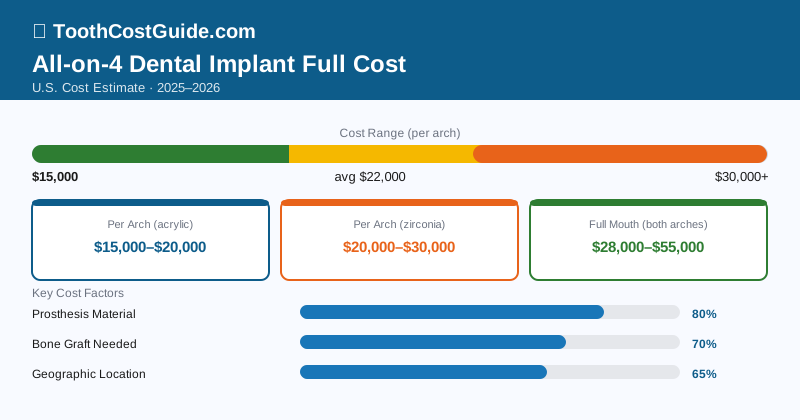
“$15,000 to $30,000 per arch — is that quote actually real?” Yes. It is. And the range isn’t vague padding; it reflects genuinely different clinical situations, geographic markets, material choices, and what’s included in that number. Some All-on-4 cases really do run $15,000. Others legitimately require $28,000 or more. Understanding why separates a reasonable quote from an inflated one.
Here’s the full cost breakdown, what the money actually covers, and how patients realistically finance it.
All-on-4 Cost Overview
| Component | Typical Cost Range |
|---|---|
| All-on-4 (one arch, full treatment) | $15,000–$30,000 |
| Both arches (full mouth) | $28,000–$55,000 |
| Temporary prosthesis (placed day of surgery) | Included or $1,500–$3,000 extra |
| Final permanent prosthesis | Often included; or $3,000–$6,000 if separate |
| CT scan / 3D imaging (pre-surgical) | $200–$600 (often included) |
| Bone grafting (if needed) | $500–$3,000 per site |
| Tooth extractions remaining teeth | $150–$350 per tooth |
The “all-in” price varies dramatically by practice. Some providers quote a comprehensive fee that includes extractions, imaging, temporary prosthesis, implant surgery, and the permanent bridge. Others give a base price for the implants and prosthesis, then add each supporting procedure separately. Always ask for a written itemized treatment plan.
What’s Actually Happening in an All-on-4 Procedure
All-on-4 is a full-arch implant restoration. Four titanium implants are placed into the jawbone — two upright at the front, two at an angle in the back to maximize contact with available bone. A fixed prosthetic bridge (12–14 teeth) is attached to these four anchor points, usually on the same day as surgery. The angled placement of the back implants is the defining characteristic that allows the technique to work in patients with some degree of bone loss who wouldn’t qualify for traditional individual implants.
The American Association of Oral and Maxillofacial Surgeons notes that edentulism (complete tooth loss) affects an estimated 40 million Americans, with the prevalence significantly higher among adults over 65. All-on-4 and similar implant-supported full-arch restorations have become the leading solution for this population, replacing conventional full dentures for patients who want a fixed, non-removable restoration.
A 2022 study in the International Journal of Oral and Maxillofacial Implants reported a cumulative implant survival rate of 94.8% over 10 years for All-on-4 restorations — comparable to individual implant success rates, which generally run 95–98% at the 10-year mark.
What Drives the Price Variation
Prosthesis material is the single largest variable within an All-on-4 case:
- Acrylic with metal reinforcement (Ti-bar): The entry-level option, $15,000–$20,000 per arch. Functional and commonly used for the immediate/temporary bridge. Heavier, less aesthetic, tends to chip over time.
- Zirconia bridge (monolithic): $20,000–$28,000 per arch. Strong, highly aesthetic, doesn’t chip or stain, the preferred long-term restoration at most quality centers.
- Full-arch PFM bridge: Less common but available, typically $17,000–$23,000.
Geographic location: A case priced at $15,000 in rural Ohio may run $26,000 at a specialty center in San Francisco or New York. The surgeon’s fee, lab fees, and facility overhead all scale with cost of living.
Surgeon credentials: Oral surgeons and periodontists with advanced implant training charge more than general dentists offering All-on-4 as a service line. For a procedure this complex, the fee differential is often worth it — your surgeon’s case volume and training directly affects outcomes.
Bone grafting requirements: If you have significant bone loss, grafting may be required before or during implant placement to ensure adequate bone volume. This adds $500–$3,000 per site and several months to the timeline.
Get quotes from at least two providers and ask each to break down: (1) what prosthesis material is included, (2) whether extractions and imaging are in the quote, (3) what the final permanent bridge consists of (acrylic vs. zirconia), and (4) what happens if an implant fails within the warranty period. These four questions make different quotes directly comparable.
Insurance and Financing Reality
Most dental insurance plans cover All-on-4 poorly, if at all. Annual maximum limits of $1,000–$2,000 barely touch a $20,000 case. Some plans cover implant placement at $1,000–$1,500 per implant (so $4,000–$6,000 toward the four implants), but prosthetic fees are often excluded or capped separately.
Medical insurance is sometimes applicable when tooth loss is linked to trauma, disease, or cancer treatment — not elective decay-related loss. If there’s a medical diagnosis in your history (oral cancer, severe autoimmune disease, trauma), it’s worth asking a billing specialist to explore whether medical benefits apply.
Financing options most patients actually use:
- CareCredit: Widely accepted, offers 0% periods of 12–24 months. For a $20,000 case, a 24-month 0% plan means $833/month. Manageable — but the deferred interest penalty if you miss the payoff date is severe.
- LendingClub Patient Solutions: Longer-term loans (up to 84 months) reduce monthly payments but significantly increase total interest paid. A $20,000 loan at 9.9% over 84 months = $336/month but $8,000+ in total interest.
- Dental tourism: Mexico (primarily Los Algodones and Tijuana) and Costa Rica offer All-on-4 for $8,000–$15,000 per arch with reputable providers. Many American patients use US-trained dentists at accredited facilities. The risk is follow-up care — if a complication arises after you return home, managing it remotely adds complexity and cost.
Be cautious of “All-on-4 for $9,999” promotions from domestic providers. Read the fine print carefully — these prices sometimes exclude the permanent prosthesis (you’re quoted for the temporary), or they include acrylic bridges that will need replacement in 3–5 years. Ask specifically: “Is the permanent zirconia bridge included in this price, and when is it placed?” If the answer is evasive, that’s a red flag.
Is All-on-4 Right for Your Situation?
All-on-4 is appropriate for patients who are missing all (or nearly all) teeth in an arch, or whose remaining teeth are unsalvageable. It’s not appropriate for partial tooth loss — individual implants or a bridge are more conservative in that case.
You also need sufficient bone volume and density to support implants. A 3D CT scan (cone beam computed tomography) is required before treatment to assess bone structure. Patients with uncontrolled diabetes, heavy smoking habits, or bisphosphonate medication use may not be good candidates — discuss this openly with your oral surgeon.
Bottom Line
All-on-4 costs $15,000–$30,000 per arch — a significant investment, but for patients facing full edentulism, the functional and quality-of-life improvement over conventional dentures is substantial. The key is understanding what’s included in a quote (prosthesis material, extractions, final vs. temporary bridge), comparing at least two providers, and having a realistic financing plan before committing. The procedure has strong long-term data behind it — 94%+ implant survival at 10 years — making it a legitimate solution when done correctly by an experienced provider.