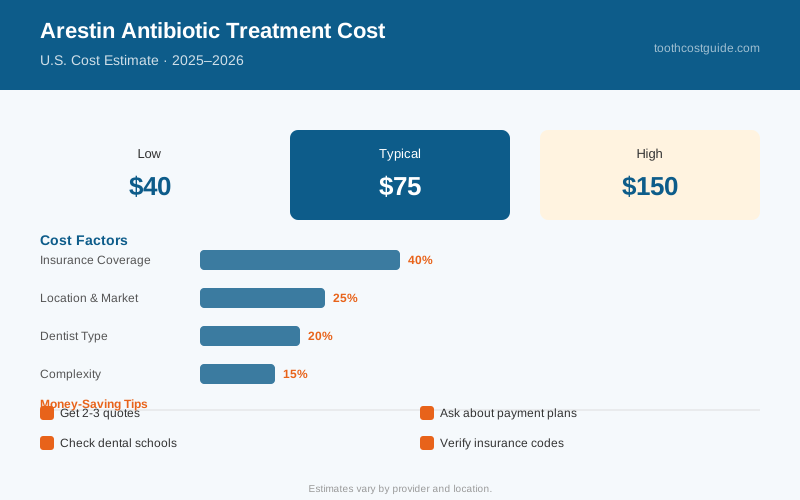
You just agreed to scaling and root planing for $1,200. Then the dentist mentions adding Arestin to each pocket for “better results.” That’ll be another $300–$600. Do you need it?
Here’s the honest breakdown.
| Arestin Application | Typical Cost |
|---|---|
| Arestin per tooth site | $50–$100 |
| 3–4 sites (common scenario) | $150–$400 |
| 6–10 sites (moderate to severe gum disease) | $300–$1,000 |
| SRP without Arestin (full mouth) | $800–$1,600 |
| SRP + Arestin (full mouth, multiple sites) | $1,100–$2,600 |
What Is Arestin?
Arestin (minocycline hydrochloride) is a time-release antibiotic in microsphere form. After scaling and root planing, the dentist or hygienist deposits these tiny beads directly into infected periodontal pockets. The microspheres stay in place and release minocycline (a broad-spectrum antibiotic in the tetracycline family) over about 14 days.
The goal: kill residual bacteria in the pocket that hand scaling and ultrasonic instruments can’t reach. Mechanical cleaning removes the bulk of the biofilm. Arestin targets what’s left.
What the Evidence Actually Shows
This is where it gets nuanced. Arestin is FDA-approved. Clinical studies do show statistically significant pocket depth reduction when Arestin is added to SRP compared to SRP alone — roughly 0.5mm additional reduction in pocket depth.
The American Academy of Periodontology recognizes local antibiotic delivery as an adjunct to SRP in cases of persistent or recurrent pocketing. However, several systematic reviews have found the clinical benefit to be modest — meaningful in some patients, marginal in others. The question your dentist should be asking (but sometimes doesn’t) is: does your specific case warrant it?
Arestin tends to provide the most benefit in:
- Sites with persistent pockets (5–7mm) after initial SRP
- Patients with a history of antibiotic-responsive bacteria
- Localized areas that don’t respond to mechanical treatment alone
It’s less evidence-supported when applied indiscriminately to every pocket in the mouth regardless of severity.
Be cautious if Arestin is recommended on your very first deep cleaning visit before SRP has even been tried. The standard of care is: do SRP first, re-evaluate in 4–6 weeks, then consider adjunct antibiotics if pockets haven’t improved. If a practice wants to apply Arestin at the same time as first-time SRP on every patient, that’s a pattern worth questioning.
Insurance Coverage
Most dental plans do not cover Arestin or similar local antibiotic delivery products (like PerioChip). Insurers classify them as adjunct medications and exclude them from coverage, treating them more like a pharmaceutical add-on than a dental procedure.
A small number of plans cover it under code D4381 (localized delivery of antimicrobial agents) — but it requires documentation of medical necessity and prior authorization in most cases. Don’t assume it’s covered; call your insurer before the appointment.
The ADA and Antibiotic Stewardship
The ADA released an updated clinical practice guideline in 2019 recommending that systemic antibiotics not be routinely prescribed for localized periodontal disease — citing antibiotic resistance concerns. Local delivery agents like Arestin avoid the systemic resistance issue because the antibiotic stays in the pocket rather than circulating through your body.
Still, the AAP notes that local delivery should be site-specific, not scatter-shot. The 2022 periodontal disease surveillance data from the CDC showed 57.6 million Americans with some form of gum disease — but not all cases are severe enough to warrant adjunctive antibiotics.
Questions to Ask Before Agreeing
- Which specific sites are you recommending Arestin for? Get the pocket depth numbers.
- Have these sites already had SRP and not responded? Or is this the first treatment attempt?
- What improvement are you expecting at the re-evaluation visit? Any good periodontist will have a measurable answer.
- What’s the per-site cost and the total? Get a written estimate.
Chlorhexidine chips (PerioChip) are an older, sometimes less expensive local antibiotic alternative — around $20–$40 per site at some practices. Systemic doxycycline (Periostat) is a low-dose oral antibiotic that some periodontists use instead of local delivery; it’s often $30–$80 for a 3-month course. Neither is a perfect substitute, but both are worth discussing as alternatives when cost is a factor.
The Bottom Line
Arestin isn’t a scam — it has real clinical backing for targeted use. But at $50–$100 per site on top of an already expensive deep cleaning, it deserves a direct conversation with your provider about why it’s being recommended for your specific pockets. Ask to see the probing chart. Ask what happens at the re-evaluation if you decline. Make an informed decision.