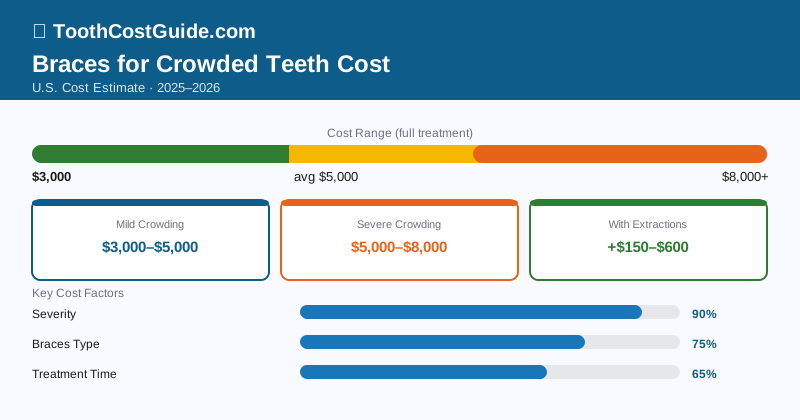
Correcting crowded teeth with braces costs $3,000–$8,000 for comprehensive orthodontic treatment. The price varies based on how severe the crowding is, whether tooth extractions are needed (adding $150–$300 per tooth), and how long treatment takes. Mild crowding is one of the most common and straightforward orthodontic issues. Severe crowding — where multiple teeth overlap significantly — is more complex and may require extractions or arch expansion in addition to braces.
| Crowding Severity & Treatment | Cost Without Insurance |
|---|---|
| Mild crowding — braces or Invisalign | $3,000–$5,500 |
| Moderate crowding — comprehensive braces | $3,500–$7,000 |
| Severe crowding — braces + possible extraction | $4,000–$8,000 |
| Tooth extraction (per tooth, if needed) | $150–$300 each |
| Palate expander (if needed for arch width) | $1,000–$2,500 (often included) |
| Invisalign for mild-moderate crowding | $3,000–$7,000 |
| Dental school treatment | $1,500–$4,000 |
What Affects the Cost of Crowding Treatment
Severity of crowding. Orthodontists measure crowding in millimeters — the difference between the space available and the space required for all teeth. Mild crowding (1–4mm) resolves in 12–18 months. Moderate crowding (4–8mm) requires 18–24 months and possibly extractions or expansion. Severe crowding (8mm+) requires 24–36 months and almost always involves either tooth extraction or significant arch expansion.
Whether extractions are needed. When there isn’t enough arch space to accommodate all teeth, an orthodontist may recommend extracting one or more teeth (typically upper and/or lower first premolars) to create room. Each extraction adds $150–$300 per tooth, performed by the dentist or oral surgeon before braces are placed. Extraction cases tend to have longer treatment times.
Arch expansion. An alternative to extraction for some cases. Palate expanders (upper arch) or removable expansion appliances create additional space by widening the arch. This is highly effective in growing children. In adults, expansion is limited without surgical assistance.
Case complexity beyond crowding. Many crowded cases also involve bite issues (overbite, underbite). Correcting both crowding and bite adds to treatment time and cost.
Crowding Severity and Treatment Approach
Mild crowding (1–4mm): Slight overlapping of front teeth, one or two slightly rotated teeth. Treatable with braces or Invisalign in 12–18 months without extractions. Minimal impact on overall treatment cost. Clear aligners are often ideal for mild crowding in adults. Cost: $3,000–$5,500.
Moderate crowding (4–8mm): More pronounced overlapping, possibly with some teeth pushed slightly behind or in front of the arch. May require arch expansion (especially in growing patients) or selective premolar extraction. Invisalign can address up to moderate crowding effectively. Treatment time: 18–24 months. Cost: $3,500–$7,000.
Severe crowding (8mm+): Multiple significantly displaced teeth, possible impacted teeth, significant arch length deficiency. Almost always requires premolar extraction or surgical expansion in adults. Long treatment time (24–36 months). Complex biomechanical planning. Cost: $4,500–$8,000+.
Impacted canines (special consideration): When upper canines are impacted (not erupted) due to severe crowding, surgical exposure by an oral surgeon is required before the orthodontist can guide them into the arch. Oral surgeon fee: $500–$2,500. This is in addition to comprehensive braces cost and represents one of the more expensive crowding treatment scenarios.
Extractions for crowding are not automatic — many moderate cases are successfully treated without extraction through arch development, especially in growing patients. Get multiple opinions on whether extraction is truly necessary before proceeding. Extraction cases and non-extraction cases have similar total costs, but extractions add visits and recovery time.
Extraction vs. Non-Extraction for Crowding
The extraction debate is one of the most controversial topics in orthodontics. Here’s a practical summary:
Arguments for extraction in severe crowding:
- Creates space predictably without over-expanding the arch
- Reduces relapse risk when arch width is genuinely insufficient
- Required for impacted teeth that cannot fit in the arch without removal of a premolar
Arguments against extraction (non-extraction approach):
- Arch expansion (especially in children) achieves similar results without permanent tooth loss
- Modern orthodontic techniques and materials can treat more cases non-extraction than historical practice suggested
- Some research suggests extraction may affect facial profile (though this is disputed)
What to do: Get a second opinion on extraction recommendation. If one orthodontist recommends extraction and another proposes expansion — ask each to explain their clinical reasoning for your specific case.
Crowding in Children vs. Adults
Children with active jaw growth: Arch development through palate expansion, removable appliances, and properly timed comprehensive treatment can resolve most moderate crowding cases without extraction. Treatment at the right age (ages 11–14) often achieves better results than treating the same case as an adult.
Adults with completed growth: Arch expansion is limited by fused bone structure. Moderate-to-severe crowding in adults more frequently requires either premolar extraction for space creation, or acceptance of slightly reduced final alignment quality.
Invisalign for Crowded Teeth
Invisalign is effective for mild-to-moderate crowding and is the preferred treatment for many adults. Limitations for crowding:
- Mild crowding (up to 4mm): Excellent results with Invisalign Lite or Comprehensive
- Moderate crowding (4–7mm): Effective with Invisalign Comprehensive; attachments improve tooth control
- Severe crowding (7mm+): Braces generally achieve more predictable results; Invisalign alone may not fully correct severe rotations
For crowding cases requiring extraction, Invisalign can be used post-extraction, though the space management requires careful planning. Many orthodontists prefer fixed braces for extraction-based crowding treatment due to better force control for closing extraction spaces.
Insurance Coverage
Standard dental insurance orthodontic benefits apply to crowding treatment:
- Lifetime maximum: $1,000–$3,000
- Coverage: 50% up to the maximum
- Age limits: Under 18–19 for most plans
Extractions: When premolars are extracted as part of orthodontic treatment preparation, the extraction cost may be covered under the dental insurance basic services benefit (typically 70–80% after deductible) separate from the orthodontic benefit. This is a meaningful additional benefit — a $250 premolar extraction at 80% coverage costs only $50 out of pocket.
If four premolar extractions are planned, have your dentist or oral surgeon pre-authorize them with your dental insurance and understand what the basic services benefit covers for extractions. Four premolar extractions at $250 each = $1,000. At 80% coverage, insurance pays $800, leaving $200 out of pocket — a meaningful savings separate from the orthodontic benefit.
Financing Options
In-office orthodontic plans: Standard 0% interest installment plans over the treatment period. For a $6,000 severe crowding case over 30 months = $200/month.
CareCredit: 0% promotional periods of 12–24 months. Useful for bridging the gap between insurance payment timing and orthodontic installment schedule.
FSA/HSA: Braces, extractions (if medically directed), and related orthodontic services are all FSA/HSA eligible. A combination of insurance + FSA can significantly reduce out-of-pocket cost.
How to Save
Get multiple consultations, specifically asking about extraction vs. expansion. Opinions on treatment approach differ. Understanding the options helps you make an informed decision and compare fees accurately.
Time treatment for growing children. Crowding cases in growing children can often be treated less expensively and with better outcomes than waiting until adulthood.
Dental school programs. Complex crowding cases are teaching cases that dental school orthodontic programs actively accept. Treatment by supervised residents costs 30–50% less.
Use extraction coverage. If extraction is needed, verify dental insurance covers it under basic services — separate from and in addition to the orthodontic benefit.
Bottom Line
Braces for crowded teeth cost $3,000–$8,000, with severity being the primary cost driver. Mild cases resolve in 12–18 months for $3,000–$5,500. Severe cases may require extractions and 24–30 months of treatment at $5,000–$8,000. Insurance covers 50% up to the lifetime maximum. Starting treatment at the optimal age for growing patients, getting second opinions on extraction necessity, and using dental school programs for complex cases are the most effective strategies for reducing total cost.
Crowded teeth are the most common orthodontic concern, and most cases are successfully treatable with braces or Invisalign. For children, treating crowding during active jaw growth prevents more costly and complex adult treatment. For adults, get multiple opinions before agreeing to extractions — modern orthodontic techniques treat many moderate crowding cases without permanent tooth removal.