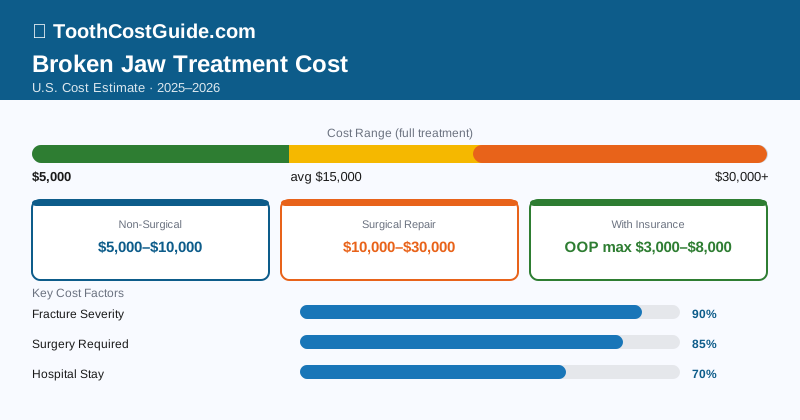
A broken jaw (mandibular or maxillary fracture) is a serious medical emergency that costs $5,000–$30,000 to treat depending on the severity, number of fracture sites, and whether surgery is required. Simple fractures managed with arch bars (jaw wiring) cost $5,000–$10,000 including hospitalization. Complex fractures requiring open reduction and internal fixation (ORIF) surgery with titanium plates cost $15,000–$30,000 or more in total hospital, surgical, and follow-up care.
| Treatment | Estimated Total Cost |
|---|---|
| Emergency room evaluation + CT scan | $2,000–$6,000 |
| Arch bars (jaw wiring), 4–6 weeks | $2,000–$5,000 |
| ORIF surgery (titanium plates) | $8,000–$20,000 |
| Hospitalization (1–3 nights) | $5,000–$15,000 |
| Anesthesia | $1,000–$3,000 |
| Post-op follow-up (4–6 months) | $500–$2,000 |
| Physical therapy (jaw rehab) | $500–$2,000 |
| Total (simple fracture) | $5,000–$12,000 |
| Total (complex fracture with ORIF) | $15,000–$35,000 |
What Affects the Cost
Location and complexity of the fracture. The mandible (lower jaw) can fracture at multiple sites: the condyle (joint area), the angle (back of the jaw near wisdom teeth), the body (horizontal portion), or the parasymphysis/symphysis (front of the jaw). Condylar fractures may be managed without surgery in some cases. Multiple simultaneous fracture sites and open (compound) fractures require more complex surgical repair.
Maxilla vs. mandible. Upper jaw (maxilla) fractures are classified as Le Fort fractures (I, II, or III) and are typically more severe. Le Fort III (complete separation of the facial skeleton from the skull base) involves comprehensive craniofacial surgery costing $30,000–$100,000+.
Treatment approach. Non-surgical management uses arch bars (metal bars wired to the teeth) to hold the jaw in alignment during healing — 4–6 weeks of jaw immobilization. Surgical management (ORIF) uses titanium plates and screws placed through external or intraoral incisions to hold fracture segments in precise alignment. ORIF allows faster return to function but costs more.
Hospital setting. Nearly all significant jaw fractures require emergency room evaluation, hospital admission, and in-patient surgery. Emergency room costs, surgical facility fees, anesthesia fees, and hospital room fees stack together.
Oral and maxillofacial surgeon fees. Jaw fracture repair is performed by oral and maxillofacial surgeons (OMS). Surgeon fees for complex ORIF cases range from $3,000–$8,000 depending on complexity, plus the facility and anesthesia fees.
Associated injuries. Jaw fractures rarely occur in isolation — they’re often part of broader facial trauma (dental injuries, eye socket fractures, nasal fractures) or systemic trauma (concussion, cervical spine injury) from motor vehicle accidents or falls. Treatment of associated injuries adds substantially to total cost.
Treatment Options & Costs
Conservative management ($5,000–$12,000 total): For minimally displaced or favorable fractures, maxillomandibular fixation (MMF) — placing arch bars and wiring the jaw closed — allows healing without surgery. The jaw is wired shut for 4–6 weeks. Patient is limited to a liquid diet and faces significant quality-of-life impact during healing. Good outcomes for uncomplicated fractures, especially condylar fractures in younger patients.
Open reduction and internal fixation (ORIF) ($15,000–$35,000 total): Surgical exposure of the fracture and rigid fixation with titanium miniplates and screws. Allows early return to function (often immediate jaw movement without wiring), more precise alignment, and better cosmetic outcomes for complex fractures. Higher upfront cost but potentially fewer complications and faster return to normal diet and function.
Condylectomy or condylar replacement (complex cases, $20,000–$50,000+): For severely comminuted condylar fractures or fractures in elderly patients with osteoporotic bone, total joint replacement of the temporomandibular joint may be required. This involves custom-fabricated total joint prostheses and specialized OMS expertise.
With vs. Without Insurance
Medical insurance is the primary coverage for jaw fractures — this is a medical emergency:
- ER visit: Subject to ER copay ($150–$500) + deductible + coinsurance
- Hospitalization: Subject to annual deductible ($1,000–$6,000) + coinsurance (typically 20%)
- Surgery: Covered under major medical at the same in-patient rates
- Anesthesia: Covered under major medical
Out-of-pocket maximum: Most ACA-compliant health insurance plans have out-of-pocket maximums of $8,700 per individual (2024) or $17,400 per family. Complex jaw fracture treatment often hits this maximum.
Dental insurance: May contribute to costs associated with tooth repair, implants, or dental restoration done in conjunction with jaw fracture treatment, but the primary jaw fracture care bills to medical.
Auto insurance: If the injury occurred in a vehicle accident, PIP (personal injury protection) or medical payments coverage ($1,000–$10,000 limits) may apply. At-fault driver’s liability may cover all medical costs through the claims process.
Charity care: For uninsured or underinsured patients, hospital charity care programs can reduce or eliminate hospital bills. Apply immediately upon admission — do not wait for the bill to arrive.
What To Do
- Call 911 or go immediately to an emergency room. A broken jaw requires emergency medical evaluation.
- Stabilize the jaw during transport by supporting the chin with a hand or bandage wrapped around the jaw — do not attempt to reduce (re-align) the fracture yourself.
- Tell the ER about all medications — some blood thinners or supplements increase surgical bleeding risk.
- Request a CT scan, not just plain X-rays, for accurate fracture characterization — this guides the surgical plan.
- Ask whether ORIF or conservative management is appropriate for your specific fracture — not all fractures require surgery.
- Apply for hospital financial assistance before leaving the hospital — ask the patient financial services department.
How to Save Money
Understand your health insurance in-network requirements. Jaw fracture surgeons and anesthesiologists at in-network hospitals must bill at in-network rates under the No Surprises Act for emergency care. Confirm your surgeons are billing as in-network.
Apply for Medicaid. If uninsured or if bills exceed your ability to pay, applying for emergency Medicaid (available in all states for emergency medical care) can retroactively cover treatment from the date of application.
Hospital charity care. Non-profit hospitals are required to have charity care programs. Qualification is based on income. A $20,000 surgical bill can be reduced to $0–$2,000 for patients below 200% of the poverty level.
Negotiate the bill. Medical billing is negotiable. Ask for an itemized bill, check for errors (very common), and ask the billing department for a prompt-pay discount or hardship reduction.
A broken jaw is a medical emergency. Call 911 if the injury is severe, there is significant bleeding, the patient has lost consciousness or has difficulty breathing, or other serious injuries are suspected. Do not attempt to eat, drink, or speak excessively until evaluated by a medical professional. Cervical spine injury must be ruled out before treating jaw fractures in trauma patients.
Bottom Line
Broken jaw treatment costs $5,000–$35,000 depending on fracture complexity and treatment approach. Medical insurance covers the core costs; most patients reach their out-of-pocket maximum for complex fractures. Hospital charity care and Medicaid are options for uninsured patients. Recovery typically takes 6–12 weeks for bone healing and up to 6 months for full return to normal jaw function.