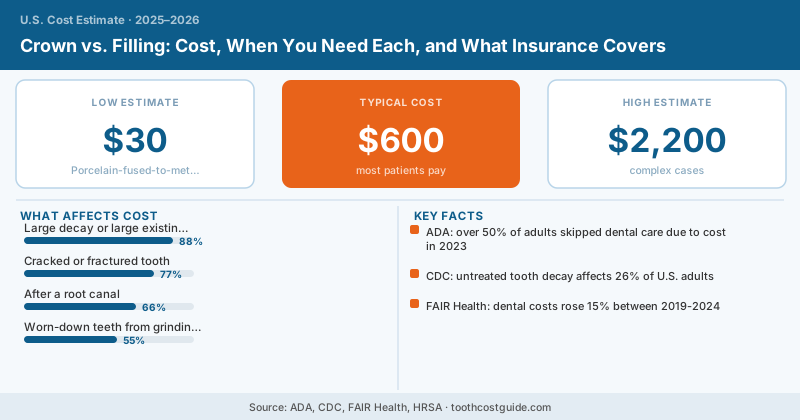
42% of Americans have at least one tooth that needs a filling or crown right now — and many of them don’t know it yet. When you finally sit down in the chair and hear the recommendation, the price gap between the two options hits fast: a filling might run $150–$500; a crown is more likely $1,000–$2,500. That’s a significant difference. Understanding why one is recommended over the other — and when either choice might be questioned — is worth a few minutes of your time.
The Cost Comparison at a Glance
| Restoration Type | Without Insurance | With Insurance (50–80% coverage) |
|---|---|---|
| Amalgam filling (1–2 surfaces) | $150–$300 | $30–$80 |
| Composite filling (1–2 surfaces) | $200–$400 | $50–$120 |
| Composite filling (3+ surfaces) | $350–$500 | $90–$180 |
| Porcelain-fused-to-metal crown | $1,000–$1,600 | $400–$800 |
| All-porcelain / zirconia crown | $1,200–$2,500 | $500–$1,100 |
| Same-day CEREC crown | $1,100–$2,200 | $500–$1,000 |
| Crown with root canal (pre-existing) | $1,700–$4,300 total | $700–$2,200 total |
When Is a Filling the Right Call?
A filling is appropriate when decay is caught early — before it has destroyed a significant portion of tooth structure. Think of it this way: if the remaining healthy tooth can bear the load of biting and chewing on its own, a filling is sufficient.
Specifically, dentists typically choose a filling when:
- Decay affects less than one-third of the tooth’s chewing surface
- No cracks extend into the cusp tips or down toward the root
- The tooth hasn’t had previous large restorations that have weakened it
- The cavity is on a single or double surface (front or back face of the tooth)
Composite (tooth-colored) fillings are now the standard in most practices. Amalgam (silver) is still used occasionally, especially on back molars, and it’s slightly cheaper — but many patients opt for composite for aesthetic reasons.
When Is a Crown Necessary?
A crown becomes necessary when the tooth structure is compromised enough that a filling would eventually crack or fail under bite pressure. Your dentist isn’t trying to upsell you if they recommend a crown in these scenarios:
Large decay or large existing fillings. If decay has eaten away more than one-third to one-half of the tooth, or if there’s already a large filling that’s failing, there isn’t enough healthy structure for a new filling to bond to reliably.
Cracked or fractured tooth. A crack that extends into a cusp — even without decay — can split the tooth under normal chewing pressure. A crown wraps around the entire tooth and holds it together. A filling can’t do that.
After a root canal. Root canal-treated teeth lose moisture and become brittle. The ADA recommends crowning back teeth (molars, premolars) after a root canal in almost all cases to prevent fracture. Front teeth may not always need a crown if they’re structurally sound.
Worn-down teeth from grinding. Severe bruxism can wear teeth down to nubs. Fillings won’t restore the vertical height and shape the way a crown can.
Yes — and dentists shouldn’t be offended by it. If you’re quoted for a crown on a tooth that you believe has minimal decay, a second opinion is reasonable. However, know that most crown recommendations are legitimate. A 2022 FAIR Health analysis found that patients who delayed crown placement after clinical recommendation had a 38% higher rate of tooth loss within 3 years compared to patients who proceeded with treatment.
Does Insurance Cover Both?
Most dental insurance plans cover fillings at 70–80% after the deductible — they’re classified as “basic” restorative work. Crowns are classified as “major” restorative procedures and typically see 50% coverage, often with a waiting period of 6–12 months from enrollment.
The catch: most plans have a $1,000–$2,000 annual maximum. If you need a crown at $1,500 and your plan covers 50%, your share is $750 — but only if you haven’t already hit your annual max on other work.
Insurance companies use “least expensive alternative treatment” (LEAT) clauses. If your plan considers amalgam the standard filling, they may reimburse at amalgam rates even if your dentist places a composite. Always ask your insurer for their allowed amount before approving treatment.
How to Decide What Makes Sense Financially
If you’re uninsured or cost is a significant concern, here’s a practical framework:
- Ask your dentist to show you the X-ray and explain why a crown is needed instead of a filling. A good dentist will spend 2 minutes walking you through the reasoning.
- Ask about monitoring. For teeth on the border between filling and crown territory, some dentists are comfortable watching and waiting 6–12 months while recommending you keep the area clean.
- Don’t delay a crown recommendation on a cracked tooth. Cracks don’t heal — they only get worse. Catching a crack before it splits below the gum line is the difference between a $1,500 crown and a $4,000 extraction + implant.
- Consider dental school clinics. Crowns at accredited dental schools typically cost 40–60% less than private practice rates, with more oversight than most patients expect.
The Bottom Line
Fillings and crowns aren’t interchangeable — they solve different structural problems. A filling works when enough healthy tooth remains; a crown is necessary when the tooth needs to be reinforced or protected from fracture. The $800–$2,000 price gap reflects a genuinely different procedure, not a markup. That said, if you’re uninsured and the cost is a barrier, dental schools and discount plans can make both options significantly more affordable.