Eleven years. That’s how long one patient went without seeing a dentist — not because of money, not because of scheduling. She had decent insurance. She just couldn’t make herself dial the number. Every time she called, she’d hang up before anyone answered.
When she finally went, it took four appointments, oral sedation, and nearly $8,000 to address the decay and gum disease that had accumulated quietly over that decade. The anxiety she thought was protecting her had cost her far more than any dentist ever would have.
Her story isn’t unusual. The ADA estimates 36% of Americans experience significant dental anxiety, and roughly 12% have a genuine dental phobia — an intense, irrational fear that stops care entirely. It’s the most commonly cited reason people delay or avoid dental treatment. And the disease that accumulates in the meantime? Expensive, painful, sometimes disfiguring.
Here’s what actually works.
Why Dental Anxiety Is Different from Other Medical Fears
Dental anxiety has specific features that make it harder to push through than, say, a fear of needles. You’re reclined in a vulnerable position with limited control. Unfamiliar sounds and vibrations happen close to your face. Injections are involved. And past painful experiences — especially childhood ones — create conditioned responses that don’t respond to logic.
The American Psychological Association classifies severe dental phobia as a specific phobia. It responds to the same evidence-based treatments used for other phobias: cognitive behavioral therapy (CBT), gradual exposure, and pharmacological support during procedures.
The Cost of Avoidance: A Real Math Problem
Skipping two cleanings and exams per year ($300–$500 total) feels like a savings. Over 5 years without dental care, you’ve “saved” $1,500–$2,500. But here’s what actually happens in that time, and it’s well documented.
Plaque turns to calculus. Calculus causes gingivitis. Untreated gingivitis becomes periodontitis. The average patient who’s avoided care for 5–10 years typically needs:
- Full-mouth deep cleaning (SRP): $600–$1,200
- Periodontal maintenance for life: $300–$800/year
- 1–3 crowns from unaddressed decay: $1,000–$2,000 each
- Possibly extractions and implants if teeth can’t be saved
The conservative estimate for 10 years of dental avoidance: $5,000–$15,000 in restorative and periodontal care — versus roughly $3,000–$5,000 in routine preventive care over the same period.
Sedation Option 1: Nitrous Oxide (Laughing Gas)
What it is: A colorless, odorless gas inhaled through a small mask over the nose. It produces mild relaxation and mild euphoria within 3–5 minutes. You stay fully conscious and can respond to the dentist. Effects clear within minutes after the mask comes off.
Who it’s for: Mild to moderate anxiety, gag reflex issues, patients who want to drive themselves home.
What it doesn’t do: It’s not a substitute for local anesthesia — you’ll still need numbing injections for most procedures. And it doesn’t work for everyone; some patients feel very little from nitrous.
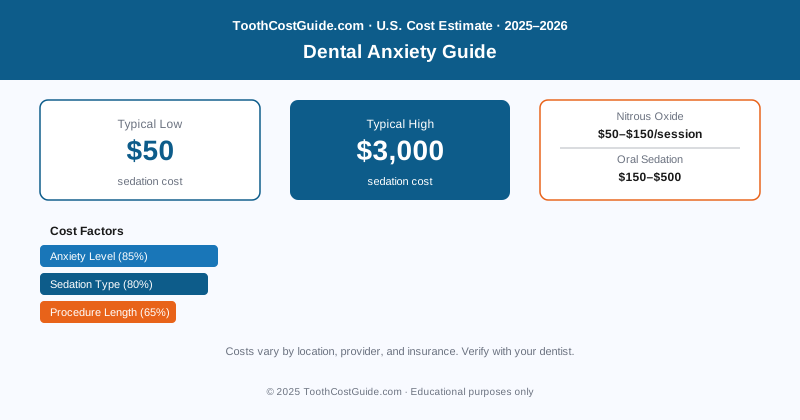
Cost: $50–$150 per session, added to the procedure cost. Most insurance doesn’t cover nitrous for routine adult procedures, though some cover it for children.
Sedation Option 2: Oral Sedation
What it is: A prescription benzodiazepine (usually triazolam, diazepam, or lorazepam) taken by mouth about an hour before the appointment. You become drowsy and deeply relaxed — many patients remember little of the procedure. You’re technically conscious and responsive, but your anxiety response is dramatically blunted.
Who it’s for: Moderate to severe anxiety, longer procedures like multiple extractions or crown preps, patients who want the amnesia effect.
Requirements: You cannot drive. Someone must bring you and take you home. Plan to rest for the rest of the day.
Cost: $150–$500 depending on the practice and number of pills prescribed.
| Sedation Type | Level of Consciousness | Drives Afterward? | Cost | Best For |
|---|---|---|---|---|
| Nitrous oxide | Fully awake, relaxed | Yes | $50–$150/session | Mild–moderate anxiety |
| Oral sedation | Drowsy, responsive | No | $150–$500 | Moderate–severe anxiety |
| IV sedation | Deep sedation, often amnesiac | No | $500–$1,000 | Severe anxiety, complex procedures |
| General anesthesia | Unconscious | No | $1,500–$3,000 | Phobia, special needs, extensive surgery |
Sedation Option 3: IV Sedation
What it is: Sedatives (typically midazolam, fentanyl, and sometimes propofol) administered intravenously by a trained dentist or anesthesiologist. Onset is immediate, and the level of sedation can be precisely adjusted throughout the procedure. Most patients have zero memory of the appointment.
Who it’s for: Severe dental anxiety, complex procedures (multiple implants, full-mouth reconstruction, complicated wisdom tooth extractions), special needs patients, and those for whom oral sedation wasn’t sufficient.
Requirements: IV line, vital sign monitoring, a recovery period, and a driver home. The dentist must hold specific training and state permits for IV sedation.
Cost: $500–$1,000 for a standard procedure, often charged per hour. Typically not covered by dental insurance, but may be covered by medical insurance for oral surgery cases.
Sedation Option 4: General Anesthesia
What it is: Full unconsciousness in a hospital, ambulatory surgery center, or equipped dental office with a full anesthesia team. You’re completely unaware and unresponsive.
Who it’s for: True dental phobia, significant cognitive or developmental disabilities, young children requiring extensive treatment, and patients who can’t cooperate with any level of conscious sedation.
Cost: $1,500–$3,000 for anesthesia alone, plus facility fees and the dental work itself. Medical insurance sometimes covers it when medically necessary.
Not every office is equipped or trained to handle anxious patients. Look for these signs: the dentist lists sedation dentistry on their website; they explicitly mention anxiety-friendly care; they offer a no-pressure consultation before treatment; they have an established stop-signal protocol (raising your hand to pause). The American Dental Society of Anesthesiology maintains a provider directory at adsa.com. You can also just ask directly: “Do you have experience treating patients with dental phobia?”
Non-Pharmacological Approaches That Actually Help
Medication isn’t the only path, and for mild to moderate anxiety, behavioral strategies can be remarkably effective.
Tell-Show-Do: The dentist explains what they’re about to do, shows you the instrument, then does it. Simple as it sounds — and research consistently shows it reduces anxiety in adults, not just kids.
Agreed-upon stop signal: A hand raise to pause the procedure at any moment. Having control over the environment dramatically cuts anxiety for most patients.
Distraction: Noise-canceling headphones with music or a podcast during treatment. Many anxious patients find this enough. Bring your own if the office doesn’t provide them.
Cognitive behavioral therapy: For genuine phobia, CBT with a psychologist before dental treatment is evidence-based and can be genuinely transformative. It takes several sessions and addresses the root cause rather than just masking symptoms.
Sleep dentistry practices: Some dentists have built their entire practice around anxious patients — softer lighting, no overhead dental light until you’re settled, warm blankets, and staff specifically trained in communicating with fearful patients.
Dental anxiety is real, it’s common, and it’s treatable. It is not a character flaw or something you should “just get over.” However, avoiding the dentist doesn’t make the anxiety better — it typically makes it worse over time, while dental disease silently progresses. Even one appointment with nitrous oxide or oral sedation can break the avoidance cycle and help rebuild dental confidence.
A Practical First Step
If you haven’t been to a dentist in years because of anxiety, the lowest-barrier starting point is to call and ask for a consultation appointment — not a cleaning or treatment, just a conversation. Most practices will accommodate this. You sit in the chair, the dentist talks to you about your history and concerns, and you leave without anything having been done to you.
That single appointment — typically $50–$100 for a brief consultation — can break the psychological ice more effectively than any amount of self-convincing. And knowing exactly what your mouth needs, with a clear treatment plan and real cost numbers, is almost always less frightening than the unknown you’ve been dreading.