“I just need a regular cleaning.” It’s one of the most common things patients say when their dentist recommends a deep cleaning — and it’s completely understandable. If your teeth don’t hurt and nothing feels wrong, why would you need an intensive, more expensive procedure?
Here’s what changes everything: a regular cleaning (prophylaxis) and a deep cleaning (scaling and root planing) treat different diseases. They aren’t interchangeable the way a basic car wash and a premium one are. Substituting one for the other doesn’t treat what’s actually there.
Prophylaxis: The Routine Cleaning
“Prophylaxis” means disease prevention. This cleaning is for patients with healthy gums or stable gingivitis — no bone loss, pocket depths of 1–3mm, and no active infection below the gumline.
What happens during a prophylaxis:
- Removal of plaque and calculus (hardened tartar) from visible tooth surfaces and slightly into the gingival sulcus — about 1mm below the gumline
- Polishing to remove light surface stains and smooth tooth surfaces
- Flossing and final irrigation
The key: prophylaxis cleans above the gumline. The hygienist works in the accessible, healthy sulcus — not in diseased pockets extending 4, 5, or 6mm below.
Who needs it: Patients with a healthy periodontium, no history of periodontitis, and pocket depths probing at 1–3mm.
Frequency: Every 6 months for most healthy adults. ADA data supports this interval for maintaining gingival health in low-risk patients; some evidence points to 3–4 months for higher-risk patients even without active disease.
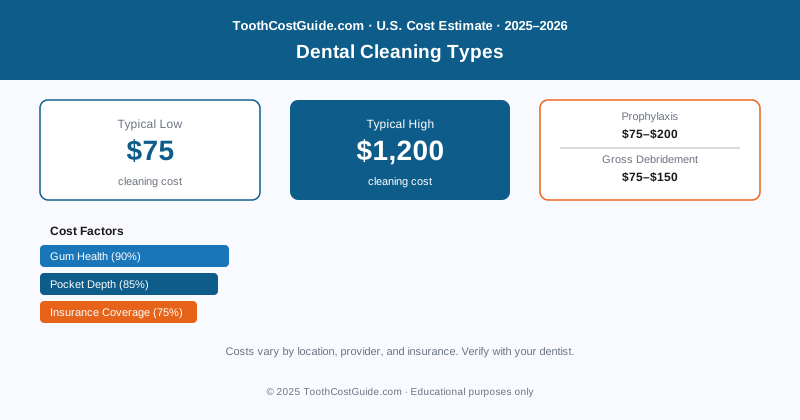
Cost: $75–$200 per visit without insurance. Most dental insurance covers prophylaxis at 100% twice yearly.
Gross Debridement: The Heavy-Buildup Appointment
Gross debridement is a distinct procedure for patients who haven’t seen a dentist in years and have heavy calculus deposits — so heavy that the dentist can’t properly examine or probe the teeth without first clearing the buildup.
It’s not a substitute for prophylaxis or deep cleaning. It’s a prerequisite: remove the bulk calculus, then assess what’s underneath and determine what the patient actually needs.
Cost: $75–$150. Usually done once. After gross debridement, most patients need either a prophylaxis or, if periodontitis is found once the gums can be properly examined, a deep cleaning.
Insurance coverage for gross debridement is inconsistent — some plans cover it, others require a prophylaxis code instead.
Scaling and Root Planing: The Deep Cleaning
Scaling and root planing (SRP) is the treatment for periodontitis — where bacterial infection has caused irreversible bone and attachment loss. It’s not a more thorough regular cleaning. It’s a medical procedure targeting a specific disease process.
What happens during SRP:
- Local anesthesia is administered (the procedure accesses areas below the gumline where tissue is inflamed and sensitive)
- The hygienist uses ultrasonic scalers and hand instruments to remove calculus from root surfaces deep in the periodontal pockets
- Root planing smooths root surfaces to remove bacterial toxins embedded in the cementum and create a cleaner surface for gum reattachment
- The process is methodical and thorough — calculus in a 6mm pocket simply isn’t reachable in a standard prophylaxis
Who needs it: Patients with periodontitis — diagnosed by probing depths of 4mm or more with bleeding on probing and radiographic bone loss. The diagnosis requires a full periodontal probing, not just a visual exam.
How it’s typically done: Usually split into two appointments — one side of the mouth per visit — because the procedure takes time, requires anesthesia, and patients shouldn’t have the entire mouth numb at once.
What to expect afterward: Some soreness and sensitivity for 1–2 weeks as tissues heal. Your gums may look like they’ve “receded” once swelling resolves — the tissue isn’t actually receding, it’s returning to its healthy, non-inflamed height. Follow-up probing at 4–6 weeks assesses how well the treatment worked.
Cost: $600–$1,200 for full-mouth SRP (typically $150–$300 per quadrant). Insurance usually covers SRP at 80% after deductible, though you’ll often use most of your annual maximum on this procedure alone.
If your dentist recommends a deep cleaning and you’ve never had one, don’t substitute a regular cleaning instead — even if cost is a concern. A prophylaxis on a patient with active periodontitis doesn’t treat the disease. The pockets remain. The infection continues. The bone loss continues. A few months later you’re in the same position, having spent money on the wrong procedure. If you need to manage costs, ask about spreading SRP across two calendar years to use two years’ worth of benefits.
Periodontal Maintenance: Not a Regular Cleaning
After completing SRP, patients enter periodontal maintenance — and this is where one of the most costly misunderstandings in dentistry happens.
Periodontal maintenance is not a prophylaxis. It’s a separate procedure code (D4910) for a clinical reason: it includes subgingival instrumentation around sites with a history of periodontal disease, reassessment of pocket depths, and ongoing disease monitoring. The hygienist isn’t maintaining a healthy patient — they’re managing a patient with a chronic disease.
Periodontal maintenance every 3–4 months is recommended indefinitely. The research is consistent: patients with periodontitis who drop back to twice-yearly prophylaxis schedules typically experience disease reactivation within 1–2 years. The bacteria causing periodontitis repopulate treated pockets within 8–12 weeks.
Cost: $100–$200 per visit. Three visits per year = $300–$600 annually. Some insurance plans cover periodontal maintenance at the same benefit level as prophylaxis; others cover it at the basic procedure rate (80%) or limit to two visits per year. Check your specific plan.
The practical cost: periodontal maintenance costs more per year than routine prophylaxis, but it’s managing a disease — and the alternative (reactivated periodontitis requiring additional SRP or surgery) costs far more.
| Cleaning Type | Patient Condition | Pocket Depths | Anesthesia? | Cost | Insurance |
|---|---|---|---|---|---|
| Prophylaxis | Healthy / stable gingivitis | 1–3mm | No | $75–$200 | 100% (2x/year) |
| Gross debridement | Heavy buildup, unexamined | Unknown | No | $75–$150 | Varies |
| Scaling & root planing | Active periodontitis | 4–6mm+ | Yes | $600–$1,200 (full mouth) | 80% after deductible |
| Periodontal maintenance | Post-SRP, stable periodontitis | 1–4mm (treated) | Occasionally | $100–$200 | Varies by plan |
How Pocket Depth Determines Which Cleaning You Need
Your dentist or hygienist probes your gums at every comprehensive exam — and should at every visit if you have a history of gum disease. The probe is a thin instrument inserted between tooth and gum to measure pocket depth in millimeters. Six measurements per tooth (three per side) create a full picture of your periodontal status.
Reading pocket depths:
- 1–3mm: Healthy. Prophylaxis is appropriate.
- 4mm: Watch zone. May be managed with prophylaxis and careful home care if there’s no bone loss or bleeding; warrants close monitoring.
- 5mm+ with bone loss and bleeding: Active periodontitis. SRP is clinically indicated.
- 6mm+ with significant bone loss: Moderate to severe periodontitis. SRP required; surgery may be needed if SRP doesn’t adequately reduce pocket depth.
Pocket depth alone doesn’t tell the whole story — bleeding on probing, bone loss on X-rays, and clinical attachment level all factor in. But pocket depth is the most immediate, actionable number.
The Conversation to Have With Your Dentist
If you’re told you need a deep cleaning for the first time, ask these questions:
“Can you show me my pocket depth measurements?” A legitimate recommendation for SRP is backed by documented probing depths. If your dentist can’t show you pockets of 4mm or more with bleeding, ask why SRP is being recommended.
“Do I have radiographic bone loss?” SRP is appropriate for periodontitis — which means bone loss should be visible on X-rays, not just pocket depth alone.
“What are my options if I can’t afford the full treatment right now?” Many dentists will work with you on sequencing — starting with the most affected quadrant — or on payment plans.
“What maintenance schedule will I need afterward?” Knowing you’ll need 3–4 month visits going forward matters for your budget.
Patients who complete a full course of SRP and maintain their 3–4 month schedule typically stabilize their periodontitis for years. The disease doesn’t disappear, but it’s arrested. Patients who skip maintenance, drift back to twice-yearly cleanings, or substitute prophylaxis for their maintenance visits often end up needing additional SRP or surgery within 2–3 years — restarting the cost cycle. Doing it correctly the first time and maintaining it is genuinely the lower-cost path over a decade.