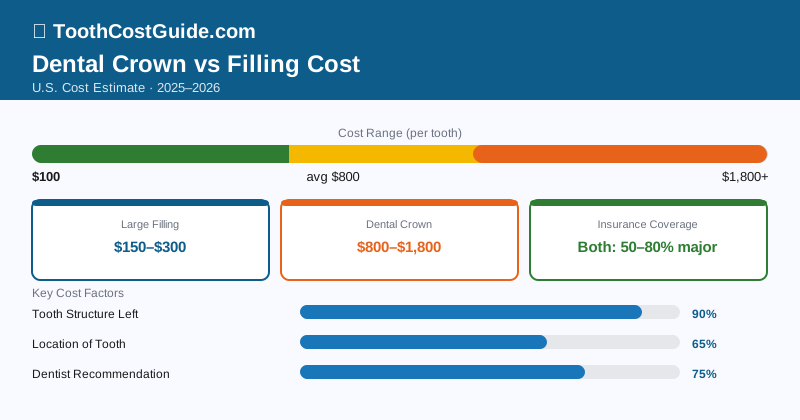
A dental filling costs $150–$450 while a dental crown costs $800–$1,800 — but choosing between them isn’t a matter of cost preference. It’s a clinical decision based on how much tooth structure remains, the location of the damage, and the tooth’s long-term prognosis. When a filling is appropriate, it’s always the better choice: less invasive, less expensive, and faster. When a crown is necessary, a filling will eventually fail — often catastrophically. Understanding when each is indicated helps you have an informed conversation with your dentist and avoid being either undertreated or overtreated.
Cost Comparison at a Glance
| Procedure | Cost (No Insurance) | Cost (With Insurance) |
|---|---|---|
| Composite filling (1 surface) | $150–$250 | $30–$80 |
| Composite filling (2–3 surfaces) | $200–$400 | $50–$120 |
| Amalgam filling (silver, any size) | $150–$300 | $30–$80 |
| Crown – porcelain-fused-to-metal | $800–$1,400 | $400–$700 |
| Crown – zirconia | $1,000–$1,800 | $500–$900 |
| Crown – same-day CEREC | $1,000–$1,800 | $500–$900 |
| Core buildup (pre-crown) | $150–$300 | $75–$150 |
| Root canal (often precedes crown) | $700–$1,800 | $350–$900 |
What Affects Whether You Need a Crown or Filling
How much tooth structure is damaged. This is the central clinical question. When a cavity or fracture removes or damages a small to moderate portion of a tooth, a filling restores the missing structure. When damage, decay, or fracture affects a large portion of the tooth — particularly the cusps (the chewing peaks of a molar) — a filling lacks the structural support to last. A crown caps the entire tooth, distributing bite forces evenly and protecting remaining structure. The general dental guideline: if decay or damage exceeds roughly 50% of the tooth structure (or removes one or more cusps), a crown is more appropriate.
Location of the decay or damage. Decay on smooth surfaces between teeth (interproximal) or simple pit-and-fissure cavities in the chewing surface are well-suited for fillings. Cracks that extend into the cusps, fractures that run vertically, or cavities extending below the gumline may require a crown for adequate coverage and protection. A crack that hasn’t yet reached the nerve can sometimes be arrested with a crown; the same crack that has reached the pulp requires a root canal before crowning.
Whether a root canal has been performed. Teeth that have had root canal treatment are significantly more brittle — the procedure removes pulp tissue that normally nourishes the tooth, and the access preparation removes significant internal structure. Root-canal-treated molars and premolars almost always need a crown afterward to prevent cusp fracture, which could split the tooth below the gumline and require extraction. Root-canal-treated front teeth may be restored with a filling or a post-and-core and crown, depending on remaining structure.
Tooth’s functional position. Molars endure 3–6 times more bite force than front teeth. A large filling in a molar is under enormous cyclic stress during chewing and is more likely to fracture the remaining tooth walls. Dentists apply a lower threshold for recommending crowns on back teeth for this reason. A similarly sized cavity in a lower front incisor might be restored with a filling that would serve indefinitely.
The “filling vs. crown” question is really “how much tooth structure is intact?” A cavity in a structurally sound tooth almost always gets a filling. A broken-down tooth with little remaining structure needs a crown. When the treatment recommendation surprises you — either a crown on a seemingly small cavity or a filling on a very compromised tooth — a second opinion from another dentist is entirely reasonable and often free or low-cost.
When a Filling Is the Right Choice
Small to medium cavities. Single-surface and two-surface composite fillings are appropriate for the vast majority of cavities. A cavity visible on X-ray but limited to one or two surfaces of a tooth is almost always a filling case. The filling material bonds to tooth structure, restores the missing portion, and functions normally for 10–15+ years if well-placed and well-maintained.
Chipped or broken tooth (small fracture). A small chip on a front tooth or a small portion of a cusp that hasn’t fractured to the pulp or gumline can be restored with composite bonding or a filling at far less cost than a crown. If the chip is purely enamel or small enamel-and-dentin, a filling is appropriate.
Replacing an old, failed filling. An existing filling that has worn, cracked, or developed secondary decay around its margins needs to be replaced. If the new cavity remains manageable in size, a new filling is appropriate. Only if significant tooth structure has been lost to decay around the old filling does the case typically escalate to a crown.
When you want to preserve options. Fillings are conservative — they remove only diseased tissue. Crowns require grinding down healthy tooth structure to accommodate the crown. A tooth that receives a filling can still be crowned later if needed. A tooth prepared for a crown cannot be “un-crowned.” This irreversibility is a reason to choose fillings when they’re clinically appropriate.
When a Crown Is the Right Choice
Large decay or fracture involving cusps. When decay or fracture extends through or removes a cusp, the remaining tooth walls are at high risk of fracturing under chewing forces. A large filling in this scenario will often crack the tooth — sometimes splitting it below the gumline and requiring extraction. A crown protects remaining structure and distributes forces safely.
After root canal treatment on molars. As described above, root-canal-treated posterior teeth need crowns. The ADA and most clinical guidelines explicitly recommend crowning root-canal-treated molars and premolars. Root-canal-treated incisors may be crowned or have a post-and-core composite restoration depending on remaining structure.
Cracked tooth syndrome. A tooth with a crack that causes sharp pain when biting on a specific spot may be experiencing stress fracture propagation. A crown binds the tooth together and prevents the crack from deepening. If the crack has reached the pulp, a root canal is required first. If the crack reaches below the gumline, the tooth may be unrestorable.
Severely worn teeth. Patients with significant bruxism (grinding) may wear teeth to near-pulp proximity over years. Rebuilding these teeth requires crowns or onlays — composite fillings don’t have sufficient surface area to restore proper height and occlusion in severely worn teeth.
Existing large filling that’s failing. If a tooth already has a very large filling covering most of its surface and that filling fractures, the amount of remaining tooth structure may no longer support another filling. At that point, a crown becomes the appropriate next step.
With vs. Without Dental Insurance
Insurance coverage differs meaningfully between fillings and crowns, and this difference affects not just cost but sometimes the timing and sequencing of treatment.
Fillings with insurance: Most plans cover composite fillings at 80–90% after deductible under “basic services.” A $250 composite filling might cost you $25–$50 after insurance. Amalgam fillings (rarely placed today) are covered similarly. Fillings rarely create annual maximum issues because the cost per filling is low.
Crowns with insurance: Crowns are “major restorative” services, typically covered at 50% after deductible. A $1,200 crown results in $600 from insurance and $600 from you — after you meet your deductible. With a $1,500 annual maximum and a deductible, insurance may contribute only $750 or less toward a single crown.
The crown recommendation question. Because insurance covers fillings at 80–90% and crowns at only 50%, and because fillings cost far less, a patient with good insurance is paradoxically less financially motivated to question a crown recommendation. But from a purely clinical standpoint, receiving a crown on a tooth that could be saved with a filling is never in the patient’s best interest — crowns require tooth reduction, and every future crown replacement means more tooth structure is lost.
Waiting periods and pre-authorization: Most insurance plans require pre-authorization for crowns, giving you a written estimate before treatment. Always request this. Some plans have 12-month waiting periods on major restorative services including crowns — factor this into timing decisions.
The American Dental Association’s own patient guides encourage seeking a second opinion for major restorative recommendations. If your dentist recommends a crown and it surprises you, spending $75–$150 on a consultation with a second dentist is worthwhile. A dentist recommending a filling where another recommended a crown — or vice versa — is common enough that second opinions are a standard cost-management practice for procedures over $500.
How to Save Money on Either Treatment
Act on fillings early. A small cavity treated now is a $150–$300 filling. The same cavity left another year is a $400 filling or a root canal and crown at $1,500–$3,600. Regular biannual X-rays catch cavities while they’re still inexpensive to treat.
Ask for composite over amalgam. Composite (tooth-colored) fillings are standard today and often cost the same as or slightly more than amalgam. Most insurance plans cover composite at the same benefit level as amalgam. The aesthetic advantage of composite is essentially free in most cases.
Get an itemized quote before the crown. Ask your dentist to detail what’s included in the crown fee: the preparation appointment, any core buildup, and the cementation. Ask explicitly whether a root canal is anticipated. These add-ons can double the total cost and are sometimes surprises if not discussed upfront.
Time crowns across insurance years. If you need two crowns and your annual maximum is $1,500, scheduling one crown in December and one in January of the following year doubles your annual insurance contribution. Ask your dentist’s scheduling team to help you optimize treatment timing.
Dental schools. Dental school clinics perform fillings at $30–$80 and crowns at $400–$700 — 40–60% below private practice. The quality is supervised and often comparable. The trade-off is time: multiple appointments and longer chair time per visit.
Financing Options
Fillings are inexpensive enough that financing is rarely needed. HSA/FSA funds are the most beneficial payment method — pre-tax dollars reduce effective cost by 22–37%.
Crowns at $800–$1,800 are the threshold where financing becomes relevant for many patients.
CareCredit. For a $1,200 crown, 0% financing for 12 months requires $100/month — manageable for most budgets. Deferred interest applies if not paid in full before the promotional period ends.
HSA/FSA. Both fillings and crowns are fully qualified medical expenses. Using these pre-tax funds effectively discounts the procedure cost by your marginal tax rate.
In-office payment plans. Many dental practices offer 0% in-house installment plans for 3–6 months. Ask before signing up for a third-party credit product — the simplest solution is often an in-house plan if available.
Bottom Line
A filling at $150–$450 is always the preferred choice when it’s clinically appropriate. A crown at $800–$1,800 is the necessary choice when it’s not. The clinical decision rests on how much tooth structure remains, the presence of fractures or cracks, and whether a root canal has been performed.
If you’re surprised by a crown recommendation on what you thought was a small cavity, ask your dentist to explain specifically why a filling isn’t sufficient — and seek a second opinion if the explanation isn’t satisfying. Similarly, if a dentist recommends a filling on a badly broken tooth, ask about long-term durability and whether a crown might save the tooth more reliably.
Good dental decisions aren’t about cost — they’re about matching the right treatment to the clinical situation. Understanding the difference helps you advocate effectively for yourself in the dental chair.
Dental cost estimates in this guide reflect U.S. national averages for 2024–2025 and may vary significantly by geographic region, provider type, and individual treatment needs. The decision between a filling and a crown is a clinical judgment requiring examination, X-rays, and professional assessment. This guide provides general educational information only — consult a licensed dentist for diagnosis and treatment recommendations.