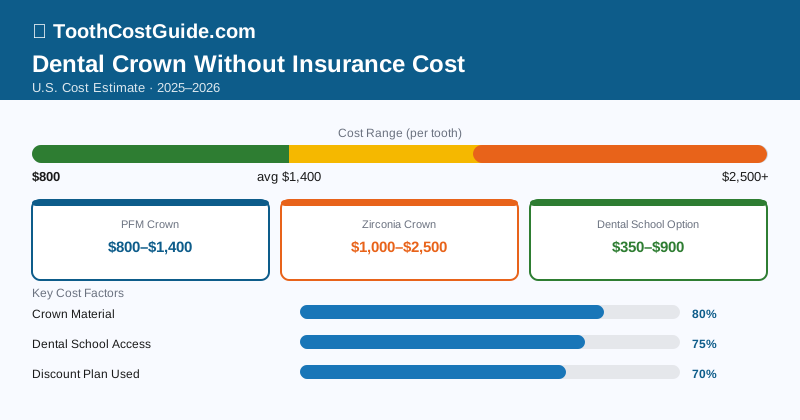
No insurance? You’re not alone. The U.S. Census Bureau estimates that about 68 million Americans have no dental coverage — and a crown is one of the most expensive single procedures they’ll face. At $800–$2,500 per tooth depending on material and location, it’s not an emergency-fund item most people have pre-planned for.
The good news: there are six concrete options for paying significantly less, and most people who do the research end up with workable numbers.
Crown Costs Without Insurance by Material
| Crown Type | Full Out-of-Pocket Cost |
|---|---|
| Porcelain-fused-to-metal (PFM) | $800–$1,400 |
| All-ceramic / e.max | $900–$1,600 |
| Zirconia (monolithic) | $1,000–$1,800 |
| Gold / full metal | $800–$1,600 |
| Same-day CEREC (in-office) | $1,000–$1,800 |
| Stainless steel (temporary/pediatric) | $300–$500 |
These figures are the crown alone. If the tooth needs a core buildup first, add $150–$300. If it needs a root canal, add $700–$1,800. The all-in cost to save a badly damaged molar without insurance can reach $2,500–$3,600.
6 Ways to Pay Less Without Insurance
1. Dental School Clinics
This is the most significant price reduction available. Accredited dental school programs offer crown placements at $350–$900 — roughly 40–60% of private practice rates. The procedure is performed by dental students under direct faculty supervision; the clinical standards are the same, the experience is just more thorough and takes longer.
The tradeoffs: you’ll likely wait several weeks to get an appointment, each appointment runs 2–3 hours, and you’ll need 3–4 visits instead of the typical 2. But if you have a flexible schedule, the savings are hard to beat. Search “[your city] dental school crown” to find programs.
2. Dental Discount Plans (Not Insurance)
Discount plans like Careington, Aetna Dental Access, or DentalPlans.com charge $80–$200/year and give you a negotiated fee schedule at participating dentists. A crown that runs $1,400 without a plan often falls to $700–$1,000 through a discount network.
These aren’t insurance — there’s no reimbursement, no annual maximum to worry about, and no waiting period. You pay the discounted fee directly at the time of service. For uninsured patients who need significant work, they frequently pay for themselves with a single procedure.
The ADA’s Health Policy Institute has noted that approximately 44% of uninsured adults delayed or skipped needed dental care due to cost — discount plans address this gap for many patients.
3. In-House Membership Plans
Many private dental practices now offer their own membership plans — typically $150–$400/year — that include preventive care (two cleanings + x-rays) and a 15–25% discount on all other procedures including crowns.
These work best if you’re already a patient at that practice and need multiple procedures. The per-crown savings may be less than a dental school, but the convenience and continuity of care are better.
4. FSA / HSA Funds
If you have a Health Savings Account (HSA) or Flexible Spending Account (FSA) through your employer, crowns qualify as an eligible dental expense. Using pre-tax dollars gives you an effective 22–37% discount depending on your marginal tax bracket.
An HSA is particularly useful because the balance carries over year to year. If you’re planning a crown 6–12 months out, you can deliberately accumulate HSA funds to cover it. A $1,500 crown funded through an HSA in the 32% tax bracket effectively costs you about $1,020 in real dollars.
5. Dental Financing Programs
CareCredit is the most widely accepted dental financing card. It offers 0% promotional periods of 6–24 months — meaning no interest if you pay the full balance before the promotional period ends. If you don’t, deferred interest kicks in retroactively at 26–29% APR from the original purchase date. That penalty is brutal. Only use it if you’re confident you can pay it off.
Sunbit is an alternative at select practices — offers straightforward installment loans without the deferred interest structure. Rates are higher than 0%, but the risk of a surprise interest bomb is eliminated.
LendingClub Patient Solutions offers longer terms (24–84 months) for larger balances. Monthly payments become manageable but total interest paid over the full term adds up.
You don’t have to pick just one option. Some patients get a crown at a dental school (reducing the base cost to $500–$700), then pay with HSA funds (another 22–37% effective discount), and use a 12-month CareCredit plan for cash flow flexibility. The combination can make even a complex case financially manageable.
6. Negotiate and Get Multiple Quotes
Less than 10% of dental patients ever ask about self-pay discounts, but many offices offer them. When you’re paying entirely out of pocket, ask: “Is there a cash-pay or self-pay rate for this procedure?” Discounts of 10–20% are not uncommon, especially at independent practices.
Getting two or three quotes from different dentists in your area also reveals meaningful price variation — $800 vs. $1,200 for the same crown type on the same tooth position isn’t unusual in most markets.
What Happens If You Don’t Get the Crown?
Delaying a crown that’s been recommended for a damaged or root-canal-treated tooth creates real financial and clinical risk. A tooth without a crown post-root canal is structurally vulnerable — it can split. A cracked tooth often can’t be crowned and needs extraction ($150–$500) plus a replacement option.
The replacement options: an implant ($3,000–$5,000), a bridge ($2,500–$5,000), or a partial denture ($700–$1,800). All of these cost more than the crown would have. The math consistently favors doing the crown.
If a dentist recommends a crown, ask for a written, itemized treatment plan with CDT procedure codes. That code list lets you call other offices for competing quotes on an apples-to-apples basis. Without the codes, comparing quotes is difficult — different offices bundle things differently and the numbers won’t be directly comparable.
Bottom Line
Without insurance, a dental crown costs $800–$2,500. That’s a real number, but it’s not your only option. Dental school clinics ($350–$900), discount plans ($700–$1,000 after discounts), HSA/FSA funds, and 0% financing together give uninsured patients a realistic path to treatment. The worst outcome financially is delaying until the tooth fails — that turns a $1,200 crown into a $4,000 implant.