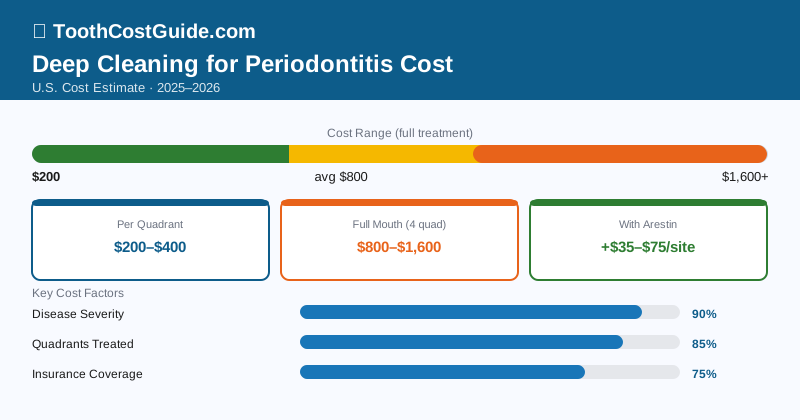
Your dentist just said you need a “deep cleaning” — and quoted you $800 to $1,600. That’s not a scam. Scaling and root planing (SRP) is a legitimate, evidence-backed treatment for periodontitis, and understanding what drives the cost helps you make sense of the bill.
What Periodontitis Is and Why a Regular Cleaning Won’t Fix It
Periodontitis is advanced gum disease. It goes beyond the gumline — bacteria work their way into pockets between your teeth and gums, destroying the bone and tissue that hold your teeth in place. The CDC reported in 2022 that 47.2% of adults aged 30 and older in the U.S. have some form of periodontal disease. By age 65, that number climbs to 70.1%.
A standard prophylaxis cleaning (the kind you get at a healthy checkup) removes plaque and tartar from above and slightly below the gumline. That’s not enough when pockets have deepened to 4mm or more. Deep cleaning goes significantly further — below the gumline — to remove hardened tartar from root surfaces and smooth the root so bacteria can’t reattach easily.
What Scaling and Root Planing Costs
Treatment is typically divided into quadrants — upper right, upper left, lower right, lower left — and done over two appointments (two quadrants per visit).
| Treatment Scope | Average Cost (No Insurance) |
|---|---|
| SRP per quadrant | $200–$400 |
| Full mouth (4 quadrants) | $800–$1,600 |
| Full mouth at dental school | $300–$700 |
| Localized antimicrobial (Arestin) per site | $35–$75 per site |
| Periodontal maintenance visit (follow-up) | $100–$200 |
The variance in per-quadrant pricing depends on the severity of disease, how much calculus buildup is present, whether anesthesia is needed, and your geographic market. Urban areas on the coasts tend to run 20–40% higher than rural Midwest or South.
Insurance Coverage for Deep Cleaning
Good news here: most dental PPO plans treat scaling and root planing as a basic or major service, not cosmetic. Coverage typically runs 50–80% after your deductible, with a maximum benefit applied.
If your annual maximum is $1,500 and you’ve already used $200 at your cleaning, you have $1,300 left — which may cover 2–3 quadrants. Some patients split treatment across two plan years to maximize benefits. Ask your dentist’s billing coordinator about this timing strategy — it’s completely above-board.
Medicaid dental coverage for adults varies dramatically by state. Some states cover periodontal treatment for adults; many do not. Call your state Medicaid office directly, as coverage often changes year to year.
During the procedure:
- Local anesthetic is almost always used — you won’t feel pain
- A piezoelectric scaler or hand instruments clean below the gumline
- Each quadrant appointment takes 45–90 minutes
In the days after:
- Expect soreness and sensitivity for 3–5 days
- Gums may bleed more than usual for a day or two
- Avoid hard, crunchy foods for 48 hours
- Tooth sensitivity to hot and cold is normal and temporary
4–8 weeks later:
- You’ll return for a re-evaluation to measure pocket depths
- If pockets have improved to 4mm or less, you’ll transition to periodontal maintenance (every 3–4 months)
- If deeper pockets persist, your dentist may refer you to a periodontist for surgical options
Is Deep Cleaning Worth It? What Happens If You Skip It?
This is the question patients ask most. The answer is straightforward: skipping SRP when it’s indicated allows periodontitis to progress. Bone loss from gum disease is permanent. Once you lose bone around a tooth, it doesn’t grow back without surgical intervention. Teeth that could have been saved with a $400 deep cleaning become $4,000 implant cases five years later.
Multiple clinical studies show that SRP reduces pocket depths, reduces inflammation, and — critically — may lower systemic inflammation markers. The American Academy of Periodontology notes that untreated periodontal disease is associated with increased risk for cardiovascular disease, diabetes complications, and adverse pregnancy outcomes. The mouth-body connection is real.
Periodontal Maintenance After SRP
Once you’ve had deep cleaning, you don’t graduate back to a twice-yearly standard cleaning. You’re on periodontal maintenance — typically every 3–4 months — for life, or until a periodontist determines disease is fully controlled. These maintenance visits cost $100–$200 each and are partially covered by most dental plans (usually at 80% under basic services).
Three-month intervals aren’t the dentist trying to make more money. Research shows that bacteria recolonize periodontal pockets in roughly 90 days, so quarterly maintenance interrupts that cycle before it restarts.
If you’ve been told you need deep cleaning but the dentist cannot show you your pocket depth measurements (the numbers called out during a periodontal probing), ask for them before proceeding. A treatment recommendation for SRP should be backed by documented pocket depths of 4mm or greater. Patients with shallow, healthy pockets don’t need deep cleaning — and a dentist who can’t produce the data to justify it is a red flag.
Bottom Line
Scaling and root planing costs $800–$1,600 for a full mouth without insurance — less with coverage, and considerably less at dental schools. It’s not optional if you have documented periodontitis. The alternative is progressive bone loss, eventual tooth loss, and far higher costs down the road. If the bill is a barrier, talk to your dentist about splitting treatment across insurance plan years, using a dental school, or setting up a payment plan.