30 minutes. That’s how long you have to save a knocked-out permanent tooth.
Most people don’t know that. They pick up the tooth, touch the root (wrong), rinse it under tap water (also wrong), wrap it in a paper towel (still wrong), and call their dentist two hours later. By then, the periodontal ligament cells are dead. Reimplantation won’t work.
The ADA estimates Americans make approximately 2 million emergency room visits for dental problems each year — and most people are completely unprepared when it happens. Worse, hospital ERs can’t actually fix dental problems. You leave with antibiotics and a $1,500 bill, still needing a dentist.
Here’s what you need to know before an emergency happens, not after.
Emergency Type 1: Knocked-Out Permanent Tooth (Avulsion)
This is the most time-critical dental emergency. The periodontal ligament cells on the root surface stay viable for roughly 30–60 minutes — if the tooth is kept moist in the right way.
Step-by-step protocol:
- Find the tooth. Handle it by the crown only — never touch the root.
- If dirty, rinse gently with water or milk. Don’t scrub. Don’t use soap. Don’t dry it.
- Best option: put it back. Reinsert it in the socket, crown out, and bite down gently on gauze or cloth to hold it. Your own mouth is the best storage medium.
- If you can’t reinsert it: Store in cold whole milk. Milk’s pH and osmolarity preserve cell viability for 30–60 minutes. Saline works too. Water is a last resort — it damages cells over time.
- Get to an emergency dentist right now. Call ahead.
Don’t do this for baby teeth — reimplanting a baby tooth can damage the developing permanent tooth underneath.
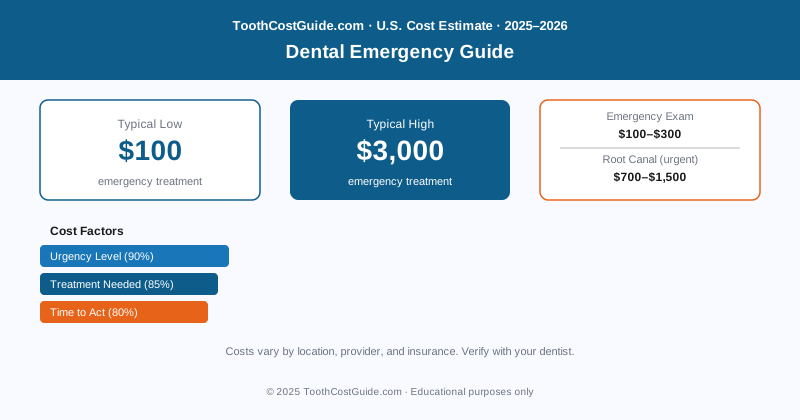
Cost: Emergency exam + reimplantation: $200–$500. If the tooth can’t be saved: extraction if needed ($200–$600), then implant ($3,000–$5,000) or bridge ($3,000–$6,000 for a three-unit bridge) later.
Emergency Type 2: Cracked or Broken Tooth
Whether it’s a chip from biting something hard or a serious crack from trauma, what you do depends on how bad it is.
Immediate steps:
- Rinse with warm water.
- Cold compress to the outside of the cheek if there’s swelling.
- If the broken edge is sharp and cutting your tongue or cheek, dental wax ($5 at any pharmacy) smooths it temporarily.
- For significant breaks with exposed nerve (intense pain from cold or air), temporary filling material like Dentemp ($5–$10) provides relief until you’re seen.
Urgency level: A small chip with no pain can wait until the next business day. A significant crack with nerve exposure or a tooth broken at the gumline needs same-day or next-day attention.
Cost: Chipped tooth (bonding): $100–$400. Cracked tooth needing a crown: $1,000–$2,000. Vertical root fracture (usually requires extraction): $200–$600.
Stock these items before an emergency happens. All available at any pharmacy or Amazon:
- Dentemp or Temparin Max ($5–$8): temporary filling/crown cement
- Dental wax ($3–$5): smooth sharp edges
- Orajel or clove oil ($5–$8): topical pain relief
- Gauze pads ($5): control bleeding, hold tooth in place
- Pain reliever (ibuprofen preferred — it’s anti-inflammatory)
- Dentist’s phone number saved in your phone
This kit covers most dental emergencies until you can reach a professional.
Emergency Type 3: Severe Toothache or Abscess
A dental abscess is a bacterial infection that creates a pocket of pus either inside the tooth (periapical) or in the gum alongside it (periodontal). It can cause intense throbbing pain — or sometimes very little pain if the nerve has died.
Signs: throbbing pain, visible gum or facial swelling, a pimple-like bump on the gum (fistula), fever, swollen lymph nodes, a bad taste that won’t go away.
What to do:
- Call a dentist immediately. This is an active infection.
- Ibuprofen (400–600mg) works better than acetaminophen for dental pain because it reduces inflammation.
- Warm salt-water rinses may encourage drainage through a fistula, but they don’t treat the infection.
- Don’t put aspirin directly on the tooth or gum — this is an old myth that causes chemical burns.
A dental abscess can be life-threatening. Oral infections can spread to the jaw (Ludwig’s angina), neck, and airway — a condition that can cause asphyxiation. If you have a dental abscess AND any of these: difficulty swallowing, difficulty breathing, fever over 101°F, swelling extending below your jawline or into your neck, or inability to open your mouth fully — go to the emergency room immediately. That’s not a dental problem anymore. It’s a medical emergency.
Treatment: Antibiotics reduce infection temporarily but don’t cure it — the source must be treated. Either root canal therapy to save the tooth ($700–$1,500 + crown) or extraction ($200–$600). Replacement may be needed afterward.
Cost: Emergency exam + treatment: $150–$500 for the visit, plus procedure cost.
Emergency Type 4: Lost Filling or Crown
Usually not a true emergency, but needs attention within 1–3 days.
Immediate steps:
- Lost filling: Temporary filling material (Dentemp) fills the hole and prevents sensitivity. Avoid chewing on that side.
- Lost crown: If you still have it, you can temporarily re-cement it with Fixodent, Dentemp cream, or dental cement from the pharmacy. Clean the crown and tooth, apply a thin layer, seat it gently. The prepared tooth underneath is fragile and adjacent teeth will start to shift within days if left exposed.
- Don’t use super glue.
Cost: Replacing a lost filling: $150–$400. Re-cementing a crown (if the crown is undamaged): $50–$250. New crown if the old one is damaged: $1,000–$2,000.
Emergency Type 5: Soft Tissue Injuries (Gum, Lip, Tongue, Cheek)
Mouth cuts bleed heavily because of the rich blood supply — which looks alarming but usually isn’t dangerous.
Steps:
- Rinse with warm salt water.
- Apply firm, direct pressure with gauze or a clean cloth for 10–15 minutes without peeking.
- For a bitten tongue or lip: ice wrapped in cloth to reduce swelling.
- If bleeding doesn’t stop after 15–20 minutes, or if the laceration is deep and gaping, go to urgent care or the ER.
The ER vs. Emergency Dentist Question
About 2 million Americans go to hospital ERs for dental pain every year. The average ER bill for a dental complaint runs $500–$3,000. The treatment they actually receive: antibiotics and pain medication — temporary relief with zero fix.
Hospital ERs aren’t equipped for dental procedures. They can’t perform root canals, pull teeth, or place fillings. They treat symptoms, not causes. You leave still needing a dentist, but now with an ER bill on top.
| Emergency | ER Visit | Emergency Dentist | What ER Can Actually Do |
|---|---|---|---|
| Dental abscess | $500–$3,000 | $150–$500 + treatment | Antibiotics + pain meds only |
| Knocked-out tooth | $500–$2,000 | $200–$500 (reimplant) | Nothing dental — refer out |
| Severe toothache | $400–$2,000 | $150–$400 + treatment | Antibiotics + pain meds only |
| Broken tooth | $400–$1,500 | $100–$400 (stabilize) | Minimal; refer to dentist |
| True emergency (airway) | Absolutely go to ER | Not equipped | Life-saving intervention |
The exception: signs of spreading infection — difficulty breathing or swallowing, severe facial swelling, high fever — mean the ER is the right call. That’s a medical emergency, not just a dental one.
Finding an Emergency Dentist
Call your regular dentist first. Most practices have an after-hours voicemail with emergency instructions. If they’re unavailable, the ADA’s Find-a-Dentist tool (ada.org) lets you filter by emergency services. “Emergency dentist near me” typically surfaces practices offering same-day appointments.
Dental school clinics often have emergency slots at reduced rates ($50–$150 for exam and basic treatment), though wait times can run longer.
The single most important preparation for any dental emergency: have a dentist you already see. They know your history, have your X-rays, and will prioritize existing patients in their schedule. An emergency is the worst possible time to be a new patient.