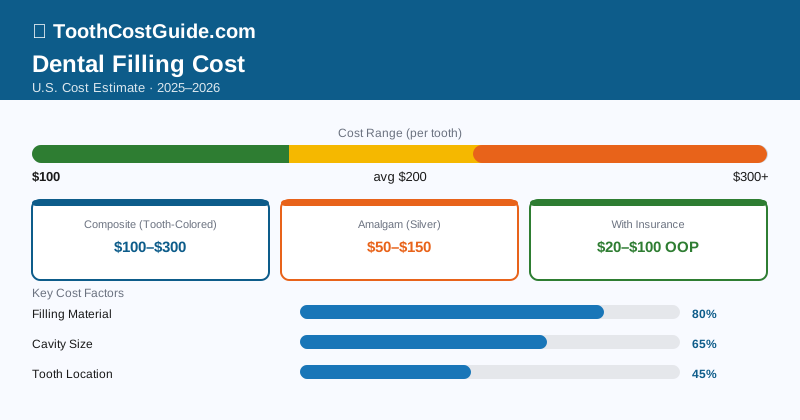
A dental filling costs $100–$300 for composite (tooth-colored) and $50–$150 for amalgam (silver) without insurance. The exact price depends on how many surfaces of the tooth are affected, which tooth needs treatment, and your dentist’s location. With insurance, fillings on most plans are covered at 70–90%, meaning your out-of-pocket cost is typically $20–$80 per filling.
| Filling Type | 1 Surface | 2 Surfaces | 3+ Surfaces |
|---|---|---|---|
| Composite (tooth-colored) | $100–$200 | $150–$250 | $200–$300 |
| Amalgam (silver, metal) | $50–$100 | $75–$150 | $100–$200 |
| Glass ionomer (temporary/pediatric) | $75–$150 | — | — |
| Gold inlay/onlay | $650–$1,200 | $800–$1,500 | — |
What Affects the Cost of a Dental Filling
Number of surfaces involved. Dental billing codes for fillings are based on how many surfaces of the tooth are affected by decay. A tooth has five surfaces (occlusal/top, mesial, distal, buccal/cheek side, lingual/tongue side). A tiny cavity on one surface costs the least; a large cavity spreading across three or more surfaces is billed at a higher rate. Your dentist determines surface count by examining the X-rays and probing the decayed area.
Material choice: composite vs. amalgam. Composite resin fillings are tooth-colored, bond directly to tooth structure, and are the dominant filling material in the U.S. today. They require more technique and time than amalgam, hence the higher cost. Amalgam (silver) fillings are durable, long-lasting, and less expensive — but many dentists have stopped placing them due to esthetic concerns and environmental regulations on mercury disposal. Some practices only place composite.
Tooth location. Back molars are harder to access and keep dry during placement, which increases the chair time and price. Some dentists add $20–$50 for molars versus front teeth.
Geographic market. Dental fees follow local cost-of-living trends. Urban coastal practices charge $150–$300 for a composite filling; similar practices in the Midwest or Southeast might charge $100–$200 for the same procedure.
When a dentist says you need a filling, ask which surfaces are affected and see the X-ray yourself. A 1-surface filling at $120 is very different from a 3-surface filling at $280. Understanding this prevents surprises on the bill.
Cost by Filling Type
Composite resin (tooth-colored): The modern standard filling. Matched to your tooth color, bonds chemically to enamel and dentin, and can be used anywhere in the mouth. Requires more technique and a dry field — harder to place perfectly on difficult back teeth. Average cost: $100–$300 depending on size and location. Lifespan: 7–15 years with good care.
Amalgam (silver/mercury alloy): Highly durable, less technique-sensitive, and less expensive. Still considered safe by the ADA and CDC despite mercury content (which is bound in the alloy and not released at dangerous levels). More common for back teeth. Some patients and some states have moved away from amalgam due to environmental mercury regulations. Average cost: $50–$150. Lifespan: 10–20 years.
Glass ionomer: A tooth-colored material that releases fluoride — often used for baby teeth or as a liner under other restorations. Less durable than composite. Average cost: $75–$150. Lifespan: 3–7 years.
Gold inlay/onlay: The most durable filling material, lasting 20+ years with excellent precision. Requires two appointments (impression and lab fabrication). Extremely expensive compared to direct fillings. Cost: $650–$1,500 depending on size. Rarely covered well by insurance; used mainly when the patient specifically requests it.
With vs. Without Dental Insurance
Fillings are typically classified as “basic restorative” by dental insurance, covered at 70–90% after your deductible.
Typical insurance coverage:
- Composite filling: Covered at 80% by most PPO plans
- Amalgam filling: Covered at 80–90%
- Annual deductible: $50–$100 (if not already met)
- Annual maximum: $1,000–$2,000; multiple fillings in one year can approach this limit
Composite vs. amalgam and insurance: Some insurance plans will only pay the amalgam-equivalent rate for back-tooth composite fillings, leaving you to pay the difference. This “least expensive alternative treatment” (LEAT) provision is common. Example: your insurance covers $80 (amalgam rate) for a back-molar filling, and the composite costs $180 — you pay $100 out of pocket even if covered.
Out-of-pocket with insurance, example:
- Two-surface composite filling: $180
- Insurance pays 80% = $144
- Patient pays: $36 (plus deductible if not yet met)
How to Save Money on Dental Fillings
Get fillings done before they grow. A small one-surface cavity costs half as much to fill as a three-surface cavity. Waiting six months to a year doesn’t make the decay go away — it makes it larger, more expensive to treat, and potentially requiring a crown instead of a filling.
Ask about amalgam. If cost is a primary concern and the cavity is on a back tooth that won’t show, ask whether amalgam is an option. It can cut the filling cost by 40–60% and is equally durable.
Dental school clinics. Fillings at dental school clinics cost $40–$100 for composite and $30–$60 for amalgam — substantially less than private practices. The time investment is longer (appointments last 2–3 hours), but these are carefully supervised student dentists.
Check for preventive application. Dental sealants ($30–$60 per tooth) applied to cavity-prone back molars in children and teens can prevent the need for fillings entirely. If you have a child in the 6–14 age range, ask about sealants.
Ask your dentist to show you the cavity on the X-ray before agreeing to a filling. Small “watch” cavities in early enamel demineralization sometimes remineralize with fluoride treatment and don’t need fillings. Knowing which stage your cavity is in helps you make an informed decision.
Financing Options
Individual fillings are rarely expensive enough to require financing ($100–$300 each). But patients who need multiple fillings simultaneously can face bills of $600–$1,500, which may warrant these options:
In-office payment plans: For multi-filling appointments over $500, ask the front desk about splitting the payment across 2–4 installments. Many offices accommodate this without charging interest.
CareCredit: Available at most dental offices for charges over $200 (though minimum amounts vary by provider). Useful if you’re facing $500–$1,500 in filling work and want to spread payments over 6–12 months at 0% interest.
FSA/HSA funds: Fillings are fully FSA and HSA eligible. Using these pre-tax accounts is the simplest way to reduce the effective cost by 22–37% depending on your tax rate.
Dental discount plans: Discount plans like Careington or Aetna Dental Access charge $80–$120/year and typically reduce filling fees by 20–35%. For someone needing multiple fillings while uninsured, the plan easily pays for itself.
Bottom Line
Composite fillings cost $100–$300 per tooth without insurance; amalgam runs $50–$150. With insurance covering 80%, most patients pay $20–$60 per filling out of pocket. The best way to minimize filling costs is to stay current with cleanings, address cavities promptly before they enlarge, and understand how your insurance’s LEAT provision affects composite coverage on back teeth.
If you’re uninsured and need several fillings, a dental school clinic, discount plan, or in-house membership plan can make a $600 filling bill into a $200 one.
Always get a written treatment plan before agreeing to any dental work. Ask your dentist to show you each cavity on the X-ray, specify the number of surfaces involved, and confirm whether your insurance’s LEAT provision will affect your composite filling coverage on back teeth.