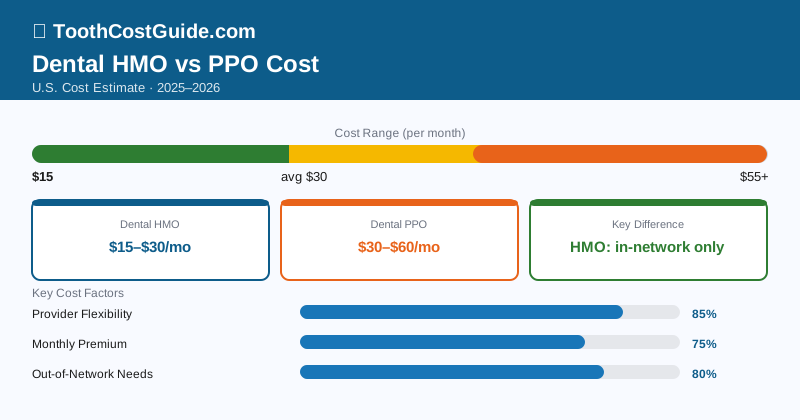
Dental HMOs average $15–$25 per month with no deductibles and fixed copays, while dental PPOs run $30–$60 per month but allow you to see any licensed dentist. The “better” plan entirely depends on where you live, your dentist preferences, and how much dental work you anticipate needing. Choosing the wrong type can cost you hundreds of dollars a year or leave you unable to see the dentist you trust.
| Feature | Dental HMO (DHMO) | Dental PPO |
|---|---|---|
| Average monthly premium | $15–$25 | $30–$60 |
| Annual deductible | None | $50–$200 |
| Annual maximum benefit | None | $1,000–$2,000 |
| Network requirement | Must use network dentists | In-network preferred; out-of-network allowed |
| Specialist referral needed | Usually yes | No |
| Typical cleaning cost | $0–$15 copay | Free (in-network) |
| Typical crown cost | $150–$350 copay | 50% after deductible (~$400–$800) |
| Orthodontics available | Some plans | Most plans (lifetime max $1,000–$2,000) |
How Each Plan Works
Dental HMO (DHMO): You select a primary care dentist from the plan’s network. That dentist coordinates all your care. There is no deductible and no annual maximum, and you pay a flat copay for each service. The copay schedule is published in the plan’s fee schedule — for example, a cleaning might be $0–$10, a filling $20–$60, a crown $150–$350. HMOs work on capitation: the insurer pays your dentist a flat monthly fee per enrolled patient, incentivizing efficiency.
Dental PPO: You can see any licensed dentist — in-network or out-of-network — but you’ll pay less when using in-network providers. After meeting your annual deductible ($50–$200), the plan pays a percentage of covered services: typically 100% for preventive, 70–80% for basic (fillings), and 50% for major (crowns, bridges). Once you hit your annual maximum ($1,000–$2,000), you pay 100% of remaining costs for the year.
HMOs are cheaper monthly but lock you into a specific dentist and require referrals for specialists. PPOs cost more monthly but offer far more flexibility. If your preferred dentist only accepts PPOs, the HMO option isn’t really viable.
Costs & Coverage Details
HMO cost example: Monthly premium of $20, no deductible. Annual checkup + 2 cleanings: $0–$20 in copays. One filling: $30–$60 copay. One crown: $150–$350 copay. Total annual cost (light dental year): ~$200–$430. There is no upper limit on how much the plan pays — a year with a crown, bridge, and implant could save you $2,000+ compared to paying out of pocket.
PPO cost example: Monthly premium of $45 ($540/year). $100 deductible. Two cleanings + exams: $0. One filling (covered at 80%): $30–$50 out of pocket. One crown (covered at 50%, negotiated rate $1,200): $600 out of pocket + $100 deductible = $700. Total annual cost in the crown year: $540 premiums + $700 = $1,240. Without insurance, that crown might have cost $1,500–$1,800.
Out-of-network costs with PPO: A PPO pays a percentage of its “allowable amount” for out-of-network dentists. If the plan’s allowable for a crown is $900 but the dentist charges $1,800, you pay the $900 difference (balance billing) plus 50% of the $900 allowable = $1,350 total. Staying in-network dramatically reduces costs.
HMO network limitations: If you live in a rural area or smaller city, HMO networks may have very few participating dentists. In some regions, the HMO network has poor geographic coverage, effectively forcing you into a PPO anyway.
Pros and Cons
Dental HMO — Pros:
- Lowest monthly premiums ($15–$25/month)
- No deductible and no annual maximum
- Predictable, fixed copays — easy to budget
- Preventive care is almost always free or near-free
- Good for people who need a lot of dental work since there’s no annual cap
Dental HMO — Cons:
- Must stay within the provider network (no out-of-network coverage)
- Must choose a primary dentist; referral required for specialists
- Provider networks are smaller and may exclude your current dentist
- Capitation incentives may result in dentists who rush through appointments
- Plan fee schedules vary widely — some DHMOs have high copays for major work
Dental PPO — Pros:
- Freedom to see any dentist, including specialists without referrals
- Your current dentist is likely in-network (PPOs have broad networks)
- Higher-quality care options, especially for complex procedures
- Useful for people who travel or split time between states
Dental PPO — Cons:
- Higher monthly premiums ($30–$60/month)
- Annual deductible adds to out-of-pocket cost
- Annual maximum ($1,000–$2,000) means big dental years still hurt financially
- Out-of-network costs can be very high due to balance billing
Who Each Plan Is Best For
Dental HMO is best for:
- Budget-conscious individuals who want the lowest possible premium
- People who live in a metro area with robust HMO networks
- Those who don’t have a preferred dentist and are flexible
- People who anticipate significant dental work, since there’s no annual maximum to hit
- Families with children who primarily need preventive and basic care
Dental PPO is best for:
- Anyone with a long-term dentist relationship they want to maintain
- People who see dental specialists (orthodontists, periodontists, oral surgeons)
- Those who need flexibility to use different dentists in different locations
- Self-employed individuals who want comprehensive coverage with maximum choice
- Anyone in a rural area where HMO networks may be thin or nonexistent
How to Save Money
Compare the actual copay schedules. HMOs publish a schedule of every procedure and its copay. Pull this document before enrolling and price out your expected procedures. A “cheap” HMO might have high copays for the specific work you need.
Check in-network dentist lists carefully. For both HMOs and PPOs, verify that your preferred dentist is in-network before enrolling. Call the dentist’s office directly — online directories are often out of date.
Run the numbers on your actual dental history. If you only get cleanings and the occasional filling, the PPO’s higher premiums may not pay off. If you need crowns or bridges regularly, the HMO’s uncapped coverage could save you more.
Maximize preventive care. Both plan types cover preventive care at 100% or near-zero copay. Two cleanings per year are the best return on your premium dollar — they catch problems early before they require expensive major work.
Ask about multi-person discounts. Family HMO plans often offer significant savings compared to individual HMO premiums. If multiple family members need coverage, compare family rates on both plan types.
Be careful with dental HMO copay schedules — not all DHMOs are created equal. Some plans list a low premium but have copays of $400–$600 for crowns. Always download the full fee schedule before enrolling to calculate your real cost.
Dental HMOs win on premium cost and are ideal when you need a lot of work done without hitting an annual cap. PPOs win on flexibility and network breadth. If your current dentist only accepts PPO, the choice is usually made for you. If starting fresh, HMOs save $200–$400 per year in premiums and work well for most people in metro areas.
Bottom Line
For most Americans, the choice between an HMO and PPO dental plan comes down to three things: cost, flexibility, and network availability. HMOs save you $15–$35 per month in premiums and have no annual maximums — a significant advantage for high dental-use years. PPOs cost more but offer broad networks, no referral requirements, and the ability to keep your current dentist. If you’re in a major metro area without a dentist preference, the HMO often delivers more value. If you have an established dentist relationship or need specialist care, the PPO’s flexibility is worth the premium.