If someone quoted you “$1,800 for an implant,” they almost certainly left out the abutment, the crown, the bone graft your jaw might need, and the CBCT scan required to plan the whole thing. That “$1,800” can become $4,500 by the time the tooth is actually functional.
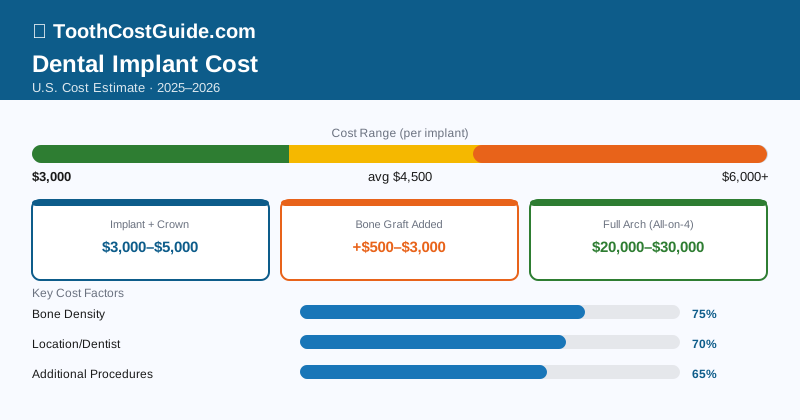
A complete single-tooth dental implant — post, abutment, and crown — runs $3,000–$6,000 at most U.S. practices. That’s the real all-in number. Here’s what drives it up or down, what insurance actually covers (not much), and where to get the same quality care for significantly less.
Estimates based on 2026 national averages adjusted for your state. Actual costs vary by provider, complexity, and plan details. Get a written treatment estimate before proceeding.
What You’re Actually Paying For
| Component | Cost |
|---|---|
| Titanium implant post (the screw) | $1,000–$2,000 |
| Abutment (connects post to crown) | $300–$600 |
| Implant crown (porcelain, custom-milled) | $1,000–$1,800 |
| Single implant all-in | $3,000–$6,000 |
| Bone graft — socket preservation | $300–$800 |
| Bone graft — major augmentation | $1,000–$3,000 |
| Sinus lift (upper jaw only) | $1,500–$3,000 |
| Tooth extraction (if needed first) | $150–$550 |
| CBCT 3D scan (diagnostic imaging) | $150–$400 |
| All-on-4 full arch | $15,000–$30,000 per arch |
Why the Cost Range Is So Wide
Bone volume is the wildcard. When a tooth is missing for more than a few months, the jawbone underneath starts to resorb — it shrinks because there’s no root stimulating it. Before an implant can be placed, that bone may need to be rebuilt. A simple socket preservation graft (done at the time of extraction to prevent future bone loss) costs $300–$800. A more involved bone augmentation after significant loss can run $1,000–$3,000. This single variable is the most common reason implants cost more than the original quote.
Upper back teeth near the sinuses sometimes require a sinus lift — the sinus membrane is gently elevated to create room for bone and the implant. Add $1,500–$3,000 for this procedure alone.
Who places the implant. Most practices split this between two providers: a surgeon (oral surgeon or periodontist) places the post, and a restorative dentist or prosthodontist handles the abutment and crown. Each charges their own fee. Some general dentists do both — often at a lower combined cost, though complex placements benefit from surgical specialist experience.
Implant brand. This matters more than most patients realize. Established systems — Nobel Biocare, Straumann, Zimmer Biomet, BioHorizons — have 20–30 years of published outcome data and industry-standard component compatibility. If an implant from your original provider ever fails, components from major brands can be worked with by almost any implant dentist. Budget implant clinics sometimes use lesser-known systems with shorter track records and limited long-term data. Ask specifically what brand and system will be used.
“What implant brand and system are you using, and is it a major manufacturer?” and “Is the quote you’re giving me for everything — post, abutment, crown, imaging, and any potential grafting?” Get both answers in writing before you commit.
Different Implant Configurations
Single tooth implant ($3,000–$6,000): One post, one abutment, one crown. Replaces a single missing tooth independently — doesn’t involve or risk adjacent teeth. The gold standard for most patients with adequate bone and a single gap.
Implant-supported bridge: Two implant posts anchor a three-unit bridge that replaces two or three missing adjacent teeth. Cost: $5,000–$10,000 depending on number of teeth replaced. Uses fewer implants than replacing each tooth individually.
All-on-4 / All-on-6 ($15,000–$30,000 per arch): Four to six strategically angled implants support an entire arch of fixed teeth. Designed for patients who have lost most or all teeth in one jaw. More affordable than placing 12+ individual implants, and life-changing for edentulous patients. Full-mouth (both arches): $25,000–$60,000.
Mini implants ($500–$1,500 each): Smaller diameter posts used primarily to stabilize lower dentures in patients with limited bone. Not appropriate as direct substitutes for standard implants in most chewing positions, but effective for their specific use case.
What Insurance Covers (Mostly: Not Much)
Traditional dental insurance was designed around a $1,000–$1,500 annual maximum — a figure established in the 1970s that has barely kept pace with inflation. Implants weren’t common then, and most plans still treat them as optional.
What most PPO plans will cover:
- The implant crown only, at 50% under major restorative — saving you $500–$900
- Some plans explicitly exclude implants entirely
- Bone grafts and sinus lifts: rarely covered
A growing minority of premium employer plans do cover implants at 50%, up to annual maximum. If your employer offers multiple plan tiers, it’s worth checking the detailed benefit summary for each.
Standalone “implant insurance” products exist but are usually poor value: 12–24 month waiting periods, $1,000–$2,000 annual maximums, and $50–$80/month premiums. You’d potentially pay $600–$1,900 in premiums before you could even use it.
The practical reality: most people pay for implants largely out of pocket. Understanding this upfront lets you plan financing instead of being surprised by it.
Cutting the Cost Without Cutting Corners
Dental school clinics are the most reliable way to get a quality implant at dramatically lower cost. Graduate programs in oral surgery and prosthodontics place implants under faculty supervision at $1,500–$3,500 all-in — roughly 40–60% of private practice fees. The ADEA (American Dental Education Association) lists accredited dental schools at adea.org. Expect longer timelines, more appointments, and careful documentation at every step.
Multiple quotes from local providers. Implant pricing varies by $1,000–$2,000 within the same city for comparable care. Request itemized quotes — not just a single “implant price” — from 2–3 providers. A higher-priced provider isn’t automatically better.
Dental tourism to Mexico or Costa Rica reduces costs to $800–$2,500 all-in at established clinics. Quality ranges from excellent to poor — research the clinic’s credentials, verify they use a major implant brand, and understand that any complications will be managed either abroad or at your full expense at home. Not right for everyone, but a realistic option for healthy patients willing to do thorough due diligence.
Maximize HSA/FSA contributions. Implants are qualified medical expenses for HSA and FSA purposes. If you know you’re getting an implant, increase your contributions for the year. Tax savings of 22–35% are effectively free money.
Time the procedure. If bone grafting is needed this year and implant placement can happen next year, spreading the cost across two calendar years may help with FSA use-it-or-lose-it deadlines and budgeting.
Financing
At $3,000–$6,000 per tooth, financing is the norm rather than the exception.
CareCredit is the most widely available option — accepted at most dental offices. 0% promotional periods of 18–24 months on qualifying amounts. The deferred interest warning is critical: if any balance remains after the promotional period, retroactive interest at 26–29% APR applies from day one. If you can’t guarantee you’ll pay it off, use an alternative.
Proceed Finance, Alphaeon, or LendingClub Patient Solutions offer true installment loans with fixed monthly payments and no deferred interest traps. Good alternatives if you need 2–5 year repayment terms.
Personal loans from a credit union or bank can beat dental-specific financing rates, especially for borrowers with good credit. Check LightStream (good for fair to excellent credit) and compare to your local credit union.
In-house payment plans — always ask. Many practices will spread the cost over 6–12 months, sometimes without a finance fee for patients they trust. It’s not advertised; you have to ask.
Bottom Line
A dental implant is the most expensive routine dental procedure and the one most likely to be poorly quoted. The all-in cost of $3,000–$6,000 is real — and can be higher with bone grafting or sinus procedures. Insurance rarely helps much. But when done well with a quality implant system, an implant is also the most durable tooth replacement available, with 15–25 year success rates well documented in the literature.
The worst financial decision is delaying a needed implant until bone loss makes the procedure more complex and expensive. The second-worst is accepting a vague quote without itemizing every component.
Before agreeing to implant treatment, request a written itemized fee schedule listing every procedure code — implant placement, abutment, crown, imaging, extractions, and any grafts — along with the specific implant brand and system. Then verify with your insurance whether any component is covered. A CBCT scan for treatment planning is non-negotiable for a quality placement — if a provider wants to skip it, that’s a red flag.
Frequently Asked Questions
A complete single-tooth dental implant—including the post, abutment, and crown—costs $3,000–$6,000 at most U.S. practices. This is the all-in price; quotes under $2,000 typically exclude the crown, abutment, or necessary bone grafts, which can add $1,500–$3,000 to the final bill.
Most traditional dental insurance plans do not cover implants because they're classified as a cosmetic or elective procedure, leaving you responsible for the full $3,000–$6,000 cost. Some dental discount plans and premium PPO policies may cover 10–50% of implant costs, so check your policy's fine print or call your provider to confirm coverage limits.
The complete implant process typically takes 3–6 months from start to finish, including the initial consultation, implant placement surgery, and final crown placement after osseointegration (bone healing). If you need a bone graft beforehand, add another 2–3 months to the timeline.