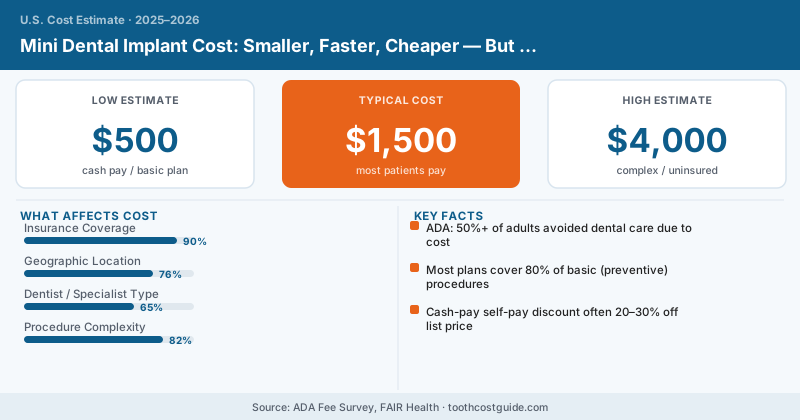
Mini implants are roughly 1.8–3.0mm in diameter — about the size of a toothpick. Standard implants run 3.5–5mm. That size difference changes everything about candidacy, placement, and long-term performance.
The appeal of mini implants is real: lower cost, faster placement, no bone grafting required in most cases, and a single-visit procedure. For the right patient, they work well. For the wrong patient, they fail early — and the failure rate data on mini implants in high-force applications is a legitimate concern worth understanding before you commit.
What Mini Implants Cost
| Scenario | Mini Implant Cost | Standard Implant Comparison |
|---|---|---|
| Single mini implant (implant only) | $500–$1,500 | $1,500–$3,500 per standard implant |
| Single mini implant + crown | $1,200–$2,500 | $3,000–$5,500 complete |
| 4 mini implants for lower denture stabilization | $2,000–$5,000 total (incl. denture modification) | $8,000–$15,000 for 2-standard-implant overdenture |
| 6 mini implants for full arch support | $4,000–$8,000 | $15,000–$30,000 for All-on-4 |
| Mini implant placement (dentist fee only) | $500–$1,000 each | $1,500–$2,500 placement fee |
What Makes Mini Implants Different
A standard dental implant is a two-piece system: a titanium post placed in the jawbone and a separate abutment (connector) that’s attached later, after osseointegration (bone fusion). The procedure involves a surgical incision, implant placement, a healing period of 3–6 months, then a second appointment to attach the abutment and eventually the crown.
A mini implant is a one-piece titanium screw with a ball-shaped head at the top. Everything — the implant and the attachment mechanism — is one unit. Placement typically happens in a single visit: a small pilot hole is drilled (sometimes without incision), the mini implant is threaded into the bone, and the prosthesis (denture or crown) is attached the same day. Start to finish in one appointment.
That design simplicity is what makes them faster and less expensive. It’s also what limits their versatility.
Who Is a Good Candidate for Mini Implants
Lower denture stabilization. This is the strongest application for mini implants and the one with the most supporting clinical evidence. Lower dentures are notoriously difficult to stabilize — the lower jaw ridge is often narrow and resorbs faster than the upper. Four mini implants placed in the lower front jaw, with O-ring or locator attachments, provide dramatically better denture retention than no implants at all. The ADA and AAOMS both recognize mini implant-supported overdentures as a legitimate treatment option for edentulous (fully toothless) patients, particularly those with insufficient bone for standard implants.
Narrow ridges with low bone volume. When bone width is insufficient for a standard 3.75–5mm implant and the patient doesn’t want bone grafting, minis can sometimes be placed where standards can’t go without extensive preliminary surgery.
Front teeth (anterior single-tooth replacement). Upper and lower incisors and canines operate under lighter biting forces than posterior teeth. A mini implant in this location bears lower loads and has reasonable outcome data for single-tooth replacement.
Patients who can’t afford standard implants. This is a real consideration. A mini implant at $1,200–$2,500 complete (implant + crown) versus $3,000–$5,500 for a standard implant case puts restoration within reach for patients who otherwise couldn’t afford it. An imperfect solution that gets placed is better than a perfect solution that never does.
The ADA notes in implant literature that implant diameter affects stress distribution in the bone. Narrower implants concentrate occlusal (bite) forces on a smaller bone-implant interface, which means each mini implant bears proportionally more stress per unit of bone contact than a standard implant would. This is manageable in low-force applications and with multiple implants distributing the load. It’s problematic for single posterior-tooth replacement under full chewing forces. Your provider should be explicit about where they’d place minis versus where they wouldn’t in your specific case.
Who Is NOT a Good Candidate
Molar replacement. Don’t use a mini implant as a single-tooth replacement in the molar or premolar region. Chewing forces on posterior teeth can exceed 200 pounds per square inch. The narrow diameter and one-piece design of mini implants are not engineered to reliably handle that load indefinitely. Failure rates in high-force posterior locations are meaningfully higher than for standard implants. AAOMS implant guidelines recommend appropriate implant diameter selection based on force distribution — which is a way of saying minis in molars are a workaround, not a solution.
Patients with bruxism (grinding). Heavy bruxism generates extreme off-axis forces that stress the implant-bone interface. Mini implants — with less bone surface area — are more vulnerable to this than standard implants. If you grind, discuss this with your provider before mini implants are recommended.
Patients who are good candidates for standard implants. If your bone volume, density, and anatomy support standard implants without grafting, standard implants are the better long-term choice. The additional cost buys 30+ years of peer-reviewed outcome data, a two-piece design that allows more prosthetic flexibility, and a better track record for long-term success in most applications.
The Long-Term Evidence Gap
Standard dental implants have been studied for more than 40 years. Long-term studies with 10–20 year follow-up data show survival rates above 95% for well-placed standard implants in appropriate candidates.
Mini implants have a much shorter evidence timeline. The peer-reviewed literature on mini implants is growing but still relatively limited compared to standards, particularly for long-term follow-up (10+ years). The evidence base for denture stabilization applications is stronger than for single-tooth replacement. Before agreeing to mini implants for any application, ask your provider to walk you through the specific outcome data they’re relying on for your scenario.
Finding the Right Provider
Mini implant placement has a lower barrier to entry than standard implant surgery — the simplified technique means more general dentists offer it, sometimes with limited implant training. That’s not universally a problem, but it means you should ask specifically:
- How many mini implants has the provider placed?
- What’s their personal complication and failure rate?
- Are they recommending minis because it’s genuinely the best option for your anatomy, or because it’s the system they’ve invested in?
Oral surgeons and periodontists who place both standard and mini implants are well-positioned to give you an honest comparison. A provider who only places one type may have a built-in bias toward that type.
Dental cost estimates in this guide reflect U.S. national averages for 2025–2026. Mini implant costs vary significantly by case complexity, number of implants, prosthetic type, and provider. Dental insurance rarely covers implants of any type — most plans classify them as cosmetic or explicitly exclude them. If your plan does cover implants partially, confirm whether it covers mini implants specifically, since some plan language refers only to “endosseous implants” meeting specific diameter or design criteria. Always get a comprehensive written treatment plan before proceeding.
Frequently Asked Questions
Mini implants can replace individual missing teeth in specific low-force locations — generally upper and lower front teeth (incisors and canines) where biting forces are moderate. They're not recommended for single-tooth replacement in the premolar or molar regions where chewing forces are highest. The smaller diameter means less surface area bonded to bone, which translates to lower load capacity. For a single missing front tooth, a mini implant may work well and costs significantly less than a standard implant. For a missing molar, a standard implant (3.5–5mm diameter) is the appropriate choice. Ask your provider specifically which teeth in your mouth are appropriate candidates.
Usually no — and this is one of their main advantages. Standard implants require a minimum bone width of about 6mm; below that, a bone graft is often needed before implant placement, adding $500–$3,000 to the case and 4–6 months of healing time. Mini implants at 1.8–3mm diameter can be placed in narrower ridges that wouldn't accommodate standard implants without grafting. For patients who've had significant bone loss and want to avoid grafting, minis are sometimes the only implant option available. That said, if bone volume is adequate for standard implants, they're typically the preferred choice for better long-term outcomes.
Mini implants are FDA-cleared devices — which is the correct regulatory pathway for medical devices, as distinct from 'FDA-approved' (the term used for drugs). Specific mini implant systems have 510(k) clearance for use as endosseous implants. The FDA clearance pathway verifies that the device is substantially equivalent to a previously cleared device, not that it's been evaluated in the same clinical trial framework as a drug. Long-term clinical data on mini implants is thinner than for standard implants, which have 30+ years of peer-reviewed outcome data. FDA clearance doesn't substitute for asking your provider about the long-term evidence base for the specific system they use.