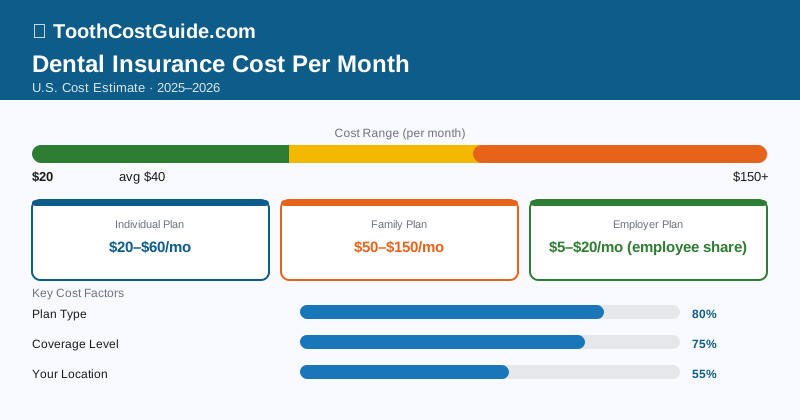
Individual dental insurance costs $20–$60 per month ($240–$720 per year) on the individual market. Family dental insurance runs $50–$150 per month ($600–$1,800 per year). Employer-sponsored plans are typically much cheaper for the employee — often $5–$25/month for individual coverage after the employer’s contribution. What you pay monthly determines whether dental insurance delivers positive or negative financial value.
| Plan Type | Monthly Premium | Annual Premium | Annual Max | Best For |
|---|---|---|---|---|
| Individual preventive-only | $12–$22 | $144–$264 | $500–$1,000 | Cleanings, X-rays only |
| Individual basic PPO | $25–$40 | $300–$480 | $1,000–$1,500 | Cleanings + fillings |
| Individual comprehensive PPO | $40–$60 | $480–$720 | $1,500–$2,000 | Full coverage including major |
| Family plan (2 adults + 2 children) | $60–$150 | $720–$1,800 | $2,000–$4,000 family | All members, including ortho |
| Employer-sponsored individual | $5–$25 employee share | $60–$300 employee share | $1,500–$3,000 | Best value; use if offered |
| DHMO (HMO-style) | $8–$20 | $96–$240 | No annual max | Limited network, low cost |
What You Get at Each Premium Level
Low-tier plans ($12–$22/month): These “preventive only” plans cover two cleanings, annual X-rays, and periodic exams — nothing else. Annual maximum is often $500–$1,000 but only applies to preventive care. These plans pay for themselves if you use two cleanings per year ($150–$400 value) at roughly $144–$264/year in premiums. You break even at best. The moment you need a filling or crown, you’re entirely on your own.
Mid-tier basic plans ($25–$40/month): These are traditional 100/80/50 plans covering preventive at 100%, basic restorative (fillings) at 80%, and major work at 50%. Annual maximum of $1,000–$1,500. At $300–$480/year in premiums, these plans deliver real value if you need even one filling per year ($100–$300) in addition to two cleanings. Break-even point is low; most dental users come out ahead.
Comprehensive plans ($40–$60/month): Higher annual maximums ($1,500–$2,000), sometimes with orthodontic riders, and better major restorative coverage. At $480–$720/year in premiums, these make financial sense for patients who regularly need major work or have a family with children approaching braces age.
Family plans ($50–$150/month): Typically cover all household members, often with per-person annual maximums of $1,000–$2,000 or a family aggregate of $3,000–$5,000. Children’s preventive care (cleanings, sealants, fluoride) is heavily used on family plans. If both parents and two children all use preventive benefits, the value of cleanings and X-rays alone justifies many family plan premiums.
A family of four using two cleanings + X-rays each per year receives approximately $1,200–$2,000 in preventive benefits at no cost (assuming 100% preventive coverage). A family plan premium of $80–$120/month ($960–$1,440/year) is break-even on preventive care alone — any additional covered treatment is pure gain.
Employer-Sponsored Plans: A Different Calculation
If your employer offers dental benefits, the math changes fundamentally because the employer typically pays 50–100% of the premium.
Typical employer contribution: Many employers pay the full employee premium ($15–$25/month individual plan) and offer family coverage for $40–$80/month employee share. Compared to the individual market price of $40–$60/month for a similar plan, you’re effectively getting a $15–$35/month benefit just from the employer subsidy.
Employer plan annual maximums: Employer-sponsored group plans typically have $1,500–$3,000 annual maximums — noticeably higher than individual market plans capped at $1,000–$1,500. Group negotiating power makes a real difference.
Open enrollment timing: Most employer dental plans require enrollment during open enrollment (typically October–November for January 1 coverage). You usually cannot add dental coverage mid-year unless you have a qualifying life event.
DHMO Plans: Low Cost, Restricted Choice
Dental HMO plans (DHMOs) operate differently from PPO plans:
- You select a primary care dentist from a limited network
- You must receive all care from that dentist or via referral
- Most services have $0 or very low fixed copays listed in a fee schedule
- No annual deductible or annual maximum in the traditional sense
- Premiums are very low: $8–$20/month individual
DHMOs work well for: Patients who are cost-conscious, live near a DHMO provider, and primarily need routine care. The very low premium and $0 preventive copays are genuinely good value.
DHMOs work poorly for: Patients who want to keep their current dentist (who may not participate), patients who move frequently, and patients with complex needs who want specialist referral flexibility.
The Hidden Costs Beyond Monthly Premiums
When calculating the true cost of dental insurance, premiums are only part of the picture:
Annual deductible: $50–$100 per person, typically applied to basic and major services. A family of four could each pay $50–$100 before their basic or major benefits kick in.
Copays on major procedures: At 50% coverage, a $1,500 crown leaves you paying $750 after insurance — on top of your premiums.
Annual maximum gap: If your plan has a $1,000 maximum and you need $3,000 in major work, you pay $2,000 out of pocket regardless of your coverage percentage.
Out-of-network costs: PPO plans cover out-of-network providers but at lower rates, and some allow balance billing — meaning you pay the difference between the dentist’s actual fee and the plan’s allowed amount.
When comparing dental plans during open enrollment, use this simple test: List the dental services you realistically expect to use in the next 12 months. Estimate the cost without insurance (check toothcostguide.com). Add the annual premium. Compare that total against what you’d pay out of pocket with each plan. The plan with the lowest total cost for your realistic usage is the winner.
Is the Monthly Premium Worth Paying?
Clearly worth it if:
- Your employer covers most or all of the premium
- You have a family with children (heavy preventive use + potential orthodontics)
- You know you need major work and the plan has no waiting period (or waiting period has elapsed)
- You want peace of mind and use two cleanings per year consistently
Less clear if:
- You’re young, healthy, cavity-free, and the plan is 100% out-of-pocket
- The individual market plan you’re considering has a 12-month waiting period on major work
- A dental discount plan at $80–$120/year provides similar savings with fewer restrictions
Clearly not worth it if:
- You’re buying individual market insurance at $50/month to cover a root canal you need this month (waiting periods prevent this)
- You won’t use the two annual cleanings consistently
- You rarely visit a dentist and have no planned or expected dental needs
Bottom Line
Individual dental insurance costs $20–$60/month ($240–$720/year) on the open market. For patients with employer subsidies, the out-of-pocket cost drops to $5–$25/month — making it nearly always worthwhile. For individual market buyers, the value depends entirely on how much dental care you actually use.
A comprehensive PPO at $40/month ($480/year) makes financial sense if you get two cleanings plus have one filling or one major procedure per year. Use the cost tables on this site to calculate your specific expected value before buying.
Always get a written treatment plan before agreeing to any dental work. When evaluating dental insurance plans, read the Summary of Benefits carefully — specifically the annual maximum, the deductible, the coverage percentages for each category, and the waiting period schedule for major and orthodontic services.