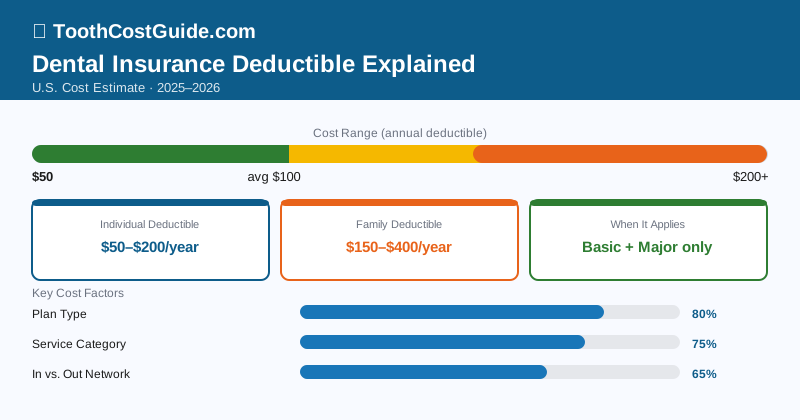
Dental insurance deductibles are typically $50–$200 per person per year — far lower than health insurance deductibles — but they still apply before your plan pays its share for most non-preventive care. Understanding how deductibles work in dental insurance prevents bill surprises and helps you time procedures strategically to get the most from your coverage each year.
| Plan Type | Typical Individual Deductible | Typical Family Deductible Cap | Deductible Applies To |
|---|---|---|---|
| Employer PPO | $50–$100 | $150–$300 | Basic and major services |
| Individual market PPO | $100–$200 | $300–$600 | Basic and major services |
| Dental HMO | $0 | $0 | N/A (copay model) |
| Indemnity dental | $50–$150 | $150–$450 | All services (sometimes) |
| ACA marketplace dental | $50–$200 | $150–$600 | Basic and major services |
| No-deductible PPO plans | $0 | $0 | N/A (higher premium) |
How Dental Insurance Deductibles Work
A dental insurance deductible is the amount you must pay out of pocket for covered dental services before your insurance plan begins paying its share. Once you’ve met your deductible for the year, your insurance kicks in and pays a percentage of covered services up to your annual maximum.
Key mechanics:
- Per-person, per-year: Dental deductibles reset every January 1 (or on your policy anniversary date). Each person on a family plan has their own individual deductible.
- Family deductible cap: Most family plans have a maximum family deductible — for example, $150 individual / $450 family cap. Once any combination of family members has collectively paid $450 in deductibles, no additional deductibles apply for that policy year.
- Doesn’t apply to preventive care: Almost all dental plans waive the deductible for preventive services — cleanings, exams, and X-rays. You pay $0 for preventive care regardless of whether your deductible is met.
- Applies to basic and major services: The deductible kicks in for fillings, crowns, bridges, dentures, root canals, and other restorative work.
Step-by-step example: You have a PPO plan with a $100 deductible and 80% coverage for basic services. You need a filling that costs $200 (at the in-network negotiated rate).
- You haven’t met your deductible yet: You pay $100 (deductible) + $20 (20% of remaining $100) = $120 total.
- If you had already met your deductible: You pay $40 (20% of $200).
- The $100 deductible doesn’t “disappear” — it counts toward your annual out-of-pocket costs, but it’s paid before insurance coinsurance kicks in.
Since preventive care (cleanings, exams, X-rays) is almost always deductible-free, get those done first to spot issues early. When you do need fillings or major work, try to cluster multiple procedures into the same policy year after the deductible is met — you’ll pay the deductible only once for all services that year.
Costs & Coverage Details
Typical deductible amounts by plan tier:
- Employer group PPO: $50/individual, $150/family cap — the most common structure in employer plans
- Individual market PPO: $100–$150/individual, $300–$450/family cap — higher deductibles offset lower premiums
- High-deductible dental plans: $200/individual, $600/family cap — rare but exist on some ACA marketplace plans
- Dental HMO: $0 deductible — the HMO copay model has no deductible concept; you pay a fixed copay per procedure regardless
Deductible waivers and exceptions:
- Preventive services: Waived in virtually all plans
- Some plans waive deductibles for diagnostic services (X-rays, exams) separately from preventive cleanings
- Medicare Advantage dental plans: Some have no deductible for dental benefits
- Some no-deductible PPO plans exist in the individual market, typically at $5–$15/month higher premium
How deductibles interact with annual maximums: The deductible you pay does NOT count toward your annual maximum benefit. The annual maximum is the total amount the insurance company pays — deductibles are amounts you pay on top. Example: $100 deductible + $1,000 annual maximum means you could pay $100 (deductible) + 20% coinsurance on services, while insurance pays up to $1,000 total.
Deductible timing: If your deductible period resets January 1 and you have dental work in December, you’ll pay a new deductible again in January if you continue treatment. This is one reason scheduling multiple procedures in a single policy year (after meeting the deductible once) can save significant money.
Pros and Cons of Low vs. High Deductibles
Low deductible ($50–$100) plans:
- Less out-of-pocket barrier before insurance pays
- Better for people who need multiple procedures per year
- Typically have slightly higher monthly premiums
- Insurance kicks in faster, reducing financial uncertainty
High deductible ($150–$200) plans:
- Lower monthly premiums
- Fine if you mainly use preventive care (no deductible for cleanings anyway)
- Painful if you unexpectedly need a crown or filling — you pay full deductible before any coverage
- May suit healthy individuals who want coverage only for catastrophic dental scenarios
No-deductible HMO plans:
- Predictable costs — just the fixed copay per procedure
- No year-end timing strategy needed
- Network and referral restrictions apply
Who Deductibles Affect Most
People with multiple dental needs feel deductibles most acutely. If you need three fillings, a crown, and an extraction, you’ll pay the deductible once but then receive insurance coverage for all subsequent work — making the deductible a manageable one-time hurdle.
People who need just one procedure per year may feel the deductible reduces their effective coverage significantly. If you need a single $200 filling and have a $100 deductible, your insurance only saves you $80 (80% of the remaining $100) — a modest benefit.
Family members with the same dentist can coordinate family dental days to ensure multiple family members’ deductibles are applied in the same year, especially useful near year-end when deductibles may already be partially or fully met.
How to Save Money on Deductibles
Schedule basic procedures in the same year you meet the deductible. If you’ve had a filling in March and met your $100 deductible, schedule any other anticipated work before December 31. The deductible is paid once per year — stack all your non-preventive care into the year you’ve already paid it.
Use preventive care to avoid deductible-triggering procedures. The best way to minimize deductible costs is to need fewer fillings and crowns through excellent preventive care. Regular cleanings, X-rays, and sealants (deductible-free) catch problems early before they require expensive work that triggers the deductible.
Check if your employer plan has a deductible waiver for the first year. Some employer plans waive the deductible for new enrollees in their first policy year. This is a valuable benefit worth checking for in your Summary of Benefits.
Coordinate family deductibles. If you have a family plan with a $300 family deductible cap and three family members each need fillings, schedule them early in the year so the family cap is met. Any subsequent family member’s procedures in the same year won’t require another deductible payment.
Consider a dental HMO if deductibles are a concern. If you dislike the deductible model, switching to an HMO eliminates deductibles entirely in favor of fixed copays. For predictable budgeting, the HMO model can feel more manageable.
Use an FSA or HSA for deductible payments. Your dental deductible is a qualified medical expense — pay it from a Flexible Spending Account (FSA) or Health Savings Account (HSA) to use pre-tax dollars, effectively reducing the cost by 20–35% depending on your tax bracket.
Some dental plans have a “deductible carryover” provision: if you meet your deductible in the last quarter of the year, it carries forward and satisfies next year’s deductible automatically. Check your plan documents for this benefit — it’s not common, but when available, it’s very valuable for patients who need year-end dental work.
Dental deductibles of $50–$200 are modest compared to health insurance but still affect your true cost per procedure. Since preventive care is always deductible-free, use it religiously. When you do need fillings or crowns, batch them into the same policy year to pay the deductible only once and then let the insurance coinsurance work in your favor for all remaining work.
Bottom Line
Dental insurance deductibles average $50–$100 for employer plans and $100–$200 for individual market plans — small amounts, but they apply every year and to every covered family member separately. The most important strategic insight: preventive care is always deductible-free, so use it proactively to avoid the restorative work that triggers deductibles. When non-preventive care is unavoidable, cluster multiple procedures into a single policy year to pay the deductible only once, and pay it with FSA or HSA pre-tax dollars to reduce the real cost.