42% of Americans have never had a panoramic dental X-ray — and a surprising number of them are walking around with impacted wisdom teeth, cysts, or jaw joint issues their dentist hasn’t seen yet. That single wide-angle image, taken in about 15 seconds, captures your entire jaw, all 32 teeth positions, your sinuses, and your temporomandibular joints in one shot. Bitewing X-rays can’t do that.
Here’s what a panoramic X-ray actually costs, when you really need one versus when you don’t, and how to avoid overpaying.
What a Panoramic X-Ray Costs
| Setting | Typical Cost (No Insurance) |
|---|---|
| General dental office | $100–$200 |
| Oral surgeon’s office | $150–$250 |
| Orthodontist’s office | $100–$200 |
| Dental school clinic | $35–$75 |
| Dental X-ray standalone clinic | $75–$150 |
| With insurance (typical 80% preventive coverage) | $20–$50 out-of-pocket |
The price you pay depends heavily on where you have it done and whether your insurance covers it. Urban practices with newer digital equipment sometimes charge at the high end — not because the image is better, but because overhead is higher. The digital sensor and rotating arm arm cost the same everywhere; it’s the practice’s fee schedule that varies.
A few details that affect the bill: some practices charge separately for interpretation (the radiologist or dentist reading the image), though most bundle it with the imaging fee. If X-rays are ordered the same day as an exam, some offices discount the package. Ask before you agree.
What a Panoramic X-Ray Shows
Standard bitewing X-rays — the ones with the little tabs you bite down on — give excellent detail of cavities between teeth and bone levels around your visible teeth. They’re the workhorse of routine dental exams.
A panoramic X-ray (CDT code D0330) does something different. Because the sensor rotates around your head, it captures the entire dental arch in a single flattened image. That means your dentist sees:
- All 32 tooth positions, including teeth that haven’t erupted, are impacted, or are congenitally missing
- Wisdom teeth in full context — their angle, depth, proximity to the inferior alveolar nerve, and relationship to adjacent teeth
- Jaw joints (TMJ) on both sides simultaneously
- Sinuses — maxillary sinus infections often appear on panoramic films
- Cysts and tumors that develop in jaw bone, often invisible on standard films
- Bone density patterns across the full jaw, relevant for implant planning and periodontal assessment
The tradeoff is resolution. Panoramic images show the big picture but lack the fine-detail sharpness needed to catch small cavities between teeth. That’s why panoramics complement bitewings — they don’t replace them.
When Dentists Order One (and When They Don’t)
Not every dental visit needs a panoramic X-ray. Here’s when one is genuinely warranted:
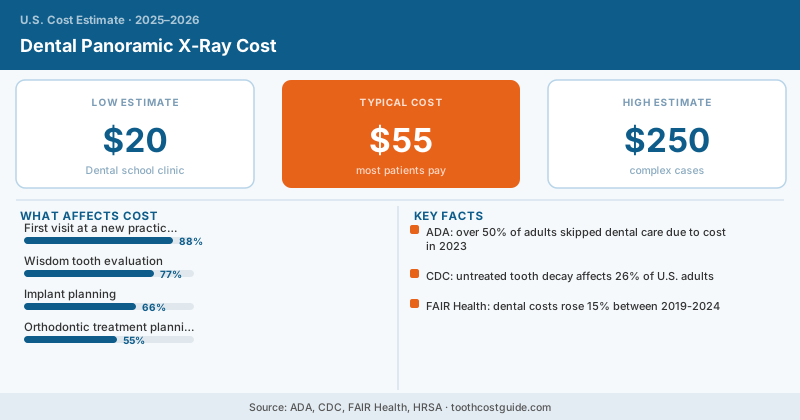
First visit at a new practice. Many dentists take a panoramic X-ray on new adult patients as part of a comprehensive baseline evaluation. It gives them a full-mouth starting point they can reference for years.
Wisdom tooth evaluation. This is the most common reason. Before recommending removal, your dentist or oral surgeon needs to see the exact position of each wisdom tooth, how close it is to the inferior alveolar nerve, and whether it’s causing pressure on adjacent teeth. A panoramic film provides all of that. The ADA guidelines on wisdom tooth management specifically reference panoramic radiography as the standard imaging for this assessment.
Implant planning. A panoramic X-ray is typically the first imaging step before implant placement — it shows bone height, sinus proximity, and nerve location. Most oral surgeons also order a CBCT (cone beam CT) scan for precise 3D measurements before surgery, but the panoramic is often the first look.
Orthodontic treatment planning. Orthodontists use panoramic films to confirm that all permanent teeth are present, assess root lengths, identify impacted canines, and verify jaw symmetry. The ADA reports that orthodontists order panoramic X-rays as standard practice before initiating comprehensive treatment.
Jaw pain or TMJ symptoms. If you’re experiencing clicking, limited opening, or jaw pain, a panoramic film gives your dentist a quick structural assessment of both joints.
Suspected cysts, tumors, or jaw pathology. Any unexplained swelling or pain in the jaw warrants panoramic imaging as a starting point.
You don’t need a panoramic X-ray at every routine checkup. If you had one within the last 3–5 years and nothing has changed significantly — no jaw pain, no planned surgery, no new orthodontic concerns — it’s reasonable to ask whether one is clinically indicated at this visit. Your dentist should be able to explain the specific reason for ordering it. Radiation exposure from a panoramic X-ray is low (about 14–24 microsieverts, comparable to a few hours of background radiation), but there’s no reason to have imaging without a clear clinical purpose.
Insurance Coverage
Most dental PPO plans cover panoramic X-rays, but with conditions.
Frequency limits. The most common coverage rule is once every 3–5 years. If you had a panoramic X-ray at your previous dentist 18 months ago and your new dentist orders another one, your plan may deny it based on the frequency limitation. Provide records from your previous dentist before agreeing to new imaging.
Coverage tier. Panoramic X-rays are typically covered under “diagnostic” benefits at 80–100% after deductible — the same tier as a comprehensive exam. That’s better coverage than major restorative procedures, but it counts against your annual maximum.
Age restrictions. Some plans cover panoramic X-rays for children differently than adults — sometimes more generously for orthodontic evaluation purposes.
Pre-authorization. Rarely required for a panoramic X-ray, but if you’re having it done in conjunction with planned implant surgery or orthognathic planning, verify coverage first.
If your insurer denies coverage based on frequency and you have a clinical reason — new jaw symptoms, suspected pathology, changed clinical status — your dentist can submit a narrative appeal explaining the medical necessity. These appeals succeed frequently.
How to Pay Less
Bring prior X-rays when switching dentists. The most common unnecessary panoramic X-ray is one ordered simply because there’s no prior imaging on file at the new practice. Request your records from your previous dentist before your first appointment. Digital X-rays can be emailed or put on a USB drive at no cost in most states.
Dental schools charge 60–70% less. A panoramic X-ray at an accredited dental school typically runs $35–$75 versus $150–$200 at a private practice. The image quality is identical — the same equipment, the same digital sensor. If cost is a concern and scheduling flexibility allows, this is the easiest way to save.
Standalone dental imaging centers exist in some markets and charge $75–$125 for panoramic X-rays without a dentist visit. Your dentist can send the referral and interpret the image themselves. This is less common but worth asking about in high-cost areas.
HSA and FSA funds cover dental X-rays as qualified medical expenses. If you have a health savings account, use it — the pre-tax discount effectively reduces your out-of-pocket cost by 22–37%.
| Payment Method | Effective Cost |
|---|---|
| No insurance, private practice | $100–$200 |
| With PPO insurance (80% coverage) | $20–$40 |
| Dental school clinic | $35–$75 |
| FSA/HSA (22% tax bracket savings) | $78–$156 (effective) |
| Medicaid (where covered) | $0–$5 copay |
If a dental office tells you that you must have a panoramic X-ray before they’ll examine you as a new patient, know that this is a practice policy — not a clinical requirement. You have the right to ask why the imaging is needed before agreeing to it, and you can request that the dentist perform a clinical exam first and order imaging only if indicated. Some practices require X-rays as a condition of care, which is their prerogative, but you’re entitled to understand what’s being ordered and why before it’s billed.
Bottom Line
A dental panoramic X-ray costs $100–$250 at a private practice and $35–$75 at a dental school. Insurance covers it at 80–100% in most PPO plans, typically once every 3–5 years. It’s a genuinely useful diagnostic tool for wisdom teeth, implant planning, orthodontics, and jaw pathology — and completely unnecessary as a routine annual expense.
Know when it’s been recommended for a clear clinical reason, bring prior images when you switch dentists, and use a dental school or your FSA funds if cost is a concern. The image itself is quick and painless. The billing conversation is worth having beforehand.