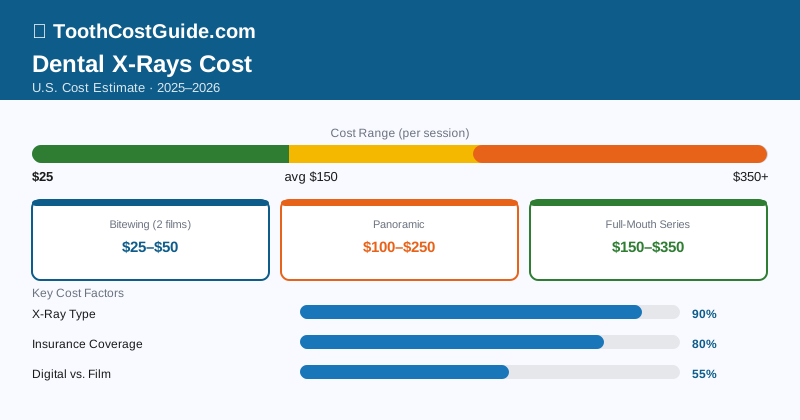
$25 to $250 — that’s the full range you might pay for dental x-rays depending on which type your dentist orders. Most patients don’t know there are five distinct x-ray types, and each carries a very different price tag. Here’s exactly what you’re looking at.
Why X-Rays Matter (and How Often You Really Need Them)
The American Dental Association recommends x-ray frequency based on your individual risk profile — not a one-size-fits-all schedule. Low-risk adults might only need bitewing x-rays every 18 to 36 months. High-risk patients (active cavities, gum disease, dry mouth from medications) may need them every 6 to 12 months.
Skipping x-rays to save money is a false economy. A cavity caught on x-ray at $200 in treatment is a lot cheaper than a root canal at $1,400 two years later when it’s reached the pulp.
X-Ray Types and Their Costs
| X-Ray Type | Average Cost (No Insurance) |
|---|---|
| Bitewing (2 films) | $25–$50 |
| Bitewing (4 films) | $50–$100 |
| Periapical (per film) | $20–$40 |
| Occlusal | $25–$50 |
| Panoramic | $100–$250 |
| Full-mouth series (FMX) | $150–$350 |
| CBCT / 3D cone beam | $300–$600+ |
Bitewing x-rays are the most common — those little cardboard tabs you bite down on. They show the upper and lower back teeth and are ideal for catching cavities between teeth.
Periapical x-rays capture the entire tooth from crown to root tip. Your dentist orders these when they suspect an abscess, root fracture, or bone loss around a specific tooth.
Panoramic x-rays give a single wide-angle view of your entire mouth — all teeth, jawbones, sinuses, and jaw joints. They’re standard before orthodontic treatment, implant planning, or wisdom tooth evaluation.
Full-mouth series (FMX) combines 14–20 individual films for a complete diagnostic picture. New patients almost always get one. It’s the most comprehensive — and most expensive — standard x-ray option.
Cone beam CT (CBCT) is 3D imaging used for complex implant planning or diagnosing jaw pathology. Most general dentists refer out for this; oral surgeons and periodontists often have the equipment in-house.
Does Insurance Cover Dental X-Rays?
Usually, yes — partially. According to the National Association of Dental Plans, roughly 77% of Americans with dental insurance have coverage that includes diagnostic x-rays. But the details vary a lot.
Most PPO plans cover bitewing x-rays at 80–100% once per plan year (or every 12–24 months). Panoramic and full-mouth series are typically covered once every 3–5 years. CBCT is often classified as a specialty service with lower reimbursement or prior authorization requirements.
- Ask if your dentist bundles x-rays into the new-patient exam fee — many do
- If you had x-rays at a previous dentist within 12 months, request records transfer instead of retaking them
- Dental schools charge 50–70% less for the same diagnostic imaging
- Discount dental plans (like Careington or Aetna Dental Access) negotiate reduced rates — typically 20–40% off the cash price
When You Can Push Back
Not every x-ray request is necessary. If your dentist suggests a full-mouth series on your third visit in two years, it’s fair to ask why — especially if you’ve had no new symptoms. The ADA’s own guidelines give dentists flexibility to reduce frequency for low-risk patients.
That said, don’t refuse x-rays your dentist believes are clinically justified. Radiation exposure from modern digital x-rays is extremely low — a full-mouth series delivers about 0.005 mSv of radiation, roughly equivalent to a few hours of natural background radiation.
Digital vs. Traditional Film
Almost all U.S. dental practices have switched to digital x-rays. Digital systems require 50–80% less radiation than traditional film and produce images that appear on screen within seconds. If your dentist still uses film-based x-rays, that’s unusual in 2026 and worth noting.
Beware of any practice that routinely orders a full-mouth series every year for every patient without clinical justification. The ADA guidelines explicitly discourage this. You have the right to ask what specific clinical indication is driving the x-ray recommendation before agreeing.
Bottom Line
For a typical checkup, expect to pay $25–$100 for bitewing x-rays if insurance doesn’t cover them or you’re paying cash. A new-patient panoramic plus FMX package can run $200–$400 out of pocket without insurance. With good PPO coverage, you’ll often pay nothing or just a small copay. The key is knowing what type your dentist ordered — and why.