A standard set of bitewing dental X-rays exposes you to 0.005 millisieverts of radiation. Your body absorbs more than that just living on Earth for a couple of days. And yet patients routinely skip X-rays over radiation concerns, then get blindsided by a $1,500 root canal that a $50 X-ray would have caught two years earlier.
There are four types of dental X-rays, each with a completely different purpose. Knowing what each one shows — and when it’s actually warranted — helps you understand your bill and make smarter decisions about your care.
Bitewing X-Rays: The Cavity Detector
Bitewings are the ones where you bite down on a small tab while the sensor sits between your teeth. They show the crowns of upper and lower teeth simultaneously — specifically the areas between adjacent teeth where cavities form invisibly.
What they detect: Interproximal cavities, early bone loss between teeth, overhanging fillings, secondary decay under existing restorations.
What they don’t show: Tooth roots, full bone levels, or anything deep below the gum crest.
Radiation dose: 0.005 mSv for a standard 4-film series. Background radiation from simply existing on Earth averages 3.1 mSv per year. A set of bitewings is less than 0.2% of your annual background dose.
ADA recommended frequency: Every 12–24 months for adults at average risk; every 6 months for high-risk patients (active cavities, dry mouth, high sugar intake).
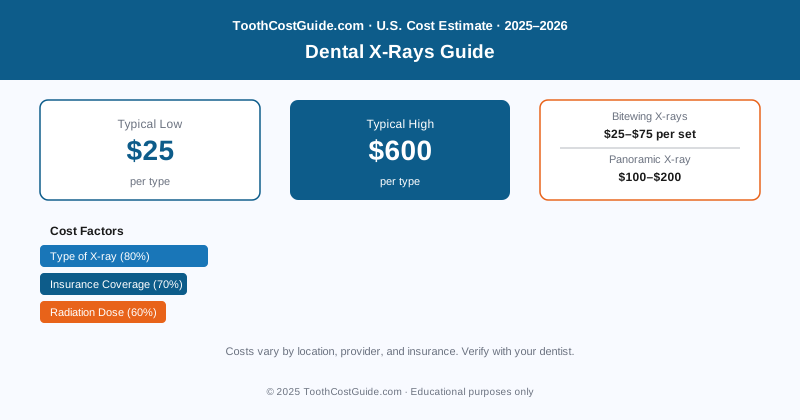
Cost without insurance: $25–$50 for a 4-film series; some offices include this in the comprehensive exam fee.
Periapical X-Rays: The Full-Tooth View
Periapical films show the entire tooth — crown, root, and the bone immediately surrounding the root tip. Where bitewings show the neighborhood, periapicals tell the full story of a single tooth.
What they detect: Abscesses at the root tip, root fractures, root length and shape (critical for root canal planning), bone loss pattern around specific teeth, cysts, tumors, and retained root fragments.
When dentists order them: When a patient has symptoms in a specific tooth, before root canal therapy, after trauma, when evaluating implant sites, and whenever something looks off on a bitewing.
Radiation dose: 0.001–0.008 mSv per film. The ADA notes that a full-mouth series of 18–21 periapical films delivers approximately 0.1–0.2 mSv total — equivalent to a few hours of background radiation.
Cost without insurance: $25–$50 per film. A full-mouth series (FMX) of 18 films: $100–$250 at most practices.
A full-mouth series of dental X-rays (18–21 films) exposes you to approximately 0.1–0.2 mSv. A 2-hour domestic flight at altitude exposes you to about 0.02–0.04 mSv from cosmic radiation. A single chest X-ray is 0.1 mSv. Modern digital dental X-rays use 50–80% less radiation than traditional film X-rays, making them genuinely one of the lowest-dose diagnostic imaging tools in medicine.
Panoramic X-Rays: The Big Picture
A panoramic (“pano”) X-ray captures the entire mouth in one image — all teeth, both jaws, the temporomandibular joints, sinuses, and surrounding bone — as the machine rotates around your head. No sensors inside your mouth.
What they show: Wisdom tooth position and impaction, jaw tumors and cysts, sinus issues affecting upper teeth, overall bone levels, tooth development in children, TMJ anatomy, and eruption patterns.
What they don’t show: Fine interproximal cavities or detailed individual root anatomy. Great for the “forest,” not for specific “trees.”
When dentists order them: New patient comprehensive exams, wisdom tooth evaluation, orthodontic planning, implant overview, and evaluating jaw pain or swelling.
Radiation dose: 0.01–0.024 mSv — similar to a 4-film bitewing series.
Cost without insurance: $100–$200. Most insurance covers one panoramic every 3–5 years.
CBCT 3D Imaging: The Surgical Precision Tool
Cone beam computed tomography (CBCT) produces a three-dimensional image of teeth, jaws, and surrounding structures. It’s the same basic technology as a medical CT scan, but optimized for dental anatomy with a dramatically lower radiation dose.
What it shows: Exact bone volume and density for implant placement, root canal anatomy in three dimensions, precise location of the inferior alveolar nerve (critical for lower wisdom tooth surgery), complex fractures, airway assessment for sleep apnea appliances, and pathology that 2D films can’t properly characterize.
When dentists order it: Implant planning (especially in the posterior mandible near the nerve), complex extractions, difficult root canal cases, jaw cysts or tumors, and orthodontic surgical cases.
Radiation dose: 0.05–0.2 mSv depending on field of view — higher than 2D films but still well below a medical chest CT at 7 mSv.
Cost without insurance: $250–$600 for a localized scan; up to $900 for a full-skull field of view.
| X-Ray Type | What It Shows | Radiation (mSv) | Cost Without Insurance | Insurance Coverage |
|---|---|---|---|---|
| Bitewing (4-film) | Interproximal cavities, early bone loss | 0.005 | $25–$50 | Covered 100% (2x/year) |
| Periapical (per film) | Full tooth + root + periapex | 0.001–0.008 | $25–$50 each | Covered when indicated |
| Full-mouth series (FMX) | All teeth in detail | 0.1–0.2 | $100–$250 | Every 3–5 years |
| Panoramic | Full jaws, wisdom teeth, overview | 0.01–0.024 | $100–$200 | Every 3–5 years |
| CBCT 3D scan | 3D bone, nerve, anatomy | 0.05–0.2 | $250–$600 | Varies; often covered for implants |
Digital vs. Film X-Rays
Virtually all U.S. dental practices have switched to digital sensors or phosphor plate systems. The real advantages:
- 50–80% less radiation than traditional film
- Instant display — no developing time or chemicals
- Easier storage and sharing between providers
- Adjustable contrast and zoom for better diagnostic precision
If you visit a practice still using film X-rays, the radiation doses were already minimal — but digital is unambiguously the current standard of care.
ADA Guidelines for X-Ray Frequency
The ADA and FDA published joint guidelines that base X-ray frequency on clinical need, not a fixed calendar. Key factors:
- Child (primary teeth): Bitewings every 6–12 months if high cavity risk; every 12–24 months if low risk
- Adolescent: Bitewings every 6–18 months; panoramic or FMX if not previously taken
- Adult (new patient): FMX or panoramic plus selective periapicals recommended for a comprehensive baseline
- Adult (established patient): Bitewings every 12–24 months based on risk; periapicals when symptoms warrant
A dentist who pushes X-rays at every appointment regardless of clinical need may be overtreating. One who never takes them is undertreating. The right answer is individualized — but the ADA guidelines give you a reasonable benchmark.
When You Can Ask to Skip X-Rays
Patients have every right to decline X-rays. Just understand the diagnostic trade-off: interproximal cavities, root abscesses, and bone loss are often undetectable without them.
If you recently had X-rays elsewhere, request that your records be forwarded. Most dentists will accept recent films (within 12–18 months) rather than retake them. Under HIPAA, you have the right to your dental records — typically for a $20–$50 copying fee.
Declining X-rays means your dentist is examining you with incomplete information. Interproximal cavities, root abscesses, and bone loss are often undetectable without X-rays. A dentist who proceeds with treatment based on a visual exam alone — especially for root canals or extractions — is working with one hand tied behind their back. The radiation risk from dental X-rays is genuinely negligible; the diagnostic cost of skipping them is not.
What This Means for Your Dental Budget
For a healthy adult at average risk, routine X-ray costs are minimal. Two bitewing series per year at $25–$50 each ($50–$100 total) plus a panoramic or FMX every 3–5 years ($100–$250) works out to roughly $70–$150/year.
Most dental insurance covers preventive X-rays at 100%, making the out-of-pocket cost zero for most covered patients. CBCT is where costs jump — but it’s ordered specifically and rarely, typically only when planning implant surgery or navigating complex anatomy.
The value is clear. X-rays that catch a Stage 2 cavity at $150–$300 are a far better outcome than missing it until it becomes a $1,500 root canal.