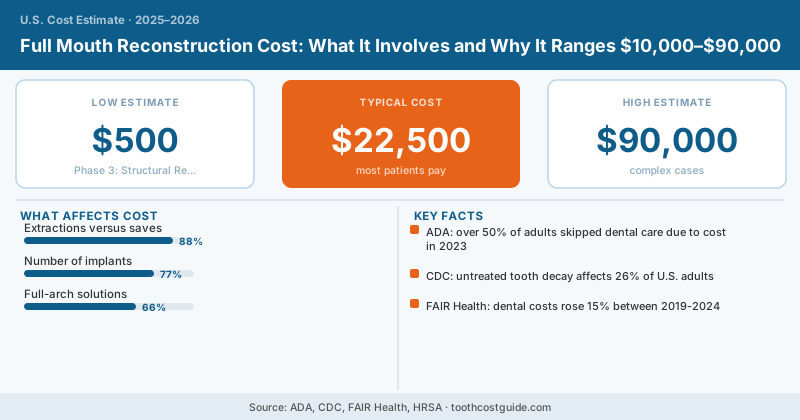
Most patients assume the term “full mouth reconstruction” means one big procedure with one big price. It doesn’t. It’s a sequenced treatment plan — often spanning 12–24 months — that combines oral surgery, periodontics, restorative dentistry, and sometimes orthodontics into a coordinated whole. The cost isn’t a mystery number. It’s the sum of every procedure your mouth actually needs.
The ADA reports that severe dental disease affects approximately 5% of US adults. For that group — people dealing with years of neglect, trauma, acid erosion, or conditions like bruxism — full reconstruction isn’t elective. It’s the path back to a functioning mouth.
Here’s how the cost is structured, what drives it from $15,000 to $80,000+, and how people actually pay for it.
What Full Mouth Reconstruction Involves
A reconstruction plan is assembled around your specific clinical situation. It might include:
- Extractions of teeth that can’t be saved
- Bone grafting to rebuild ridge volume
- Sinus lifts for upper back implants
- Dental implants to replace extracted teeth
- Crowns on teeth being restored
- Root canals on teeth with pulp damage
- Periodontal treatment (scaling and root planing, gum surgery)
- Possibly orthodontics to correct bite alignment
The team coordinating this work could include a general dentist, periodontist, oral surgeon, and prosthodontist. Prosthodontists — dentists with three additional years of specialty training in complex restorations — often lead the planning for the most involved cases.
Cost by Case Type
| Case Type | Estimated Cost |
|---|---|
| Moderate: crowns + periodontal + a few implants | $15,000–$30,000 |
| Mid-range: implants + crowns + veneers | $30,000–$50,000 |
| Extensive: full-arch implant solutions | $40,000–$80,000+ |
| All-on-4 (one arch, implant-supported bridge) | $20,000–$35,000 per arch |
The All-on-4 approach deserves a separate note. It replaces an entire arch of teeth with four strategically placed implants supporting a fixed bridge. At $20,000–$35,000 per arch, it’s actually at the lower end of full reconstruction cost for patients who’ve lost most or all teeth in an arch — because four implants cost far less than 10–12 individual implants. Many full reconstruction cases that previously would have cost $70,000+ are now handled with All-on-4 or All-on-6 solutions at lower total cost.
What Drives the Cost Higher
Number of implants. This is the single biggest variable. Each implant adds $1,500–$2,500 for placement plus $1,000–$2,500 for the crown. A plan with 6 implants versus 2 implants is a $20,000+ difference before anything else changes.
Whether teeth can be saved. Every tooth that needs extraction potentially needs an implant or bridge to replace it. Saving a tooth with a crown costs $1,000–$1,800. Replacing it with an implant costs $3,000–$5,000. The clinical decision about which route to take has enormous cost consequences.
Bone and sinus work. If you need bone grafts ($300–$800 per site) or sinus lifts ($1,500–$3,000 per side) before implants can be placed, those costs stack. A case requiring bilateral sinus lifts and multiple graft sites can add $6,000–$10,000 to the total before a single implant goes in.
Aesthetic components. Veneers on front teeth, laser gum contouring, and whitening are often included in reconstruction plans — but they’re elective and almost never covered by insurance. Each veneer runs $900–$2,500. Aesthetic phase costs can easily add $5,000–$20,000 to the total.
One of the most effective ways to reduce out-of-pocket cost is strategic phasing. Dental insurance annual maximums (typically $1,000–$2,000) reset every January 1. If you complete certain phases before December 31 and begin the next phase in January, you can capture two years of insurance benefits on a single reconstruction. Your dentist or prosthodontist can help sequence treatment to maximize this — ask about it explicitly during treatment planning.
What Insurance Covers — and What It Doesn’t
Insurance doesn’t cover “full mouth reconstruction” as a category. It covers the individual procedures that make up the plan — each subject to its own coverage tier, waiting period, and benefit limit.
What typically gets covered:
- Extractions: 75–90% (basic surgical)
- Deep cleaning / scaling and root planing: 50–80%
- Root canals: 40–60%
- Crowns: 40–60% (after waiting period)
- Implants: 40–50% under plans that cover them; many plans exclude implants entirely
What’s almost never covered:
- Veneers and cosmetic work
- “Reconstruction” as a bundled concept
- Bone grafts or sinus lifts when linked to implant placement
For a $40,000 reconstruction, realistic insurance contributions — if you have a plan that covers implants — might be $3,000–$6,000 spread over two plan years. That’s meaningful, but it’s not going to cover the bulk of the cost.
Medical insurance angle: If tooth loss resulted from an accident, trauma, or certain medical conditions, your medical insurance may cover some components under injury or reconstructive benefit codes. It’s worth a call to your medical carrier specifically — separate from your dental plan.
Financing Options
Most practices offering full mouth reconstruction have financing relationships in place. The most common options:
CareCredit is the most widely accepted dental financing plan. It offers 0% promotional periods of 12–24 months on large balances. The critical caveat: if the full balance isn’t paid before the promotional period ends, retroactive interest applies from the purchase date at roughly 26–29% APR. Track the payoff deadline carefully.
Proceed Finance and LendingClub Patient Solutions offer longer repayment terms (up to 84 months) with straightforward interest — no deferred interest trap. Monthly payments on a $30,000 plan over 60 months at 8–10% APR run roughly $600–$650.
In-house payment plans. Many prosthodontic and implant practices offer their own 12–24 month interest-free financing for established patients. Ask whether this is available before applying for outside credit.
HSA and FSA funds can be applied to all medically necessary components — extractions, implants, crowns, root canals, periodontal treatment. Pre-tax dollars give you an effective 22–37% cost reduction depending on your tax bracket. If you’re planning a major reconstruction, maximizing your HSA contributions in the planning year is worth doing.
Be skeptical of any practice that presents a reconstruction quote as a single lump sum without an itemized breakdown. You’re entitled to a written treatment plan listing every procedure code, the fee for each item, which specialist performs each stage, and the sequencing timeline. A practice that resists providing this — or can’t produce it — is one to be cautious about for a six-figure investment. Get the itemized plan before signing any financial agreement.
Getting the Plan Right Before Spending Anything
The diagnostic phase is where reconstruction cases are won or lost. A cone-beam CT scan (CBCT) gives your provider 3D imaging of bone density and anatomy — essential for implant planning and identifying any issues a standard X-ray would miss. A diagnostic wax-up creates a physical or digital model of the intended final result before any irreversible treatment begins.
Expect to spend $500–$2,000 on a thorough diagnostic workup. That’s not wasted money — it’s the blueprint that prevents $10,000 surprises partway through a $40,000 treatment plan.
Bottom Line
Full mouth reconstruction costs $15,000–$80,000+ because it’s the sum of whatever your mouth actually needs — not a package with a fixed price. Typical mid-range cases (implants + crowns + periodontal work) run $30,000–$50,000. All-on-4 full-arch solutions land at $20,000–$35,000 per arch. Insurance covers individual components at 40–60%, subject to annual maximums. Phase the work across calendar years to maximize benefits, use HSA/FSA funds for all medically necessary components, and get a complete itemized treatment plan before you commit to anything.