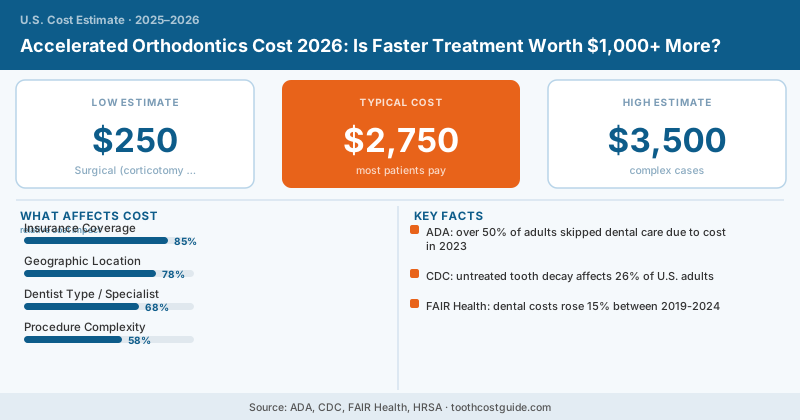
Most people assume braces take two years and there’s nothing you can do about it. Not quite. A growing menu of accelerated techniques promises to shave months off your timeline — and yes, you’ll pay extra for the privilege, usually $500 to $3,000 on top of your base treatment.
Whether that premium makes sense depends on one question: how badly do you need to be done early? A bride with a six-month runway thinks differently than a 14-year-old with all the time in the world.
| Acceleration Method | Added Cost | Time Saved |
|---|---|---|
| High-frequency vibration device | $500–$1,500 | Up to 30% faster (varies) |
| Micro-osteoperforation (in-office) | $250–$1,000 | 2–4 months |
| Surgical (corticotomy / PAOO) | $2,000–$3,500 | 30–50% faster |
| Light/photobiomodulation device | $700–$2,000 | Modest, case-dependent |
The Three Main Approaches
Acceleration isn’t one product — it’s a category. The cheapest options are at-home devices you bite down on for a few minutes daily, using gentle vibration to speed how teeth move through bone. The middle tier is micro-osteoperforation, where your orthodontist makes tiny pinpoint perforations in the bone to spark faster remodeling.
The heavy artillery is surgical. A periodontist or oral surgeon performs a corticotomy — small cuts in the bone around your teeth — which triggers a healing response that lets teeth shift dramatically faster. It costs the most and carries real surgical considerations, but it can cut treatment nearly in half for the right candidate.
Acceleration adds upfront cost, but a shorter treatment means fewer adjustment visits. If your orthodontist charges per visit, some of that premium comes back. Ask whether your braces or Invisalign quote is flat-fee or per-visit before you decide.
Does the Science Hold Up?
Here’s the honest part: results are mixed. The American Association of Orthodontists has noted that evidence for at-home vibration devices is inconsistent, and some studies show little measurable benefit. Surgical methods have stronger backing for speed but obviously involve more risk and cost.
A 2024 review echoed what many orthodontists already tell patients — the most reliable accelerator is simply wearing your aligners or keeping your brackets intact and showing up to every appointment. Skipping that $1,500 vibration gadget and just being a compliant patient often gets you a similar result. The CDC’s data on oral health underscores that consistency matters more than gadgets for long-term outcomes.
What Drives the Final Price
Your base treatment sets the floor. If you’re in adult braces at $5,500 and you add micro-osteoperforation, you’re now near $6,500. Surgical acceleration on a complex aligner case can push a total past $9,000 once you add the periodontist’s fee.
Geography matters too. Acceleration services concentrate in larger metro practices, and those markets price higher. Smaller-town orthodontists may not even offer surgical options, which can mean a referral and a second provider’s bill.
And don’t forget the finish line. No matter how fast you get there, you’ll still need a retainer — $150–$500 — to hold the result. Acceleration speeds the journey, not the maintenance.
Paying for the Speed
Insurance almost never covers acceleration as a separate line item. Your ortho benefit (if you have one, capped around $1,000–$2,500 lifetime) applies to the base treatment, and the accelerator is on you.
That’s where an FSA for dental expenses helps — orthodontic care is eligible, and acceleration tied to it usually qualifies. For larger surgical bills, a CareCredit dental plan can spread the cost over months.
Be wary of any provider promising to “cut your treatment in half” with a device alone. The strongest evidence is for surgical methods, which carry surgical risks. For at-home gadgets, get the claims in writing and ask for the orthodontist’s own patient results — not the manufacturer’s marketing.
The Verdict
For most patients with normal timelines, accelerated orthodontics is an expensive luxury with uneven payoff. But if you have a hard deadline and a complex case, surgical acceleration can genuinely change the math. Talk it through at your orthodontist consultation — and ask for honest odds, not marketing promises.
Frequently Asked Questions
Accelerated orthodontics typically adds $500 to $3,000 to your total treatment cost, depending on the method used and your orthodontist's location and fees. For example, if traditional braces cost $3,500 to $6,000, you can expect to pay $4,000 to $9,000 with acceleration techniques like vibration devices, micro-osteoperforations, or prescription medications.
Most dental insurance plans do not cover accelerated orthodontics as a separate benefit, since they classify it as an elective enhancement rather than medically necessary treatment. You will likely pay the $500–$3,000 acceleration premium entirely out-of-pocket, though your base orthodontic coverage may still apply to the standard braces or aligner portion.
Accelerated techniques can reduce treatment time by 25–50%, potentially cutting a typical 24-month timeline down to 12–18 months depending on the method and your specific case. Popular methods like AcceleDent vibration devices or micro-osteoperforations show the most dramatic results, though individual outcomes vary based on your bite complexity and age.