One in four orthodontic patients in the US is now an adult. That number has roughly doubled since 2000, according to the American Association of Orthodontists — and yet the financial side of adult braces still catches most people off guard. The bill is higher than childhood treatment. Insurance usually covers less, or nothing at all.
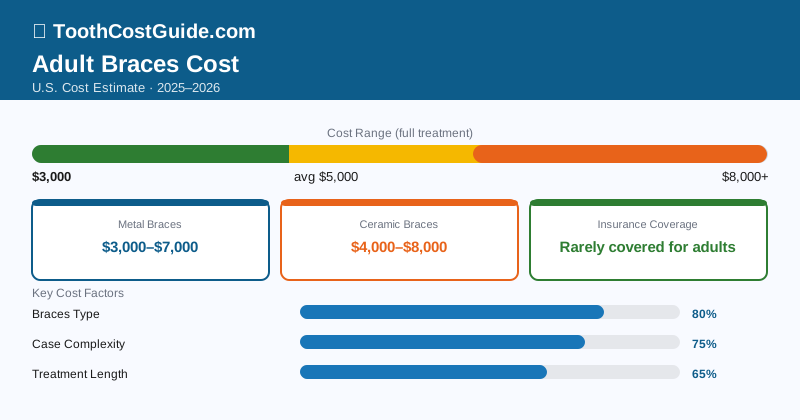
Adult braces run $3,000–$8,000 depending on appliance type, case complexity, and treatment length. Adults typically pay 10–20% more than teenagers for comparable cases. That gap comes from slower bone remodeling, more complicated dental histories, and a strong preference for discreet options like ceramic or lingual braces.
| Adult Orthodontic Treatment | Cost Without Insurance |
|---|---|
| Metal braces (adult) | $3,500–$7,500 |
| Ceramic (tooth-colored) braces | $4,500–$8,000 |
| Lingual braces (behind teeth) | $8,000–$13,000 |
| Invisalign Full | $3,500–$8,000 |
| Invisalign Lite/Express (mild cases) | $1,800–$3,500 |
| Self-ligating braces (Damon, etc.) | $4,000–$8,000 |
| Dental school adult treatment | $1,500–$4,000 |
Why the Bill Is Higher for Adults
Bone remodels more slowly. A teenager’s jaw is still growing, so teeth move faster and more predictably. The same 3mm crowding correction that takes 14 months at age 13 might take 18–22 months at 35. More appointments, more archwire changes, higher total fee.
Adults bring baggage. Crowns, bridges, old implants, gum disease history — any of these complicate the orthodontic mechanics. Cases requiring coordination with a periodontist or prosthodontist add professional fees beyond what the orthodontist charges.
The aesthetics cost more. Adults overwhelmingly choose ceramic, lingual, or Invisalign over traditional metal. That preference is legitimate, but it adds $500–$5,000 to the baseline.
Retention is stricter. With no jaw growth left to stabilize results, adults typically need more rigorous lifelong retention. Bonded permanent retainers ($150–$350 per arch) are commonly added on top of the initial treatment fee — and they’re worth every dollar.
Adult orthodontic treatment is more common, more socially accepted, and better supported by orthodontists than ever before. The main financial distinction for adults is insurance: many dental plans exclude adults from orthodontic benefits or apply lower lifetime maximums. Plan for larger out-of-pocket costs and explore FSA/HSA options proactively.
Picking the Right Appliance
Clear aligners (Invisalign, ClearCorrect) — $3,000–$8,000: The most popular adult choice. Removable for meals, meetings, and photos. Effectiveness matches braces for mild-to-moderate crowding, but they require 20–22 hours of wear daily. For severe skeletal problems, they’re not the right tool.
Ceramic braces — $4,500–$8,000: Fixed brackets, which means no forgetting to wear them. Tooth-colored ceramic is far less noticeable than metal. The trade-off: elastic ligatures can stain, and ceramic brackets are more fragile — repairs run $25–$75 per bracket at most practices.
Traditional metal braces — $3,500–$7,500: Still the most effective option for complex cases. Fewer adults choose them for cosmetic reasons, but for severe crowding, significant bite correction, or anyone skeptical of their own compliance with removable aligners, metal delivers the best result per dollar.
Lingual braces — $8,000–$13,000: Bonded to the tongue side of the teeth. Completely invisible from the front. The go-to for adults in high-visibility professional roles who need fixed-appliance precision with zero visual impact.
Invisalign Lite/Express — $1,800–$3,500: Built for mild adult cases — often people who had braces as kids and experienced some post-treatment drift. Usually 7–14 aligners over 3–6 months. Excellent value when the case qualifies.
The Insurance Reality
This is where adult orthodontics gets frustrating. Most dental plans with orthodontic benefits were designed around children.
Lifetime orthodontic maximum: $1,000–$3,000. Not annual — ever. If you used $800 of a $2,000 lifetime maximum at age 14, you have $1,200 left as an adult.
Age cutoffs: Many plans only cover orthodontic treatment through age 18–19. Dependents on a parent’s plan may qualify through 26, but that depends on the specific dental plan — not a universal ACA rule.
Adult-specific coverage: Some employer benefit packages do include adult orthodontic coverage. Check your Summary of Benefits and Coverage document. Look for “orthodontia” and note both the age limits and the lifetime maximum before assuming anything applies to you.
If your employer plan currently covers adult orthodontics, don’t delay. If the plan changes at open enrollment, the replacement plan may have a waiting period or may not cover adults at all. Starting treatment under a favorable plan locks in the benefit.
Making It Work Financially
In-house orthodontic payment plans: Most orthodontists spread the total cost over the treatment period at 0% interest. A $6,000 case over 24 months is $250/month. No credit check, no interest — start by asking about this first.
CareCredit and Lending Club Patient Solutions: Promotional 0% interest periods of 12–24 months. Useful, but pay the balance before the promotional period ends. Deferred-interest provisions can retroactively bill all accumulated interest at once at 17–27% APR — a nasty surprise on a $5,000 balance.
FSA and HSA: Adult braces are fully eligible. For someone in the 24–37% federal tax bracket, using $5,000 in FSA funds saves $1,200–$1,850 in federal taxes on that amount alone. The smartest move is maximizing FSA contributions before the calendar year treatment starts.
Practical Ways to Spend Less
Get consultations at 2–3 orthodontic offices. Initial consultations are free and include case assessment. Fees for equivalent cases routinely vary $500–$2,000 within the same city. Ask for a written treatment plan and total fee at each visit.
Consider dental school orthodontic clinics. Supervised orthodontic residents — licensed dentists in specialty training — handle cases at 30–50% below private practice rates. Treatment may take slightly longer due to scheduling, but outcomes are closely supervised. Find programs at aaoinfo.org.
Ask honestly about Invisalign Lite. If you’re an adult who had braces before and your teeth shifted post-treatment, limited aligner programs were built for this. They cost 50–60% less than comprehensive retreatment.
Invest in permanent retainers. Bonded wire retainers add $150–$350 per arch but dramatically cut the odds of relapse. Retreatment from shifting teeth costs $2,000–$5,000. The math is obvious.
The Bottom Line
Adults are getting braces in record numbers, and the market has responded with better options at every price point. The challenge is insurance — many adults get less coverage or none at all, making out-of-pocket costs the real planning variable. Metal braces at $3,500–$7,500 remain the most cost-effective choice for complex cases. FSA funds, free consultations, and dental school programs are the most reliable ways to close the gap between what treatment costs and what you can comfortably spend.
More Americans are getting braces as adults than ever before. The key financial differences from childhood treatment are longer timelines, more frequent insurance exclusions, and a preference for more expensive aesthetic appliances. Maximize FSA/HSA contributions, compare multiple orthodontists, and consider dental school programs to bring adult orthodontic costs into reach.
Frequently Asked Questions
Adult braces typically cost $3,000–$8,000 total, depending on the type of appliance and complexity of your case. Metal braces are usually the least expensive option at $3,000–$5,000, while ceramic or lingual braces can run $4,000–$8,000, and Invisalign aligners often fall in the $4,000–$7,500 range.
Many dental insurance plans offer limited coverage for adult orthodontics, typically paying 40–50% of the cost after a waiting period, with lifetime maximum benefits of $1,000–$2,000. However, some plans exclude orthodontics entirely, and Medicare does not cover braces for adults, making out-of-pocket costs a significant consideration.
Adult braces typically require 24–36 months of active treatment, though some cases may be completed in 18 months or take up to 3+ years depending on tooth alignment complexity. Adults often take slightly longer than children because adult bones no longer grow, requiring the teeth to move more gradually and deliberately.