Sarah, 28, hadn’t been to the dentist in four years — mostly out of fear of the drill. When her new dentist mentioned air abrasion as an option for two small cavities, she almost didn’t believe it. No shot. No drill sound. Out in 40 minutes.
That’s the reality for small cavities treated with air abrasion. It uses a fine stream of aluminum oxide particles — accelerated by compressed air — to cut away decayed tooth structure. No friction, no heat, no vibration. And for early-to-moderate decay, it genuinely works.
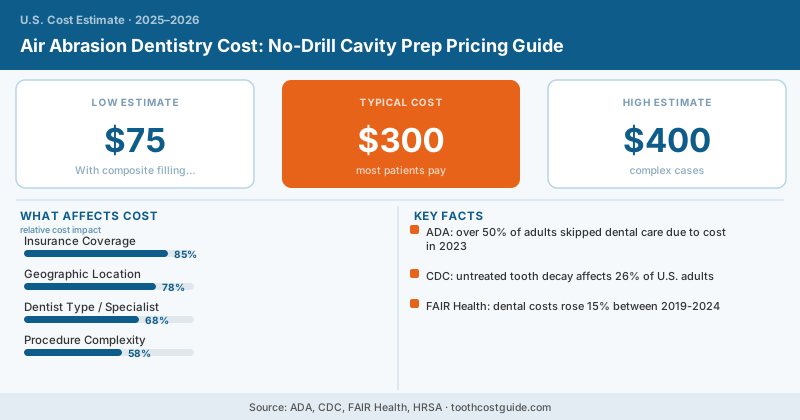
The cost runs $75–$200 per tooth for the preparation, usually bundled with the composite filling material. That’s typically in line with or slightly below traditional drilling costs.
How Air Abrasion Works
The handpiece blows a high-pressure stream of 27–50 micron aluminum oxide particles directly at the decay. The particles knock away the softened, demineralized tooth structure without cutting healthy enamel. Because there’s no rotary friction, there’s no heat generation — the main source of nerve stimulation that makes drilling hurt.
Research published in the Journal of Conservative Dentistry found that approximately 65% of patients treated with air abrasion for Class I and II restorations required no local anesthesia at all. In a traditional drilling scenario, that number flips — most patients expect a shot. For needle-phobic patients, this is significant.
The system isn’t silent — it produces a high-pitched hiss — but the absence of the drill’s characteristic whine and vibration reduces anxiety considerably in most patients.
Cost Comparison: Air Abrasion vs. Traditional Drilling
| Procedure | Air Abrasion | Traditional Drill |
|---|---|---|
| Small (Class I) cavity prep | $75–$125 | $100–$175 |
| Medium (Class II) cavity prep | $100–$175 | $150–$250 |
| With composite filling (bundled) | $150–$350 | $200–$400 |
| Anesthesia (if needed) | Often not required | Usually included |
| Dental school treatment | $50–$150 | $75–$200 |
The cost advantage of air abrasion is modest — typically $25–$75 less per tooth than conventional drilling. The real advantage is the patient experience, not the price.
When Air Abrasion Is the Right Choice
Air abrasion shines in specific situations. It’s not a universal replacement for the drill.
It works best for:
- Small to medium cavities on biting surfaces and in pit-and-fissure areas
- Patients with dental anxiety who want to avoid anesthetic injections
- Children for whom the drill experience creates long-term fear
- Preparing teeth for composite bonding or sealants
- Removing old composite restorations for replacement
It doesn’t work for:
- Large cavities with significant structural loss
- Cavities near or involving the pulp
- Preparing teeth for crowns (which need precise margins)
- Removing silver amalgam fillings (the particles would contaminate the surface)
Patients sometimes ask if inhaling the particles is dangerous. Modern air abrasion units use an intraoral vacuum to capture particles at the source, and the dentist places rubber dam or cotton isolation around the work area. The particles are not respirable in the clinical context — the containment systems used in dental offices prevent systemic exposure.
Finding a Dentist Who Offers Air Abrasion
Not every office has air abrasion equipment. The systems — KaVo SONICflex, MicroEtcher, PrepStart — cost $3,000–$8,000, so smaller practices sometimes skip them. You’re most likely to find it at:
- Cosmetic and biomimetic dentistry practices emphasizing minimal intervention
- Pediatric dentists managing anxious young patients
- Tech-forward general practices that have invested in newer equipment
Call ahead and ask specifically: “Do you use air abrasion for cavity preparation?” If the front desk isn’t sure, ask to speak with the dentist directly.
Air abrasion is a precision technique. In unskilled hands, the particle stream can damage adjacent teeth or gum tissue if not properly isolated. Always verify your dentist has experience with the technique — ask how many air abrasion procedures they perform per month before agreeing to treatment.
Insurance and FSA Coverage
The good news: insurance doesn’t know or care whether your dentist used a drill or air abrasion. Coverage is based on the ADA procedure code for the filling that results — typically D2391 through D2394 for posterior composites, or D2330–D2335 for anteriors. Same codes, same coverage, regardless of prep method.
If you have an FSA or HSA, the entire cost — prep and fill — is a qualified dental expense.
The Bottom Line
Air abrasion won’t save you a huge amount of money compared to drilling. But for patients who’ve been avoiding the dentist because they dread the drill, the psychological savings are enormous. Treating two small cavities today with air abrasion beats ignoring them for another year and watching them grow into something that needs a crown.
If your dentist mentions early decay, ask whether air abrasion is an option. For the right cavity, it’s one of the most anxiety-reducing tools in modern dentistry — at no real premium in cost.
Frequently Asked Questions
Air abrasion for cavity preparation typically costs $75–$200 per tooth, which is comparable to or slightly less than traditional drilling. The final cost depends on the size of the cavity being treated, the region, and whether it's bundled with the composite filling material — most dentists quote air abrasion prep and the filling together as a single fee.
Most patients describe air abrasion as pressure and sound without the sharp pain associated with a drill. Studies show approximately 60–70% of patients who undergo air abrasion for small cavities don't need any anesthetic injection. For larger preparations or cavities near the pulp, some numbing may still be needed — but the absence of heat and vibration significantly reduces discomfort.
Yes — dental insurance typically covers air abrasion the same way it covers traditional drilling. Insurance pays based on the procedure being performed (the filling) rather than the preparation method, so you'd get the same coverage you'd expect for a composite or amalgam filling. The technique itself isn't separately billed in most cases.