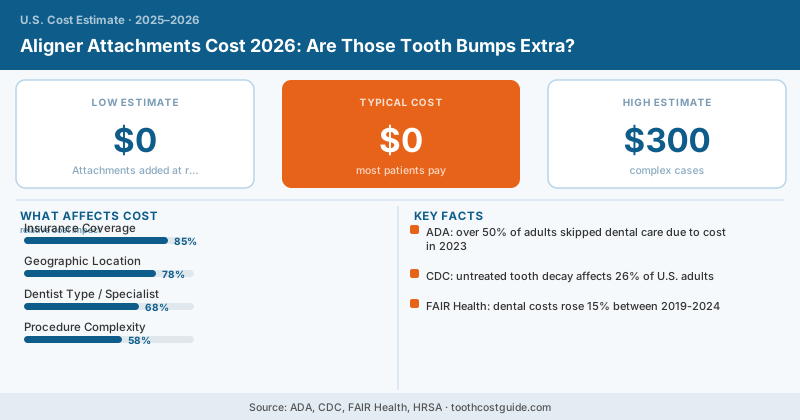
Good news first: those little tooth-colored bumps your orthodontist glues to your teeth during clear aligner treatment — the attachments — usually cost you nothing extra. They’re baked into your treatment fee. But “usually” isn’t “always,” and a few scenarios can put $0 to $300 on your bill. Let’s clear up exactly when attachments cost money.
Attachments are small bonded shapes, also called buttons or SmartForce features, that give your aligners something to grip. Without them, trays would just slide around. With them, your aligners can apply precise force to rotate, extrude, or tip teeth that would otherwise be impossible to move.
| Attachment Scenario | Typical Cost | Notes |
|---|---|---|
| Standard attachments with treatment | $0 (included) | Part of flat aligner fee |
| Re-bonding a fallen attachment | $0–$150 | Often free at routine visit |
| Attachments added at refinement | $0 (usually included) | Covered by refinement policy |
| Mid-treatment provider with à la carte pricing | Up to $300 | Rare, ask upfront |
What Attachments Actually Do
Clear aligners are great at tipping teeth, but lousy at certain movements on their own — rotating a round tooth like a canine, or pulling a tooth down that’s sitting too high. Attachments fix that. They’re tiny anchors the tray pushes against, turning a simple plastic shell into a precision tool capable of complex movements.
Your orthodontist bonds them on early in treatment, and they stay until the work is nearly done, then get polished off. They’re tooth-colored, so they’re not very noticeable — though you’ll feel them with your tongue and they can catch a bit of staining if you drink a lot of coffee or wine without rinsing.
Reputable orthodontists and brands include attachments in your overall Invisalign or clear aligner fee. If a provider tries to charge you per attachment, that’s a red flag — ask them to put the full all-in price in writing before you start. Compare brands in our clear aligners comparison.
When They Might Cost Extra
A few situations can generate a charge. If an attachment pops off — which happens occasionally with sticky foods — re-bonding it is often free at a routine visit, but some practices charge a small fee if you need a special trip. If you switch orthodontists mid-treatment, the new provider’s à la carte pricing might itemize attachments separately.
Mail-order aligner brands are a different animal. Many remote-only systems don’t use attachments at all, because there’s no in-person provider to bond them. That’s actually one of the reasons remote aligners struggle with complex cases — they’re missing the tool that makes hard movements possible. The American Association of Orthodontists has repeatedly flagged that the absence of in-person clinical features is a limitation of direct-to-consumer aligners.
Why This Matters for Your Results
Here’s the part that connects to value. Attachments are a big reason doctor-supervised aligners outperform on tough cases. The AAO has noted that comprehensive orthodontic outcomes depend on the ability to control three-dimensional tooth movement — exactly what attachments enable. The CDC’s broader oral-health guidance stresses that proper bite correction prevents long-term problems, and attachments are part of getting the bite right.
So if you’re choosing between a cheaper attachment-free system and a doctor-led one with attachments, you’re often choosing between a tool that can do the job and one that can’t. For complex cases, that’s not a small distinction. It may even be the reason a provider steers you toward adult braces instead, since brackets handle complex movements natively.
Paying for Treatment (Attachments Included)
Since attachments are part of the overall fee, they fall under whatever orthodontic insurance benefit you have — typically a $1,000–$2,500 lifetime cap. There’s no separate “attachment claim.”
For your out-of-pocket share, an FSA for dental expenses covers the full aligner treatment with pre-tax dollars, and a CareCredit dental plan can finance it monthly.
Avoid coffee, red wine, and tea while wearing trays over attachments — they stain. And if an attachment falls off, call your orthodontist promptly. A missing attachment means that tooth isn’t moving as planned, which can quietly stall your timeline.
Bottom Line
In almost every legitimate treatment, aligner attachments cost you nothing extra — they’re part of the package and a key reason your trays actually work. Just confirm the all-in price upfront, watch out for à la carte charges, and remember you’ll still need a retainer at the end to hold your results.
Frequently Asked Questions
In most cases, attachments cost nothing extra because they're included in your clear aligner treatment fee (typically $3,000–$8,000 total). However, if you need attachments added after your initial treatment or switch providers, you may pay $0–$300 depending on how many attachments are needed and your orthodontist's fees.
Most dental insurance plans cover clear aligner attachments at the same rate as the base aligner treatment, typically paying 50% of the cost after your deductible. However, some plans exclude clear aligners entirely or cap coverage at $1,000–$2,000 per year, meaning attachments would fall under that limit rather than being billed separately.
Placing attachments usually takes 30–45 minutes during a single appointment. Your orthodontist will bond tooth-colored composite material to specific teeth, and the attachments harden under a curing light before you leave with your first set of aligners.