You’ve gotten two quotes for All-on-4 implants. One is $21,000. The other is $27,500. They’re both from board-certified surgeons in the same city. Before you choose the lower price, you need to know what each one actually includes — because there’s a good chance they’re not quoting the same procedure.
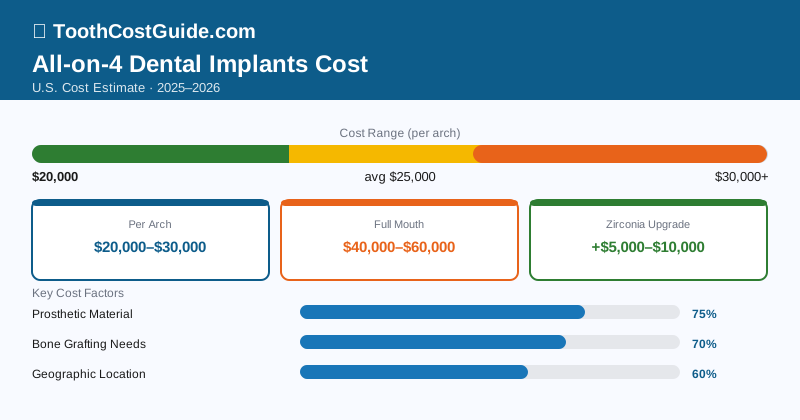
All-on-4 dental implants cost $20,000–$30,000 per arch in the U.S. in 2025. Full mouth (both arches): $35,000–$60,000. The range is wide. The variation is real. And the gap between quotes almost never reflects a difference in surgeon quality — it reflects differences in what’s bundled, what implant brand is used, and what material goes in your mouth for the final bridge.
| Component / Scenario | Cost |
|---|---|
| Single arch (upper or lower) — average range | $20,000–$30,000 |
| Full mouth (both arches) | $35,000–$60,000 |
| Provisional (temporary) prosthesis | Often included; sometimes $2,000–$5,000 extra |
| Extractions (remaining teeth) | $150–$300 per tooth, or $1,500–$4,000 if full arch |
| Bone grafting (if needed) | $500–$3,000 per site |
| All-on-6 (6 implants per arch) | $24,000–$35,000 per arch |
| Zirconia final prosthesis upgrade | May add $2,000–$5,000 |
| Budget / dental tourism All-on-4 | $6,000–$12,000 per arch (outside the U.S.) |
The One Question That Changes Everything
Before comparing any two All-on-4 quotes, ask both providers: “Can you give me an itemized list of every procedure and cost included in this quote?”
A complete All-on-4 quote should cover: consultations, CBCT 3D imaging, all remaining tooth extractions, four implant fixtures (plus placement surgery), a temporary prosthesis worn while you heal, and the final permanent prosthesis. Some practices quote only the implant placement and bill everything else separately — extractions at $150–$300 per tooth, CBCT at $300–$600, and the final bridge as a significant additional charge.
A $21,000 all-inclusive quote and a $27,500 quote that excludes extractions and uses acrylic for the final bridge may have nearly identical real costs when everything is accounted for. Do this comparison with every provider. Every single one.
What the Price Actually Reflects
Implant brand. Nobel Biocare invented the All-on-4 protocol and remains the reference standard. Straumann and Zimmer Biomet are other premium brands with decades of published clinical data. These implant systems cost the dentist $300–$800 per implant in materials. Budget brands used in lower-priced practices cost $100–$200 per implant. The difference between a $21,000 and a $26,000 quote sometimes traces back entirely to implant brand — which matters for a titanium device you’ll have in your jaw for 20+ years.
Final prosthesis material. The arch prosthesis — your “teeth” — comes in two main forms. Acrylic/hybrid prostheses have a titanium or cobalt-chrome frame with acrylic teeth. Less expensive, easier to repair if chipped, but more prone to staining and wear. Zirconia monolithic prostheses are machined from a single block of material — stronger, more aesthetic, more natural-looking, significantly more expensive to fabricate. Zirconia can’t be repaired if it fractures; the whole prosthesis must be remade. Upgrading from acrylic to zirconia typically adds $2,000–$5,000 to the total cost.
Geographic market. A prosthodontist in Manhattan charges materially more than a general dentist in Tulsa. Neither necessarily delivers a better outcome — but overhead costs, real estate, and local market rates create genuine price differences of $5,000–$10,000 for the same treatment between cities.
Team-based vs. single-provider. Some All-on-4 centers use a team approach — oral surgeon places the implants, prosthodontist designs and fits the prosthesis. This often delivers superior aesthetic outcomes for complex cases but adds cost. Single-provider practices do everything in-house, which may be more efficient.
When comparing All-on-4 quotes from different practices, the price difference is almost never apples-to-apples. A $20,000 quote that includes extractions, CBCT, temporaries, and the final zirconia prosthesis may be a better value than a $22,000 quote that excludes extractions and uses acrylic for the final bridge. Demand an itemized quote from each provider.
All-on-4 vs. The Alternatives
All-on-6 ($24,000–$35,000 per arch). Six implants instead of four — all placed vertically, no tilting required. Additional support points, which some clinicians prefer for patients with heavy grinding or larger prostheses. Not universally superior to All-on-4; the extra implants provide redundancy. The right choice depends on your bone anatomy and your clinician’s preference.
Implant-supported overdenture ($3,500–$8,000 per arch). Two to four implants with locator attachments support a removable denture that snaps on and off. Far less expensive than All-on-4. The prosthesis is not fixed in place, which some patients find unsatisfying. Easy to clean because it’s removable. Good option for patients who want implant stability at a fraction of the full fixed-bridge cost.
Traditional full denture ($1,000–$3,000 per arch). No surgery. No implants. The lowest-cost option. Many patients adapt well to dentures; others find them uncomfortable, unstable, and damaging to long-term jawbone health. The cost difference between dentures and All-on-4 is $18,000–$27,000 per arch — a real financial consideration, particularly for older patients with other health priorities.
Insurance: What Realistically Gets Covered
Standard dental insurance does not cover All-on-4 implants. A handful of newer “major dental” plans advertise implant coverage, but annual maximums of $1,000–$3,000 leave an enormous gap on a $25,000 procedure. Check the policy carefully before assuming implant coverage is meaningful.
What can get partially covered within a full treatment plan:
Extractions: Typically covered at 50–80% as oral surgery. Ten remaining teeth at $200 each equals $2,000 — insurance may cover $800–$1,200 of that.
Bone grafting: May have partial coverage if underlying disease is documented, though grafting done to enable implant placement is usually excluded.
Implants and prosthesis: Not covered by most plans, period.
Medical insurance: Occasionally relevant following jaw cancer surgery or other medically necessary tooth replacement. Rare, but worth exploring with your oral surgeon’s billing department if your situation involves medical diagnosis.
All-on-4 treatment is a qualified medical expense for HSA and FSA purposes. With a $3,850 HSA contribution limit (individual, 2025) or FSA allocation, you can reduce a portion of your out-of-pocket cost using pre-tax dollars. For a $25,000 procedure, that’s a meaningful but partial offset. Higher HSA contributions in prior years may have accumulated a larger fund.
Getting the Cost Down
Get three or more consultations. Fees for All-on-4 vary $5,000–$10,000 between practices in the same city. Consultation fees ($100–$300 each) are worth paying to understand the full range of options in your area. Some practices offer free All-on-4 consultations — call ahead.
University dental programs. Oral surgery and prosthodontic residency programs perform All-on-4 at 40–60% below private practice rates — typically $10,000–$16,000 per arch. Performed by residents under direct faculty supervision. Cases take longer, scheduling can be challenging, but for patients with flexibility, the savings are $10,000–$15,000 per arch.
Dental tourism. Mexico (Tijuana, Los Algodones, Cancun) and Costa Rica offer All-on-4 procedures at $6,000–$12,000 per arch, often using Nobel Biocare or Straumann implants. Many Americans save $15,000–$30,000 on full-mouth restorations this way. The risks are real: managing complications from a distance, multiple travel trips for follow-up, and variable clinic quality. If you pursue this route, vet the provider thoroughly — verify implant brands, surgeon credentials, and what happens if something fails.
Package pricing. Many implant-focused practices offer all-inclusive pricing that bundles extractions, CBCT, implants, temporaries, and the final prosthesis. Package pricing is almost always less than itemized billing for each component. Ask specifically: “What’s the all-inclusive price versus itemized?”
One arch at a time. For full-mouth cases, starting with one arch (typically upper) allows you to spread cost over time, collect any insurance benefits across two calendar years, and evaluate satisfaction before committing to the second arch.
Financing: Almost Everyone Needs It
All-on-4 is the largest dental expense most patients ever face. Very few people write a check for $25,000.
In-house financing. Many All-on-4 practices have structured payment plans with low down payments ($1,000–$2,000) and monthly payments of $300–$600 spread over 5–7 years. Ask about these first.
CareCredit / Alphaeon Credit. For amounts over $2,500, CareCredit offers 0% promotional periods of 18–24 months. On a $25,000 procedure, clearing the balance before interest kicks in requires $1,040/month — feasible for some patients. Past the promotional period, interest retroactively applies at 26–29% APR on the original amount.
Personal loans. For multi-year financing, an unsecured personal loan from a bank, credit union, or online lender (LightStream offers dental-specific loan products) typically carries 8–15% APR — significantly lower than dental credit cards when financed long-term. Compare offers before committing to a dental card.
401(k) loans. Some patients borrow against retirement savings for large dental expenses. This avoids interest but carries risk if you leave your employer and tax consequences if the loan isn’t repaid on schedule. Consult a financial advisor before this approach.
Dental cost estimates in this guide reflect U.S. national averages for 2024–2025 and may vary significantly by geographic region, provider type, and individual treatment needs. All-on-4 procedures involve surgery and long-term prosthetic maintenance — choose your provider based on credentials, published outcomes, and after-care protocols, not price alone. Always request a fully itemized written treatment plan before committing to any provider.
Frequently Asked Questions
All-on-4 implants cost $20,000–$30,000 per arch in the U.S., with a full mouth (both arches) ranging from $35,000–$60,000. The final price depends on bone quality, surgeon experience, geographic location, and what's included in the quote—such as extractions, bone grafting, or the type of prosthetic used.
Most dental insurance plans do not cover All-on-4 implants because they're considered cosmetic or elective surgery; however, some plans may cover 10–50% of the implant fixture cost if deemed medically necessary. You should expect to pay the majority out-of-pocket, typically $18,000–$29,000 per arch after any insurance benefits.
The complete All-on-4 process typically takes 3–6 months from initial surgery to final prosthetic placement, though some patients receive a temporary bridge the same day as implant placement. Full osseointegration (bone fusing to implants) takes 3–4 months, and your final restoration is fitted once integration is confirmed.