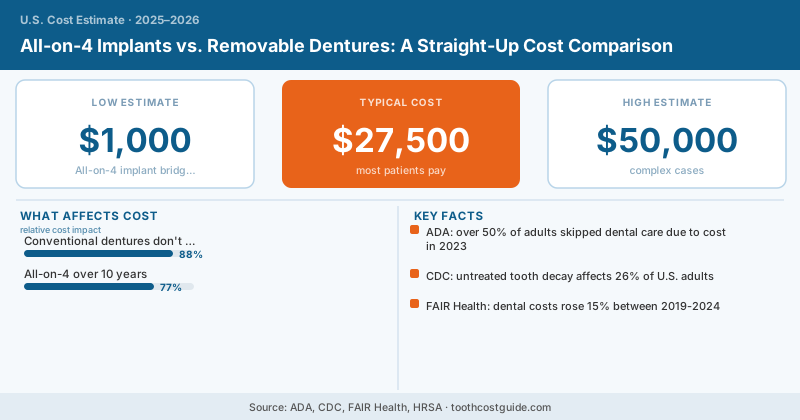
$1,200 vs. $28,000. That’s the upfront cost difference between conventional complete dentures and All-on-4 implants for one arch. For most people facing full tooth loss, that gap ends the conversation before it starts.
But the upfront number isn’t the real cost. Over a decade, the gap closes — and over a lifetime, it may reverse. More importantly, the quality-of-life difference between these two options is substantial enough that many patients who chose dentures for financial reasons spend the next decade wishing they’d found a way to finance the implants.
Here’s the straight math and the honest tradeoffs.
Upfront Cost
| Option | Cost Per Arch |
|---|---|
| Complete removable dentures (conventional) | $1,000–$3,000 |
| Implant-retained denture (snap-on, 2 implants) | $4,000–$10,000 |
| All-on-4 implant bridge (fixed) | $20,000–$35,000 |
| All-on-6 implant bridge (fixed) | $25,000–$40,000 |
| Zygomatic implants (severe bone loss cases) | $30,000–$50,000 |
All-on-4 means four implant posts anchor a fixed full-arch prosthesis — you can’t remove it. You eat, sleep, and brush it like natural teeth. Conventional dentures rest on the gum and are taken out nightly. The middle option — implant-retained dentures with 2–4 snaps — costs substantially less than All-on-4 while providing more stability than bare dentures.
The 10-Year Total Cost of Ownership
This is where the math shifts.
Conventional dentures don’t last forever. The American College of Prosthodontists recommends replacing complete dentures every 5–10 years as the jawbone resorbs and the fit changes. In the meantime, most denture wearers need professional relines every 2–3 years at $300–$500 each, plus periodic adjustments. That’s before accounting for the $50–$100/year in adhesives for patients who find their lower denture doesn’t stay put.
A realistic 10-year conventional denture cost per arch:
- Initial dentures: $1,500
- Reline at year 3: $400
- Reline at year 6: $400
- New dentures at year 8: $1,800
- Adhesive products, adjustments: $600
- Total: ~$4,700
All-on-4 over 10 years:
- Initial treatment: $28,000
- Annual hygiene appointments and cleanings: $200–$400/year
- Possible prosthesis adjustment: $200–$500 over 10 years
- Total: ~$30,500
The gap is still large. But spread $25,800 over 10 years and you’re paying roughly $215/month for implants vs. $39/month for dentures. That reframe matters when you’re evaluating financing.
The Bone Loss Problem Nobody Explains Upfront
Here’s what denture salespeople don’t prominently advertise: without tooth roots stimulating the jawbone, the bone resorbs. After a full extraction, the jawbone begins shrinking within months. After 10 years of full denture wear, many patients have lost a significant percentage of their original bone volume.
This matters for three reasons. First, it changes your facial appearance — bone loss causes the lower third of the face to collapse inward, creating the sunken look associated with long-term denture wearers. Second, it makes denture retention progressively harder, especially on the lower arch, which is why many 10-year denture wearers use large amounts of adhesive just to keep lower dentures in place. Third, if you ever want implants later, you may not have enough bone left to place them without expensive grafting — sometimes making All-on-4 impossible and requiring $5,000–$15,000 in bone reconstruction before implants can even begin.
Implants stop bone loss. The titanium post acts like a tooth root, preserving the jawbone through mechanical stimulation.
- Patients for whom the upfront cost of implants is genuinely unworkable, even with financing
- Elderly patients with significant medical comorbidities (diabetes, blood thinners, immunosuppressants) who face higher implant surgery risk
- Patients with severe bone loss and no appetite for the bone grafting process
- Those who want the lowest possible initial cost and can live with the lifestyle tradeoffs
- Patients under 70 with adequate bone volume and no major contraindications
- Anyone who values eating without restriction — implants allow you to eat virtually anything; dentures significantly limit diet
- Patients prioritizing long-term facial structure preservation
- Anyone whose career or social life would be meaningfully impacted by removable dentures
Quality of Life: The Data
A 2019 systematic review in Clinical Oral Implants Research found that All-on-4 patients scored significantly higher on oral health-related quality of life measures than conventional denture wearers, specifically in chewing efficiency, comfort, and confidence. Perhaps more telling: bite force with All-on-4 prostheses averages roughly 70–80% of natural dentition, compared to 20–25% with conventional complete dentures.
That difference shows up at every meal. Steak, raw carrots, corn on the cob — things most denture wearers quietly stop ordering at restaurants.
How to Make All-on-4 Affordable
CareCredit and dental payment plans are the most common financing routes. Most All-on-4 practices offer in-house payment plans. CareCredit’s 24-month 0% promotional financing on balances over $200 lets a $28,000 case run at $1,167/month — still steep, but manageable for patients with strong credit.
Dental schools with oral surgery residency programs perform All-on-4 at 40–60% below private practice costs, supervised by attending faculty. This is a legitimate option that many patients overlook.
FSA and HSA funds can be applied to implant treatment — helpful if your employer offers these accounts.
Finally, get quotes from at least three implant-focused practices. All-on-4 pricing varies by $10,000+ between practices in the same city, partly based on the prosthesis material (acrylic vs. zirconia) and partly on practice overhead.
The Bottom Line
Conventional dentures win on upfront cost. All-on-4 wins on everything else — chewing function, bone preservation, long-term stability, facial structure, and a 10-year cost curve that’s less dramatic than the initial numbers suggest. The right choice depends on your financial situation, age, health, and how much the quality-of-life gap matters to you. Just make sure you understand the bone loss consequences before you decide — that’s the piece most patients wish someone had explained clearly at the start.
Frequently Asked Questions
All-on-4 implants cost $20,000–$50,000 per arch, while complete dentures run $1,000–$3,000 upfront. However, over 10 years the total cost of ownership narrows significantly because dentures require ongoing adjustments, relines ($300–$600 each), and eventual replacements every 5–8 years, whereas All-on-4 implants have minimal maintenance costs after the initial placement.
Most dental insurance plans do not cover dental implants, including All-on-4, leaving patients responsible for the full $20,000–$50,000 cost out-of-pocket. Complete dentures may receive partial coverage (typically 50%) under some plans, reducing your out-of-pocket cost to $500–$1,500, though many plans classify dentures as cosmetic and cover nothing.
All-on-4 surgery typically takes 2–3 hours, and most patients return to soft foods within 1–2 weeks and gradually progress to normal eating over 3–6 months as the implants osseointegrate (fuse to the jawbone). In contrast, you can wear complete dentures immediately after fitting, though adjustment periods of 2–4 weeks are common for comfort and fit.