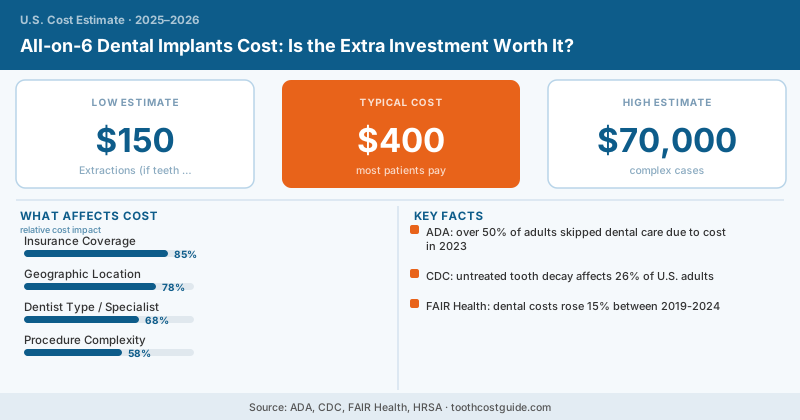
Most patients assume that going from All-on-4 to All-on-6 is simply “2 more implants, so 50% more money.” Wrong — the actual price difference is usually much smaller than that math suggests, typically just $3,000-$6,000 more per arch, not a proportional jump.
All-on-6 uses 6 implants per arch instead of 4 to support a full fixed prosthetic bridge. The extra 2 implants distribute chewing force across more anchor points, which many oral surgeons prefer for patients with strong bite forces, a history of teeth grinding, or bone density that makes 4 implants feel like a narrower margin of safety.
| Component | Typical Cost |
|---|---|
| All-on-6 per arch (implants, abutments, prosthetic) | $20,000–$35,000 |
| Both arches (upper and lower) | $40,000–$70,000 |
| All-on-4 for comparison, per arch | $15,000–$30,000 |
| Extractions (if teeth remain, per tooth) | $150–$650 |
| Bone grafting (if needed) | $300–$3,000+ |
| CBCT 3D imaging | $150–$400 |
Why the Cost Difference Isn’t as Large as You’d Expect
Most of the cost in a full-arch implant case comes from the surgical planning, the CBCT imaging, the anesthesia, and the custom-milled prosthetic bridge — not the implants themselves. Adding 2 more implants means 2 more fixtures and a slightly longer surgical appointment, but it doesn’t double the imaging, doesn’t require two separate prosthetics, and doesn’t multiply the anesthesia time proportionally. That’s why the total gap between All-on-4 and All-on-6 tends to run a few thousand dollars, not 50% more.
When Surgeons Actually Recommend 6 Implants Over 4
Higher bite force or bruxism history. Patients who grind their teeth heavily place more mechanical stress on the prosthetic and implants. Distributing that force across 6 anchor points instead of 4 can reduce stress concentration on any single implant.
Lower bone density in specific areas. If CBCT imaging shows adequate bone in more locations across the arch, a surgeon may prefer using more implants at more favorable sites rather than relying heavily on just 4, some of which may be angled to avoid the sinus or nerve.
Patient preference for redundancy. Some patients specifically want the added margin of safety that comes with more implants supporting the same prosthetic — if one implant were ever to fail, the load-bearing system has more remaining support than a 4-implant case would.
When All-on-4 Remains the Better Choice
All-on-4 was specifically engineered — using angled posterior implants to reach denser available bone — to work well even in patients with significant bone loss who might otherwise need extensive grafting to support 6 implants. For many patients, particularly those with lower bone volume from years of missing teeth, All-on-4’s angled placement avoids the need for grafting altogether, keeping both the surgical complexity and total cost lower.
Whether 4 or 6 implants is right for your specific jaw depends on bone density, sinus position, nerve location, and bite force — all visible on a CBCT scan. Be skeptical of any practice that recommends one approach as a blanket policy for every patient rather than basing the recommendation on your specific imaging. Ask to see your own scan and have the surgeon point out exactly why they’re recommending the implant count they’ve proposed.
Long-Term Considerations
Some research on full-arch implant outcomes suggests that force distribution across more implants may reduce certain mechanical complications, like screw loosening or prosthetic material fracture, over years of use — particularly relevant for patients who clench or grind. That said, both All-on-4 and All-on-6 have strong long-term success rates in the hands of an experienced surgeon; the “right” number of implants is more about matching the approach to your specific anatomy than treating extra implants as automatically superior.
Insurance and Financing
As with All-on-4, standard dental insurance rarely covers a meaningful portion of All-on-6’s total cost, given typical implant benefit caps of $1,000-$2,000. Financing considerations are identical: in-house payment plans, CareCredit, or medical credit lines are the norm, and FSA/HSA funds apply since the procedure is medically necessary tooth replacement, not cosmetic.
Don’t choose between All-on-4 and All-on-6 based on price alone. The few thousand dollars separating them is far less important than whether the implant count matches your specific bone density and bite force — a mismatch here risks implant failure and a far more expensive redo down the line.
The Bottom Line
All-on-6 costs $20,000-$35,000 per arch, typically just $3,000-$6,000 more than All-on-4 despite having 2 additional implants. The right choice between the two comes down to your CBCT imaging, bone density, and bite force — not a fixed rule that more implants is always better. Ask your surgeon to explain their recommendation using your specific scan before deciding.
Frequently Asked Questions
All-on-6 typically costs $20,000–$35,000 per arch, roughly $3,000–$6,000 more than All-on-4's $15,000–$30,000 range. The added cost reflects 2 additional implants, which usually requires more surgical time and sometimes more bone grafting depending on the patient's jaw structure.
Neither is universally 'better' — the right choice depends on individual bone density, jaw anatomy, and bite forces. All-on-6 distributes chewing force across more implants, which some surgeons prefer for patients with strong bite forces or lower bone density, while All-on-4 was specifically engineered to work well even with reduced bone volume using angled implant placement.
Not necessarily in every case, but distributing force across 6 implants instead of 4 can reduce the load on each individual implant, which some studies suggest may lower the risk of mechanical complications like screw loosening or prosthetic fracture over the long term, particularly in patients with bruxism (teeth grinding) or higher bite forces.