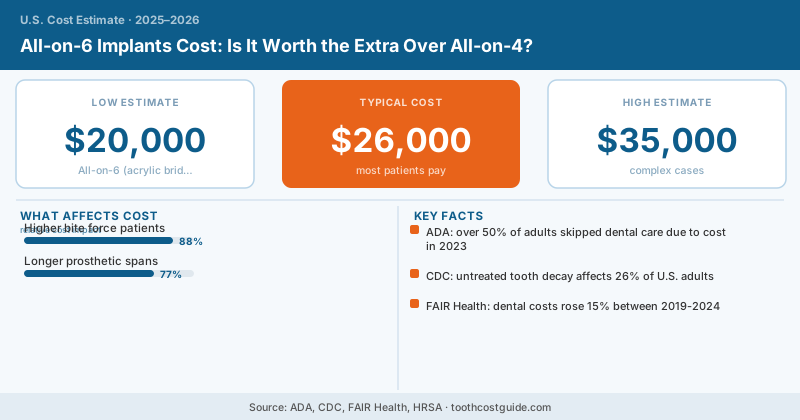
In 2010, a full-arch implant restoration required 6–8 implants and could run $50,000 per arch. Today, the All-on-4 technique brings that down to four implants and $20,000–$25,000. All-on-6 sits in the middle — two more implants, $4,000–$8,000 more per arch, and a specific subset of patients who genuinely benefit from the upgrade. Whether you’re in that subset depends on your bone volume, bite force, and what your CT scan actually shows.
All-on-6 vs. All-on-4: The Cost Comparison
| Option | Cost Per Arch | Full Mouth (Both Arches) |
|---|---|---|
| All-on-4 (acrylic bridge) | $20,000–$25,000 | $40,000–$50,000 |
| All-on-4 (zirconia bridge) | $24,000–$30,000 | $48,000–$60,000 |
| All-on-6 (acrylic bridge) | $24,000–$28,000 | $48,000–$56,000 |
| All-on-6 (zirconia bridge) | $28,000–$35,000 | $56,000–$70,000 |
The price difference between All-on-4 and All-on-6 comes down to two additional implants — roughly $2,000–$3,000 per implant in surgical and component costs — plus any incremental complexity in the prosthetic design. The bridge itself (whether acrylic or zirconia) is often the same regardless of implant count, so you’re paying mostly for more titanium posts and the surgical time to place them.
Geography matters more here than in most dental procedures. An All-on-6 in Manhattan or San Francisco can run $35,000+ per arch. The same implant count with equivalent materials in rural Tennessee or Kansas might come in at $22,000–$26,000. That’s a real difference worth a phone call or two.
Who Actually Needs Six Implants Instead of Four?
Honest answer from most implantologists: All-on-4 works for the majority of edentulous patients. But there are specific situations where six is the genuinely better clinical choice.
Patients with adequate posterior bone volume. All-on-4’s angled posterior implants are a workaround for patients with bone resorption who need to avoid the sinus and nerve. If you still have good posterior bone, placing two additional straight implants there distributes bite force more evenly — which may reduce long-term prosthetic stress over a 15–20 year span.
Higher bite force patients. Larger individuals, men with strong jaw musculature, and patients who grind at night put more mechanical stress on the prosthetic. More implants spreading that load matters over time.
Longer prosthetic spans. Some surgeons argue that a 14-unit bridge supported by six implants versus four has less flex under load, which protects the acrylic or zirconia from micro-fractures over the years.
Before agreeing to All-on-6, ask: “Would All-on-4 provide equivalent long-term outcomes for my specific bone anatomy?” If they can’t give you a clear clinical reason based on your CT scan, it may be a revenue decision rather than a clinical one. Get a second opinion from a different oral surgeon or prosthodontist.
Material Choice: Acrylic vs. Zirconia
This decision often matters more than the implant count. Acrylic bridges are lighter, easier to repair if a tooth chips, and less expensive. Zirconia bridges are harder, more natural-looking, and don’t stain — but if a tooth breaks, repair is more complicated and costly.
A zirconia bridge for All-on-6 is not a lifetime restoration without maintenance. Plan for prosthetic replacement or significant repair every 10–15 years. A $32,000 zirconia bridge that needs $8,000 in work at year 12 has a different real cost than a $24,000 acrylic bridge you can repair chairside for $500. Run those numbers before you commit to the premium material.
Financing All-on-6
At $28,000–$35,000 per arch, financing isn’t the exception — it’s the norm. CareCredit’s 24-month deferred interest period and Alphaeon Credit are the most common options at implant centers. Some practices offer in-house installment plans at 0% for 12–18 months for established patients.
A few oral surgery centers have started offering “implant savings plans” — prepaying for the surgical phase at a discount and financing the prosthetic phase separately. If you’re planning a full-mouth case, ask whether splitting the payment across surgical and prosthetic phases helps with cash flow.
For a deeper look at the baseline comparison, see our detailed guide on All-on-4 implants cost. And if you’re considering individual implants instead of a full-arch restoration, our dental implant cost guide covers per-tooth pricing.
Bottom Line
All-on-6 implants cost $24,000–$35,000 per arch, about $4,000–$8,000 more than a comparable All-on-4 case. For most patients with typical bone resorption, All-on-4 is clinically adequate. All-on-6 makes genuine sense for patients with good posterior bone, high bite forces, or when your surgeon has CT evidence supporting better load distribution with six implants. Don’t pay for the extra two without a clear, documented clinical rationale.
Frequently Asked Questions
All-on-6 implants cost $24,000–$35,000 per arch, while All-on-4 implants cost $20,000–$30,000 per arch, making All-on-6 about $4,000–$8,000 more expensive per arch. The extra cost covers two additional implants that provide enhanced stability and support for patients with specific bone and bite characteristics. Both options are significantly cheaper than the traditional 6–8 implant approach that cost around $50,000 per arch a decade ago.
Most dental insurance plans classify All-on-6 implants as a cosmetic or major procedure with limited or no coverage, leaving patients responsible for 50–100% of the cost out-of-pocket. Some plans may cover a portion of the abutment or crown restoration (typically 50%), but implant placement is rarely covered. It's essential to review your specific plan or contact your insurer before treatment, as coverage varies widely by policy and provider.
All-on-6 is ideal for patients with moderate bone loss, a strong bite force, or a history of implant problems who need extra stability that four implants cannot provide. The procedure typically takes 4–6 months from implant placement to final restoration, similar to All-on-4 timelines. Your dentist or oral surgeon will evaluate your bone volume and bite mechanics to determine if the upgrade is necessary or if All-on-4 will work for your situation.