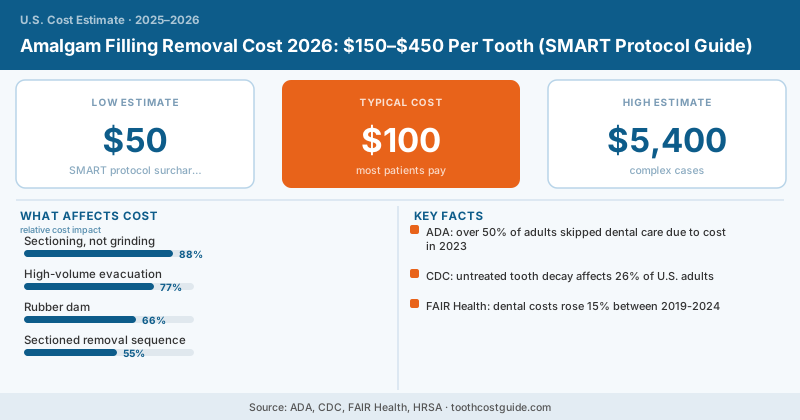
In 42 states, you can still get a new silver amalgam filling placed at a conventional dentist today. But millions of people want their old ones out. Amalgam removal costs $150–$450 per tooth — and the spread between those two numbers is almost entirely about safety protocol.
Here’s what’s actually worth paying for.
| Service | Conventional Dentist | SMART-Certified Dentist |
|---|---|---|
| Amalgam removal + composite (1-surface) | $150–$280 | $200–$350 |
| Amalgam removal + composite (2-surface) | $200–$350 | $280–$420 |
| Amalgam removal + composite (3-surface) | $250–$400 | $320–$450 |
| SMART protocol surcharge (per tooth) | Not offered | $50–$150 |
| Rubber dam (if not included) | $20–$50 | Typically included |
| Full mouth (6–12 fillings) | $900–$4,800 | $1,200–$5,400 |
| Emergency re-treatment (crown if needed) | $1,200–$2,000 | $1,200–$2,000 |
What Is the SMART Protocol?
SMART stands for Safe Mercury Amalgam Removal Technique. It was developed by the IAOMT — the International Academy of Oral Medicine and Toxicology — and published in peer-reviewed form. The core problem it addresses: drilling out an amalgam filling releases a burst of mercury vapor and fine particulate that the patient, dentist, and assistant can inhale.
The IAOMT’s SMART protocol requires specific precautions to minimize this exposure:
Sectioning, not grinding. SMART dentists cut amalgam into large chunks rather than grinding it down, which generates significantly less vapor and particulate.
High-volume evacuation. A specialized saliva ejector placed close to the tooth throughout the procedure. Some practices add an additional external air purifier or IQ Air unit running simultaneously.
Rubber dam. A latex or nitrile barrier isolating the tooth prevents amalgam particles from reaching the tongue and throat.
Sectioned removal sequence. Starting with the least contaminated quadrant and working toward the most affected, with patient protection maintained throughout.
Patient protection. Hair covering, full-body draping, nasal oxygen or a clean air source, and eye protection are all part of full SMART compliance.
A 2019 study published in Environmental Research found that mercury blood and urine levels in patients do temporarily increase following amalgam removal — underscoring why the technique matters if you’re going to remove them at all.
When Removal Is Clinically Indicated
- Existing amalgam filling is cracked, leaking, or has decay forming underneath it
- Adjacent tooth needs a crown or crown prep requires removal of the adjacent amalgam
- Patient has documented mercury sensitivity or allergy confirmed by testing
- Patients in high-risk FDA groups: pregnant women, children under 6, kidney impairment
- Cosmetic: replacement for visible front-tooth amalgams where appearance is a concern
The FDA’s 2020 safety guidance explicitly notes that “the existing data shows that current levels of mercury vapor in dental amalgam can cause health effects in these high-risk groups.” For everyone else, the guidance says that for people with existing amalgam fillings that aren’t in need of repair, removal isn’t recommended — because removal itself carries exposure risk.
Don’t let anyone pressure you into removing stable, intact amalgam fillings without a clinical reason. The risk-benefit equation genuinely doesn’t favor it for low-risk patients.
When Removal Is a Consumer Choice (Not Medical Necessity)
Many people remove amalgam fillings for reasons the dentistry community would classify as cosmetic or precautionary rather than medically necessary:
- They want white teeth throughout, including posterior teeth
- They prefer not to have mercury-containing material in their mouth for philosophical reasons
- They want to “detox” from amalgam before pregnancy
These are legitimate personal choices. They’re just not covered by insurance in the same way clinically-indicated replacement is. You’re paying out-of-pocket for a decision that mainstream medicine doesn’t classify as urgent.
What Insurance Actually Covers
Here’s how it typically plays out:
Your plan covers composite fillings at a percentage — often 50–80% — of their scheduled fee after your deductible. They don’t cover “removal of amalgam.” They cover “restoration placement.” So you get partial coverage on the composite being placed, not on the reason you’re replacing the old filling.
The SMART protocol surcharge, any IV supplementation or chelation add-ons, air purification, or specialized suction equipment: not covered. These are out-of-pocket.
If a biological dental practice recommends removing all your amalgam fillings in one session, be cautious. Multiple simultaneous removals generate cumulative mercury exposure. IAOMT’s own guidance recommends spacing removal over multiple visits, starting with the largest or most compromised fillings. Any practice offering a one-day “full mouth detox” is not following the SMART protocol they’re billing you for.
Quadrant-Based Removal — A Cost-Saving Approach
If you have multiple amalgam fillings and want them removed over time, quadrant-based scheduling is both clinically sensible and financially manageable:
- Quadrant removal: 2–4 fillings per session, one area of the mouth at a time
- Fewer mercury vapor bursts per visit
- More manageable per-visit cost ($300–$900 per quadrant vs. thousands at once)
- Allows time to recover between sessions
Plan for 2–4 appointments spread over several months if you have a full mouth of amalgam. Budget $1,500–$4,000 total at a SMART-certified practice.
Finding a SMART-Certified Dentist
The IAOMT maintains a searchable directory at iaomt.org. Look specifically for SMART certification — not just IAOMT membership, which doesn’t require SMART training. Ask the office directly: “Are you SMART-certified, and does your protocol include sectioning, rubber dam, high-volume evacuation, and patient oxygen?” If they can’t answer those questions specifically, look elsewhere.
For patients who also want ozone therapy or other biological dental services during the same appointments, SMART-certified biological practices typically offer the full range — often worth bundling to reduce the number of separate appointments.
Frequently Asked Questions
Standard amalgam removal with composite replacement runs $150–$300 per tooth at a conventional dentist. At a SMART-certified biological dentist using the full mercury-safe removal protocol, expect $200–$450 per tooth. Removing a full mouth of amalgam fillings — often 6–12 fillings — can run $1,200–$5,400 total depending on the number and size of fillings and whether you choose a conventional or SMART-certified practice.
Insurance typically covers the composite filling replacement at their scheduled rate — usually 50–80% of the composite cost after deductible. The SMART protocol surcharge, rubber dam placement, additional suction equipment, and any detox supplements are almost never covered. You're essentially paying out-of-pocket for the safety precautions even if the filling itself has partial coverage.
Intact, undisturbed amalgam fillings release very low levels of mercury vapor. The FDA's 2020 updated guidance recommends that high-risk groups (pregnant women, children under 6, people with kidney impairment, and those with mercury allergies) avoid unnecessary amalgam use and consider removal only if clinically indicated. For most adults with stable amalgam fillings, leaving them undisturbed is lower-risk than removal, which generates mercury vapor. If removal is needed for clinical reasons — cracking, decay under the filling, cosmetics — the SMART protocol minimizes exposure.