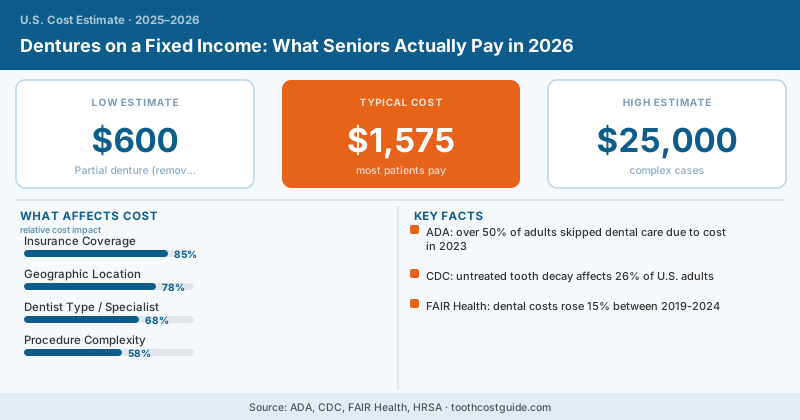
Martha is 74, lives on Social Security plus a small pension, and had been chewing on one side of her mouth for two years before she called a denturist. Her quote for a full upper and lower set: $3,400. Her first question wasn’t about the fit. It was “how am I supposed to pay for that?”
That question comes up constantly. Roughly 1 in 6 adults 65 and older in the US have lost all their natural teeth, according to CDC data — most managing that reality on Social Security, a pension, or both.
| Denture Type | Typical Cost (Per Arch) |
|---|---|
| Basic/economy full denture | $600–$1,200 |
| Standard full denture | $1,500–$3,000 |
| Premium/custom full denture | $3,000–$4,500 |
| Partial denture (removable) | $650–$2,500 |
| Immediate denture (same-day, before extractions heal) | $1,500–$3,500 |
| Implant-supported denture (per arch) | $6,000–$25,000+ |
Why Fixed-Income Budgets Struggle With Denture Pricing
Prices above are per arch, so a full set — upper and lower — often doubles the headline number people expect. A “standard” denture at $2,000 per arch becomes a $4,000 total bill, and extractions push the number higher still.
Medicare doesn’t help most seniors here. Original Medicare excludes routine dental care almost entirely, and while some Medicare Advantage plans added dental benefits after 2020, the coverage caps — usually $1,000–$2,000 a year — get consumed fast by extractions, exams, and the denture itself.
Where the Real Savings Are
Dental schools. Supervised students, licensed faculty overseeing every step, and fees 40–50% below private practice. The trade-off is time — expect more appointments and a longer timeline than a private denturist. Search the American Dental Education Association’s directory for a program near you.
Federally Qualified Health Centers (FQHCs). These clinics use a sliding fee scale tied to income. A senior on Social Security alone may qualify for the lowest tier, sometimes bringing a full denture down to a few hundred dollars.
State Medicaid dental benefits. Coverage varies enormously — some states cover dentures in full, others offer nothing for adults. Check your state Medicaid dental page directly; don’t assume based on what a neighboring state offers.
Denture-specific clinics (Affordable Dentures & Implants and similar regional chains) generally price lower than a general dentist’s office because dentures are their entire business model, not a side service.
Immediate dentures are placed the same day teeth are extracted, letting you avoid a toothless gap — but they typically need a professional reline 6–12 months later as your gums heal and shrink, adding $150–$450. Conventional dentures wait 6–8 weeks after extraction for full healing, which usually means a better long-term fit without the extra reline cost. If your budget is tight, ask your provider to price both paths.
Financing That Doesn’t Backfire
In-office payment plans. Many denturists will split a $3,000 bill into 6–12 monthly payments with no interest, since dentures don’t carry the same lab-cost risk as implants. Always ask before assuming you need a credit card.
CareCredit and similar medical credit cards. These work, but only if the balance is paid off inside the promotional 0% window. Deferred-interest terms mean a forgotten $2,000 balance can suddenly accrue interest from day one at 20%+ APR.
Local Lions Clubs and dental charities. Many chapters run “vision and dental” assistance programs specifically for low-income seniors. It costs nothing to ask.
Never sign a financing agreement the same day as your consultation under pressure. Take the written treatment plan home, and if a sales rep discourages you from “shopping around,” treat that as a signal to get a second opinion.
The Bottom Line
A full denture bill of $3,000–$4,500 feels impossible on a fixed income, but it’s rarely the only price on the table. Dental schools, FQHCs, and state Medicaid dental benefits routinely cut that number by half or more. Before agreeing to any quote, ask three questions: is this the school or nonprofit rate, does my state Medicaid plan cover any of this, and can the remaining balance be split into a no-interest payment plan? Those three questions alone can turn an unaffordable bill into a manageable one.
Frequently Asked Questions
A full set of conventional dentures (upper and lower) typically runs $1,500–$4,500, though basic sets from dental schools or nonprofit clinics can cost as little as $600–$1,200. Implant-supported dentures cost significantly more, often $6,000–$25,000+, and are rarely realistic for a strict fixed budget without financing or a payment plan.
Original Medicare (Parts A and B) does not cover dentures or routine dental care in almost all cases. Some Medicare Advantage plans include limited dental benefits, but annual caps of $1,000–$2,000 rarely cover a full denture case. Medicaid coverage for dentures varies significantly by state, with some states offering full coverage and others none.
Dental school clinics typically offer the lowest prices, often 40-50% below private practice rates, though treatment takes longer due to student supervision. Community health centers on a sliding fee scale and denture-specific clinics (as opposed to general dentists) are also usually less expensive than a full-service private practice.