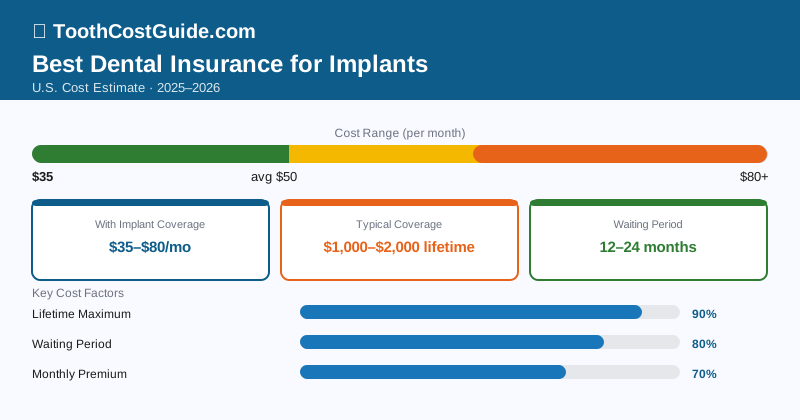
Here’s something nobody tells you when they say a dental plan “covers implants”: that phrase can mean a $2,000 reduction in your bill, or it can mean $500 off the crown while you’re still on the hook for the $2,000 titanium post going into your jaw. The difference matters enormously — we’re talking about a procedure that runs $3,000–$5,000 per tooth.
Only 30–40% of dental plans include any implant coverage at all. And of those, a meaningful chunk apply a “missing tooth clause” that disqualifies you before you even start. So before you pay premiums for an “implant-covering” plan, it’s worth spending fifteen minutes on the fine print.
| Plan | Monthly Premium | Covers Implants? | Missing Tooth Clause | Annual Max | Waiting Period |
|---|---|---|---|---|---|
| Spirit Dental Gold | $33–$45 | Yes (full) | No | $3,000 | None |
| Spirit Dental Platinum | $45–$57 | Yes (full) | No | $5,000 | None |
| Ameritas PrimeStar Advance | $40–$55 | Yes (full) | No (most states) | $1,500–$2,000 | 12 months |
| Delta Dental PPO Plus Premier | $40–$60 | Yes (some markets) | Varies by plan | $1,500–$2,000 | 12 months |
| Cigna Dental 1500 Plus | $45–$60 | Yes | Yes (most plans) | $1,500 | 12 months |
| Guardian Direct Diamond | $50–$70 | Yes | Check plan docs | $2,000 | 12 months |
| Humana Complete | $40–$58 | Sometimes | Yes | $1,500–$2,000 | 12 months |
| Standard PPO (most) | $25–$50 | No | Yes or N/A | $1,000–$2,000 | — |
Three Landmines Hidden in “Implant Coverage” Plans
You need to ask three specific questions before buying any plan marketed as covering implants. Miss one of them, and you might end up with a $4,000 surprise after the surgery is done.
Does it cover all three components — or just the crown?
An implant has three parts: the titanium post that goes into bone ($1,500–$2,000), the abutment that connects everything ($500–$800), and the crown on top ($1,000–$1,800). Some plans cover only the crown as a “prosthetic” while treating the post and abutment as excluded surgical procedures. That saves you $500–$900. A plan covering all three at 50% saves you $1,500–$2,500. Those are not the same thing.
Is there a missing tooth clause?
This one trips up a lot of people. If you’re buying dental insurance specifically because you have a gap where a tooth used to be, check whether the plan covers teeth that were already missing when you enrolled. Most insurers that include this clause won’t cover implant replacement of any pre-existing gaps. It’s the most common reason implant claims get denied on “implant-covering” plans.
Is the annual maximum high enough to matter?
A plan covers implants at 50%. Great. Now: what’s the annual maximum? If it’s $1,500, and the 50% benefit on your $4,000 implant would be $2,000, the plan only pays $1,500 — not $2,000. You’ve still been exposed to $2,500 of cost. High annual maximums aren’t a luxury feature for implant patients; they’re the whole ballgame.
Before buying any plan advertised as covering implants, ask three specific questions: (1) Does it cover the implant post, abutment, AND crown — or just the crown? (2) Is there a missing tooth clause that would exclude teeth already missing? (3) What is the annual maximum — will it actually cover 50% of a $4,000 implant?
The Plans Worth Your Time
Spirit Dental Gold and Platinum — No Other Plan Comes Close for Most Patients
Spirit is the only major carrier that checks all three boxes simultaneously: covers all implant components, no missing tooth clause (in most states), and no waiting period. The annual maximums — $3,000 on Gold, $5,000 on Platinum — are the highest in the individual market by a significant margin.
Run the real numbers on Spirit Gold for a single implant:
- Total implant cost: $4,200
- Plan pays 50% = $2,100 (safely under the $3,000 max)
- Annual premiums: $45 x 12 = $540
- Net savings compared to no coverage: $1,560
The Gold plan at $33–$45/month serves most patients well. Go Platinum ($45–$57/month) if you’re looking at multiple implants or expensive bone grafting on top of the implant work — that $5,000 ceiling gives you room.
Spirit uses a network of 130,000+ dentists nationally and is underwritten by Dentegra Insurance Company. Available in all 50 states. Verify the no-missing-tooth-clause applies in your state before enrolling.
Ameritas PrimeStar Advance — Best for Patients With Lead Time
If you’ve got 12+ months before you need an implant, Ameritas competes seriously with Spirit. It covers the full implant (post, abutment, crown) at 50% after the waiting period. No missing tooth clause on the Advance tier in most states. Annual max starts at $1,500 and increases in subsequent years. Premiums run $40–$55 depending on location.
The catch: that 12-month wait. If your oral surgeon is ready to schedule your implant in six months, this plan won’t help you.
Delta Dental PPO Plus Premier — Strongest Network, Moderate Coverage
Delta Dental’s top-tier individual plans cover implants in many (not all) markets after a 12-month wait. The real advantage here is the network — 155,000+ participating dentists is unmatched. If your oral surgeon is Delta Dental in-network, the negotiated fee savings can be substantial on top of the 50% coverage.
Check two things before enrolling: whether the specific plan in your state includes a missing tooth clause, and whether your oral surgeon is PPO-network (not just Premier-network, which has different fee schedules).
Cigna Dental 1500 Plus — Solid but Clause-Limited
Cigna’s higher-tier plans do cover implants at 50% after 12 months. The missing tooth clause is the issue — most Cigna plans have it, which makes this a poor fit for patients replacing existing gaps. Good option for patients whose future tooth loss happens during active coverage. Network of 90,000+ dentists. Annual max is $1,500, which limits real-world payout to a single implant per year.
Guardian Direct Diamond — Comprehensive but Pricier
Guardian’s premium tier covers implants at 50% with a $2,000 annual max. At $50–$70/month, it’s one of the more expensive options, but the coverage is solid. Check plan documents specifically for missing tooth clause language in your state.
What to skip:
Low-premium plans under $30/month almost universally either exclude implants entirely or offer crown-only coverage. Dental HMOs rarely cover implants at all — their copay schedules don’t include implant placement. And any plan with a $1,000 annual maximum is essentially useless for implants: after your two cleanings eat $150–$200 of that cap, you’ve got $800 left to apply to a procedure that costs $3,000–$5,000.
Making Your Coverage Work Harder
Split procedures across two policy years. Implant placement typically happens in two stages months apart — the post first, then the crown after osseointegration. If your plan has a $2,000 annual max, schedule the post and abutment in December (Year 1) and the crown in January (Year 2). You’ve just accessed two full annual maximums for a single implant. Theoretical combined benefit: up to $4,000.
Get a predetermination before you commit to anything. Your oral surgeon or dentist can submit the full treatment plan to your insurer before any work begins. The predetermination response tells you exactly what they’ll cover, what they won’t, and what your out-of-pocket will be. It’s not binding, but it eliminates surprises and gives you documentation if anything gets disputed later.
Check your bone graft situation. A significant percentage of implant cases require bone grafting first — often $300–$3,000 depending on extent. Bone grafts may be categorized differently than the implant itself and could have separate coverage rules. Ask your insurer specifically about bone graft coverage before scheduling.
Pair remaining costs with HSA dollars. Implants are qualified medical expenses. If you’ve got an HSA, pay your out-of-pocket portion (the 50% not covered) with pre-tax dollars. At a 22% marginal rate, that’s roughly $440 off every $2,000 in implant costs.
Even the best implant insurance plans won’t cover full-arch implant procedures (All-on-4, All-on-6) comprehensively. These procedures cost $20,000–$50,000 per arch. Insurance annual maximums of $1,500–$5,000 cover only a fraction of full-arch costs. For extensive implant rehabilitation, dental school clinics and third-party financing (CareCredit, etc.) are more practical solutions than insurance.
Who Should Enroll Right Now
If your dentist has told you that you’ll probably need an implant — whether due to a fracture, a failing root canal, or anything else — start your waiting period clock today. Even if surgery is 14 months away, 12 of those months can be spent satisfying a waiting period while you’re paying modest premiums. Waiting until you need it urgently forces you into Spirit Dental’s premium no-wait tier.
People with partial dentures who want to convert to implant-supported restorations should specifically seek plans without missing tooth clauses. Most of your teeth are already gone — a missing tooth clause would eliminate coverage for every single implant.
Adults in their 40s and 50s managing long-term dental health proactively: the actuarial likelihood of needing at least one implant in the next two decades is high. Paying $400–$550/year now to maintain implant coverage is reasonable insurance against a $4,000+ future expense.
Spirit Dental Gold or Platinum is the best dental insurance for implant coverage for most patients — no waiting periods, no missing tooth clause, and annual maximums of $3,000–$5,000 that can actually cover a meaningful portion of implant costs. For patients with 12+ months before they need an implant, Ameritas PrimeStar Advance and Delta Dental PPO Plus Premier offer solid coverage at slightly lower premiums.
Putting It Together
Finding actual implant coverage — not the crown-only version, not the missing-tooth-clause version — comes down to reading the fine print rather than the marketing headline. Spirit Dental’s Gold and Platinum plans are the strongest overall options because they eliminate all three landmines: no missing tooth clause, no waiting period, and annual maximums high enough to pay a meaningful portion of real implant costs.
For patients with time before the procedure, Ameritas PrimeStar Advance and Delta Dental PPO Plus Premier offer competitive 50% coverage with broader networks. Just confirm the missing tooth clause status before enrolling in either.
For single implants, the right plan saves $1,500–$2,500 out of pocket. For multiple implants, splitting procedures across policy years and targeting Spirit Platinum’s $5,000 annual maximum can dramatically reduce your total exposure. Run the actual numbers — you’ll find the math usually lands clearly in favor of quality implant coverage over going uninsured.
Frequently Asked Questions
A single dental implant typically costs $3,000–$5,000 per tooth in the US, with the breakdown roughly $1,500–$2,000 for the titanium post (fixture), $800–$1,500 for the abutment, and $800–$1,500 for the crown. Full-mouth implants (4–6 teeth) can range $15,000–$30,000 or more depending on bone grafting needs and your location.
Only 30–40% of US dental plans include any implant coverage at all, and those that do typically cover just 50% of costs after a 12-month waiting period, saving patients $1,500–$2,500 per tooth. Many plans that claim to cover implants only pay for the crown portion while leaving you responsible for the $2,000 titanium post, making the phrase 'implant coverage' misleading without careful policy review.
You typically need to wait 3–6 months after tooth extraction before implant placement to allow the jawbone to heal and stabilize, though some cases allow placement immediately after extraction. The entire implant process (extraction, placement, osseointegration, and crown placement) usually takes 6–12 months total, and your dentist may recommend bone grafting if you lack sufficient jaw density, which adds 4–6 months to the timeline.