Your dentist just told you that old filling isn’t going to hold much longer, and a crown is coming. You call around about dental insurance and discover that most plans won’t pay for a crown until you’ve been enrolled for 12 months. So you can either wait a year — hoping the tooth holds — or pay $1,500 out of pocket right now.
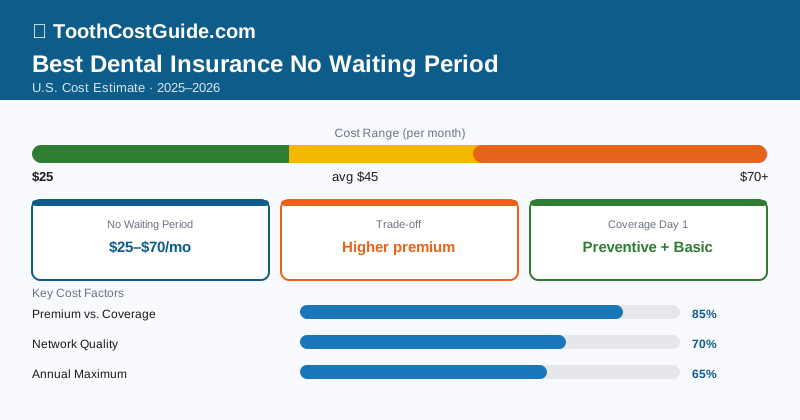
There’s a third option. No-waiting-period dental plans cover major work from the first day the policy is active. You can enroll Monday and get a crown Wednesday. These plans cost $10–$30 more per month than comparable waiting-period plans, and for most people with imminent dental needs, that premium difference is recovered with the savings on a single procedure.
| Plan | Monthly Premium | Annual Max | Major Work Coverage | No-Wait Guarantee |
|---|---|---|---|---|
| Spirit Dental Gold | $33–$45 | $3,000 | 50% (Year 1) | Yes, all services |
| Spirit Dental Platinum | $45–$57 | $5,000 | 50% (Year 1) | Yes, all services |
| Ameritas PrimeStar Advance | $38–$55 | $1,500 | 50% (Year 1) | Yes, most states |
| Cigna Dental Loyalty Plus | $35–$55 | $1,000–$1,500 | 50% (Year 1) | Select markets |
| Humana Loyalty Plus | $30–$50 | $1,000–$2,000 | 50% (Year 1) | Select states |
| Delta Dental (select plans) | $40–$60 | $1,500–$2,000 | 50% (Year 1) | Plan-specific |
The Mechanics of No-Wait Plans
A true no-waiting-period dental plan covers all service categories from the policy effective date. Preventive, basic (fillings), and major (crowns, bridges, root canals) — all of it starts on day one. There’s no tier-based waiting, no special class of procedures that stays locked.
What still applies:
- Annual maximums — you’re limited to whatever the plan’s yearly cap is
- Coinsurance — you typically still pay 50% of major work, 20% of basic
- Deductibles on some plans (check each one)
- Orthodontic waiting periods — even “no-wait” plans often maintain ortho waiting periods separately
Why these plans charge more: Without waiting periods, insurers can’t filter out adverse selection — people who sign up already knowing they need expensive work. Instead of a waiting period, they charge higher premiums to compensate for that risk. The extra $10–$30 per month essentially buys the right to use coverage immediately rather than waiting.
Watch out for “graduated first-year” plans. Some plans say “no waiting periods” but actually just reduced your first-year benefit instead of making you wait. You get 25% coverage on major work in year one, 40% in year two, 50% in year three. Technically no waiting period — but practically speaking, you’re getting much less in the first year when you probably need it most. A genuine no-wait plan gives you 50% coverage on major work starting with your first claim.
If you need a $1,500 crown within the next few months, a no-waiting-period plan at $55/month saves you approximately $750 (50% of the crown cost) minus $55–$110 in premiums — a net savings of $640–$695 vs. paying out of pocket and switching to a cheaper plan later.
Plans Worth Considering
Spirit Dental & Vision
Spirit is the most widely recognized no-wait carrier on the individual market. Three tiers:
Bright (~$22–$33/month): Covers preventive from day one at 100%. Basic and major still have 12-month waits. This is NOT a true no-wait plan for major work — don’t be misled by the Spirit name here.
Gold (~$33–$45/month): This is the one. No waiting periods for any tier. $3,000 annual maximum. 50% major, 80% basic, 100% preventive. No missing tooth clause on most plans. Available in all 50 states; 130,000+ dentists in network. Underwritten by Dentegra Insurance Company.
Platinum (~$45–$57/month): Same no-wait structure with a $5,000 annual maximum. Significantly better protection for patients with multiple upcoming procedures — you won’t hit the cap after one crown.
Spirit Gold is the benchmark. Most other no-wait plans are measured against it.
Ameritas PrimeStar Advance
Available in most states at $38–$55/month. The Advance tier waives waiting periods for preventive, basic, and major. Annual maximum of $1,500 in year one, increasing in subsequent years. Network is strong through Ameritas’s Delta Dental relationship in many states. Some tiers include orthodontic coverage without waiting periods. Good choice if you want a broader network and Ameritas is well-represented in your area.
Cigna Dental Loyalty Plus
Cigna’s no-wait option at $35–$55/month. Covers all service tiers from day one. Annual max $1,000–$1,500 — lower than Spirit, which limits protection if you need multiple procedures. Network of 90,000+ Cigna dentists. Available in select markets. Best when your preferred dentist is already Cigna in-network.
Humana Loyalty Plus
$30–$50/month; no waiting periods; $1,000–$2,000 annual max depending on tier; same 100/80/50 structure for preventive/basic/major. Available in select states, not nationwide. Humana’s network — 277,000+ dentists — is actually the largest of any carrier by raw count. Worth checking if you’re in a state where Humana Loyalty Plus is offered.
Renaissance Dental
$25–$55/month; some plans eliminate waits on basic services and shorten major waiting periods to 0–3 months. Annual max $1,000–$2,000. Good regional availability. Not as clean a “true no-wait” as Spirit, but useful in some markets.
Is a No-Wait Plan Right for You?
The decision comes down to a simple calculation. Here’s how to run it:
- Estimate your likely dental costs in the next 12 months (get a treatment plan from your dentist if you can)
- Find the premium difference between a no-wait plan and a comparable waiting-period plan (usually $10–$30/month)
- Calculate what the no-wait plan would actually save you on your anticipated procedures
If you need a crown: 50% of $1,500 = $750 in savings. Minus $20/month premium difference = $240/year extra in premiums. Net benefit of going no-wait: $510.
If you only need cleanings: The premium difference isn’t offset by any coverage advantage, since cleanings are covered the same on both plan types. Stick with the cheaper plan.
The math almost always points clearly one way or the other. Don’t let “I might need something” override “I actually need X.”
Who no-wait plans are clearly right for:
- Anyone who just got a treatment plan from their dentist with near-term major work
- People re-entering dental coverage after a gap (standard plans restart your waiting periods)
- Self-employed people between insurance situations who want immediate coverage
- Seniors transitioning off employer dental who can’t wait a year
- People who’ve been avoiding the dentist and know they’ve got accumulating issues
Who doesn’t need to pay the premium:
- People current on their dental care with clean bills of health — save the premium difference
- Anyone whose employer plan already provides coverage without a waiting period
One More Thing to Verify
Before you enroll, ask for the actual benefits schedule — not just the marketing summary. You want to see in writing that year-one major work is covered at 50%, not a graduated benefit schedule dressed up as “no waiting period.” This is especially important for plans from carriers you haven’t heard of. Spirit, Ameritas, Cigna, and Humana are established carriers where you can verify this easily. With lesser-known plans, read before you buy.
Verify the specific plan documents before assuming coverage is truly immediate. Some plans advertise “no waiting periods” in marketing materials but have fine print showing reduced year-one coverage percentages. Request a sample benefits schedule and read it before enrolling.
Spirit Dental Gold ($33–$45/month, $3,000 annual max) is the strongest no-waiting-period dental plan for most adults — no missing tooth clause, true day-one coverage for all services, and an annual maximum high enough to actually cover major work. If you need dental work in the next 6 months, run the numbers: the premium difference is almost always recovered with savings on even a single crown or multi-filling visit.
The Bottom Line
No-wait dental insurance makes financial sense when you have real near-term dental needs. Spirit Dental Gold is the strongest option for most patients — true day-one coverage for all service tiers, a $3,000 annual maximum that’s double or triple the competition, no missing tooth clause. Ameritas and Humana are solid alternatives where their networks are stronger.
If you’re purely trying to cover future unknowns and you’re currently in good dental health, a waiting-period plan at $10–$20 less per month is probably the better value. But if your dentist has told you something’s coming — don’t let a waiting period be the reason you pay full price.
Frequently Asked Questions
A single dental crown typically costs $1,200–$2,500 out of pocket, depending on the material (porcelain, ceramic, or gold) and your location. With no-waiting-period insurance, you can reduce this to 50% coinsurance after meeting your deductible, bringing your share to $600–$1,250 for the same procedure.
Yes, no-waiting-period plans from carriers like Spirit and Ameritas cover major restorative work from day one of enrollment, unlike traditional plans that impose 6–12 month waiting periods. These plans typically cost $30–$60 per month and cover major procedures at 50% after you meet your annual deductible (usually $50–$150).
You can schedule your crown appointment immediately after your coverage becomes active, which is typically the first of the month following enrollment. Most dental offices can complete crown placement within 1–2 weeks once you have active insurance and have met any applicable deductible.