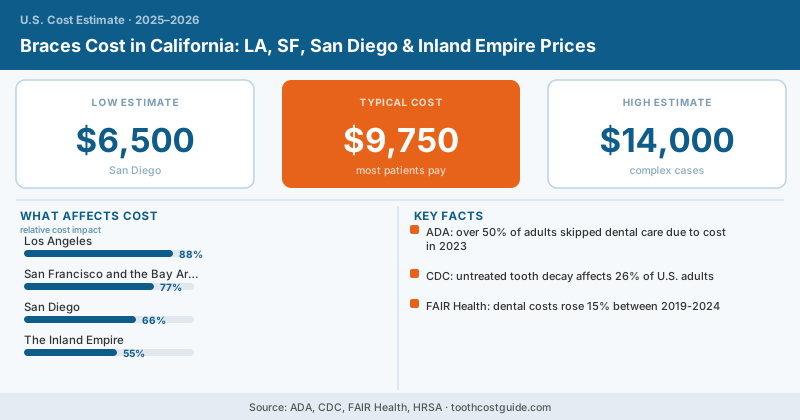
In 2010, a full course of traditional metal braces in California cost about $4,200. In 2025, the same treatment runs $5,500–$7,500 in Los Angeles and $6,000–$9,000 in San Francisco. That’s 30–40% price growth in 15 years — outpacing inflation, driven by rising overhead, specialist demand, and California’s general cost structure.
The AAO (American Association of Orthodontists) reported in 2024 that the national average for comprehensive orthodontic treatment is $5,000–$6,000, but California consistently runs 20–30% above that. Here’s a full regional breakdown and your realistic options for keeping costs manageable.
California Braces Prices by Region
| Region | Metal Braces | Ceramic Braces | Lingual Braces |
|---|---|---|---|
| San Francisco / Bay Area | $6,000–$9,000 | $7,000–$10,500 | $9,000–$14,000 |
| Los Angeles (Westside) | $5,500–$8,500 | $6,500–$9,500 | $8,500–$13,500 |
| Los Angeles (San Fernando Valley) | $4,500–$7,000 | $5,500–$8,000 | $7,500–$12,000 |
| San Diego | $4,500–$7,500 | $5,500–$8,500 | $7,500–$12,000 |
| Sacramento | $4,200–$6,500 | $5,000–$7,500 | $7,000–$11,500 |
| Inland Empire (Riverside / San Bernardino) | $4,000–$6,500 | $4,800–$7,500 | $6,500–$11,000 |
| Central Valley (Fresno / Bakersfield) | $3,800–$6,000 | $4,500–$7,000 | $6,500–$10,500 |
| UC / CSU orthodontic clinics (supervised) | $2,500–$4,500 | $3,000–$5,000 | n/a |
These prices are for comprehensive treatment (full mouth, typically 18–24 months). Retainers are usually not included — add $400–$900 for a set of fixed and removable retainers after treatment.
LA vs. San Francisco vs. San Diego vs. Inland Empire
These four markets have distinct dynamics:
Los Angeles has the widest price range of any California region because of its size. Westside and South Bay orthodontists (Santa Monica, Manhattan Beach, Brentwood) charge premium rates comparable to SF. The San Fernando Valley — despite being part of the same metro — runs 15–25% lower. Same board-certified orthodontists, lower overhead, lower fees.
San Francisco and the Bay Area is consistently the most expensive California orthodontic market. The combination of extreme commercial real estate costs, the highest dental staff wages in the state, and a patient population with above-average ability to pay creates fees at the upper end of the national range. $6,000–$9,000 for metal braces is genuinely common here for comprehensive treatment.
San Diego runs closer to LA Valley pricing than SF pricing — still above the national average, but more competitive. The corridor from Mission Valley through Chula Vista to Escondido has a high density of orthodontists with competitive pricing. The proximity to Tijuana also gives San Diego patients the most accessible dental tourism option in California.
The Inland Empire (Riverside and San Bernardino Counties) is California’s value orthodontics market. Lower commercial rents, more price-sensitive patient populations, and strong competition among practices keep pricing closer to national averages. A comprehensive treatment that costs $7,500 in Santa Monica runs $4,500–$5,500 in Rancho Cucamonga or Corona. The Inland Empire is worth considering for LA residents who drive and prioritize cost.
In California, orthodontic treatment is technically available from general dentists who’ve completed additional training, but most comprehensive treatment is done by board-certified orthodontists — dentists who completed a 2–3 year orthodontic residency after dental school. Orthodontists’ fees are typically 10–20% higher than general dentists doing ortho. For comprehensive cases involving significant tooth movement, the specialty training usually justifies the premium. For minor alignment correction, a general dentist with orthodontic training may be appropriate.
Denti-Cal for Kids: What California’s Medicaid Program Covers
California’s Medi-Cal dental program (Denti-Cal) is more generous than most state Medicaid dental programs, and orthodontics is one area where it offers meaningful coverage — but only for children under 21 with a Handicapping Labio-lingual Deviation (HLD) score above a threshold that indicates medical necessity.
Practical translation: severe crowding, significant bite problems, and major skeletal discrepancies qualify. Purely cosmetic alignment improvements don’t. An orthodontic screening determines eligibility.
For Denti-Cal-eligible children in California:
- Covered orthodontic providers must be enrolled Denti-Cal providers
- Treatment is covered at no cost to the family
- Wait times for Denti-Cal orthodontic providers can be significant — demand exceeds supply in many regions
To find Denti-Cal orthodontic providers, use the Medi-Cal website’s provider search tool or call 1-800-322-6384. UCLA, USC, UCSF, and UCSOP all accept Denti-Cal for covered orthodontic treatment.
For adults on Medi-Cal, orthodontic coverage does not exist. Adult braces are entirely out-of-pocket.
University Orthodontic Clinics in California
Graduate orthodontic programs are the most reliable way to get significantly reduced braces in California. Graduate residents perform treatment under faculty supervision — often with more thorough diagnostic workup than a private office, and at 40–60% below private practice fees.
UCLA Orthodontic Clinic (Westwood): Graduate residents provide comprehensive orthodontic treatment at approximately $2,800–$4,500 for metal braces, $3,200–$5,200 for ceramics. Wait lists exist — initial screening appointments can be booked 4–10 weeks out.
USC Herman Ostrow Orthodontic Clinic (University Park): Similar pricing to UCLA. Graduate program in orthodontics supervised by full-time faculty. Cases with complex craniofacial issues are particularly welcome, as they provide training value.
UCSF Orthodontic Clinic (San Francisco): Graduate residency program. Pricing $3,000–$4,800 for comprehensive treatment. San Francisco’s high cost of living is partially offset — but not eliminated — by the teaching model.
University of the Pacific Arthur Dugoni Orthodontic Clinic (San Francisco and Stockton): Undergraduate dental students (under close supervision) and graduate orthodontic residents treat patients. Among the most affordable options in Northern California.
Loma Linda University Orthodontic Clinic (Inland Empire): Excellent option for Inland Empire and LA patients. Graduate program with competitive pricing, typically $2,500–$4,000.
For more on dental school options and how these clinics work, see our dental school clinics guide.
Insurance Coverage for Braces in California
Most California PPO dental plans include an orthodontic benefit, typically structured as:
- Lifetime maximum of $1,000–$2,000 per person for orthodontic treatment (separate from the annual dental maximum)
- Coverage at 50% of the orthodontist’s fee, up to the lifetime maximum
- Usually limited to children under 18 or 19; some plans cover adults
For a $6,000 treatment in LA: insurance lifetime maximum of $1,500 at 50% saves $750. Out-of-pocket: $5,250. Not dramatic, but it’s something.
Plans through Covered California (individual/family market) vary significantly in orthodontic benefits. Pediatric orthodontics is required by the ACA for children’s dental plans, but adult orthodontic coverage is not.
To maximize your benefit: Orthodontic treatment is often spread over multiple years. Check whether your plan’s lifetime maximum applies to the first payment or is spread proportionally. Some plans pay 50% of the contract amount upfront (to the orthodontist’s retention account), while others pay per visit.
When to Start Treatment: Timing That Saves Money
The Academy of General Dentistry recommends an orthodontic evaluation at age 7 — not to start treatment necessarily, but to identify issues early. Starting treatment at the optimal age (usually 10–14 for comprehensive treatment) avoids more complex and expensive interventions later.
For adults, there’s no wrong time to start, but there is a strategic timing consideration: if you have dental insurance with an orthodontic lifetime benefit you’ve never used, using it now is better than losing it. Unlike annual dental benefits, orthodontic lifetime maximums don’t reset.
Treatment start timing also matters seasonally. Summer (June–August) is when California orthodontists’ schedules are busiest and discounting is rare. January–March is typically slower — some practices offer $200–$500 off contract fees for patients who start in slower months. It’s worth asking.
California orthodontic “discount plans” and third-party orthodontic membership programs have proliferated. Some are legitimate savings vehicles; others are just prepaid treatment plans marketed as discounts. Before enrolling in any membership program, compare the discounted fees against quoted prices from 2–3 practices in your area. Often the “discount” is off an artificially high starting price.
How California Braces Compare to Invisalign
Traditional braces are generally less expensive than Invisalign for comprehensive cases in California — by $1,000–$2,500 depending on the practice. Metal braces at $5,500 vs. Invisalign Full at $6,500–$8,500 is a typical LA comparison. For mild-to-moderate cases, Invisalign Lite or similar limited-scope aligners can cost less than full braces — but only if the clinical case supports a limited-scope approach.
If cost is your primary concern and you have a comprehensive case (significant crowding, bite correction needed), traditional metal braces remain the more affordable choice. For mild alignment issues, Invisalign’s limited versions can be competitive on price while offering the cosmetic advantage.
The bottom line for California: you’re going to pay more for braces here than in most of the country — that’s simply the cost of doing business in the state. But the Inland Empire, Central Valley, and university orthodontic clinics offer meaningful relief, and Denti-Cal provides real coverage for kids who qualify.
Frequently Asked Questions
Braces in California cost $5,500–$9,000 depending on location and complexity. Los Angeles typically ranges $5,500–$7,500, while San Francisco averages $6,000–$9,000, which is 20–30% higher than the national average of $4,000–$6,000.
Denti-Cal covers orthodontic treatment for children under 21 if medically necessary, typically paying 50% of approved costs after you meet the deductible. Out-of-pocket costs usually range $1,500–$3,500 depending on your plan and the severity of the case.
Traditional metal braces typically take 18–24 months to complete treatment, though complex cases may extend to 3 years. Treatment time depends on the severity of misalignment, age, and how well you follow care instructions like wearing rubber bands and maintaining good oral hygiene.