Picture this: the orthodontist lays your X-rays on the light board, points to the cluster of overlapping teeth, and says, “You’ve got significant crowding.” For millions of patients, that’s where the cost anxiety begins. Here’s the honest breakdown.
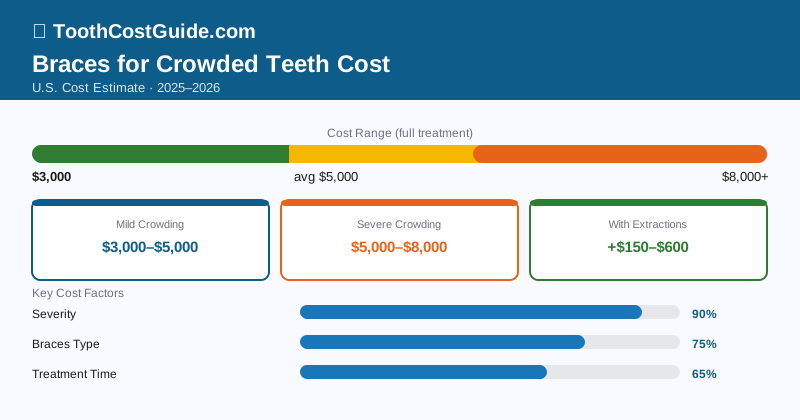
Correcting crowded teeth runs $3,000–$8,000 for comprehensive orthodontic treatment. Severity is the biggest variable — whether you need a tooth pulled, whether your child’s jaw is still growing, and whether a palate expander needs to enter the picture all shift the final number. The good news: crowding is the most common orthodontic problem in the country, and orthodontists treat it every single day.
| Crowding Severity & Treatment | Cost Without Insurance |
|---|---|
| Mild crowding — braces or Invisalign | $3,000–$5,500 |
| Moderate crowding — comprehensive braces | $3,500–$7,000 |
| Severe crowding — braces + possible extraction | $4,000–$8,000 |
| Tooth extraction (per tooth, if needed) | $150–$300 each |
| Palate expander (if needed for arch width) | $1,000–$2,500 (often included) |
| Invisalign for mild-moderate crowding | $3,000–$7,000 |
| Dental school treatment | $1,500–$4,000 |
The Millimeter Problem
Orthodontists measure crowding in millimeters — specifically the gap between how much arch space exists and how much space your teeth actually need. That number determines almost everything: treatment length, whether extractions enter the conversation, and ultimately what you’ll pay.
1–4mm of crowding (mild): A few teeth slightly rotated, maybe some minor front-tooth overlap. Most patients in this range finish treatment in 12–18 months. Clear aligners work beautifully here. No extractions needed. Expect to pay $3,000–$5,500.
4–8mm of crowding (moderate): This is where the fork-in-the-road moment happens. Some orthodontists will recommend arch expansion — especially for patients who are still growing. Others lean toward extracting a premolar on each side to create space. Treatment runs 18–24 months and costs $3,500–$7,000.
8mm+ of crowding (severe): Multiple teeth significantly out of position, sometimes with impacted canines that haven’t erupted at all. Nearly always involves either extractions or surgical arch expansion in adults. Plan for 24–36 months of treatment and costs from $4,500–$8,000+.
Impacted canines: A category of their own. When an upper canine gets stuck beneath the gum due to severe crowding, an oral surgeon has to surgically expose it before the orthodontist can guide it into the arch. The oral surgery fee adds $500–$2,500 on top of the comprehensive braces cost.
Extractions: Necessary or Not?
Few orthodontic debates generate more disagreement than this one. If your orthodontist recommends pulling premolars, know that a second opinion is entirely reasonable before you agree. Here’s where each side stands:
The case for extraction: When there genuinely isn’t enough arch length to fit all the teeth, extraction creates space predictably. Trying to fit ten pounds of teeth into a five-pound arch risks flaring the front teeth forward and increasing relapse chances.
The case against: In growing children especially, palate expansion creates more arch space without permanently removing teeth. Modern orthodontic wires and techniques also allow many moderate cases to resolve without extraction that older methods couldn’t. Some research — though contested — suggests extraction may influence facial profile.
What this means for you: If extraction is on the table, see at least two orthodontists and ask each to walk you through the clinical reasoning for your specific measurements. Extraction and non-extraction cases run similar total costs, but extraction adds appointments and recovery time.
Extractions for crowding are not automatic — many moderate cases are successfully treated without extraction through arch development, especially in growing patients. Get multiple opinions on whether extraction is truly necessary before proceeding. Extraction cases and non-extraction cases have similar total costs, but extractions add visits and recovery time.
Children vs. Adults: Why Timing Changes Everything
Treat a growing child with moderate crowding and you’ve got options. Treat an adult with the same case and those options narrow considerably.
Growing kids (roughly ages 11–14): The jaw bones respond to expansion forces. A palate expander can widen the upper arch over 6–12 months, creating room without any extraction. Comprehensive braces afterward can then align the teeth into the expanded arch. Treating during peak growth often means better outcomes at lower total cost than waiting until adulthood.
Adults: Once growth is complete, the bone doesn’t respond to expansion the same way. Moderate-to-severe crowding in adults more often requires either premolar extractions or some acceptance that the final alignment won’t be quite as ideal as an earlier-treated case. Adults also have more gum recession and bone density considerations that make complex movements slightly riskier.
Does Invisalign Work for Crowding?
For mild-to-moderate crowding, yes — and it’s often the preferred choice for adults who don’t want visible brackets.
- Up to 4mm crowding: Excellent outcomes with Invisalign Lite or Comprehensive
- 4–7mm crowding: Effective with Invisalign Comprehensive; small tooth-colored attachments bonded to the teeth improve control of tricky rotations
- 7mm+ crowding: Traditional braces generally win here for predictability; severe rotations in particular are harder to manage with removable aligners
If extractions are needed, Invisalign can be used after the teeth are pulled — but many orthodontists still prefer fixed braces for extraction-based treatment because of better control over closing the extraction spaces.
What Insurance Pays
Standard dental insurance orthodontic benefits work the same for crowding treatment as any other orthodontic case:
- Lifetime maximum: $1,000–$3,000 (varies widely by plan)
- Coverage level: 50% of the fee, up to the lifetime maximum
- Age restrictions: Most plans only cover patients under 18 or 19
One underused benefit: when premolar extractions are recommended as part of orthodontic preparation, the extraction cost often falls under the dental insurance basic services benefit — separate from the orthodontic benefit. That means it gets covered at 70–80% after your deductible, not counted against your orthodontic lifetime max.
If four premolar extractions are planned, have your dentist or oral surgeon pre-authorize them with your dental insurance and understand what the basic services benefit covers for extractions. Four premolar extractions at $250 each = $1,000. At 80% coverage, insurance pays $800, leaving $200 out of pocket — a meaningful savings separate from the orthodontic benefit.
Making It Affordable
Stack your savings. Insurance covers up to the lifetime max. HSA or FSA funds pay the rest with pre-tax dollars. An in-office 0% payment plan spreads what’s left over months or years. A $6,000 severe crowding case at $1,500 insurance benefit, $1,000 from FSA, and the remaining $3,500 over 24 months comes to about $146/month.
Dental school programs. Complex crowding cases — exactly the kind that require careful planning — are prime teaching cases for orthodontic residency programs. Supervised resident treatment runs 30–50% less than private practice. The main tradeoff is appointments that run longer and a wait list to get started.
Time it right for kids. Starting at the optimal growth window (typically 11–14 for most kids) often means better results and avoids more costly adult treatment later.
The Bottom Line
Crowding costs $3,000–$8,000, with the severity in millimeters driving nearly every other variable. Mild cases close quickly and affordably. Severe cases demand more time, more planning, and sometimes more procedures — but they’re still very treatable. Get multiple consultations, don’t agree to extractions without understanding the alternatives, and use every coverage tool available to bring the out-of-pocket number down.
Crowded teeth are the most common orthodontic concern, and most cases are successfully treatable with braces or Invisalign. For children, treating crowding during active jaw growth prevents more costly and complex adult treatment. For adults, get multiple opinions before agreeing to extractions — modern orthodontic techniques treat many moderate crowding cases without permanent tooth removal.
Frequently Asked Questions
Treatment for crowded teeth typically costs $3,000–$8,000 depending on severity and treatment length. Mild crowding may fall toward the lower end ($3,000–$4,500), while moderate to severe cases requiring tooth extraction or longer treatment can reach $6,000–$8,000.
Many dental insurance plans cover 40–50% of orthodontic treatment, with annual maximums of $1,000–$2,000, meaning you typically pay $1,500–$4,800 out-of-pocket. Some plans exclude orthodontics entirely or require a waiting period, so check your specific policy benefits.
Most crowded teeth cases require 18–24 months of active braces treatment, though mild crowding may resolve in 12–18 months and severe cases could take 24–30 months. Your orthodontist will provide a specific timeline after evaluating your X-rays and bite.