No orthodontic condition has a steeper cost penalty for delayed treatment than an underbite. A child who gets a $2,500 facemask at age 8 may avoid a $30,000 surgery at age 22. That’s not a hypothetical — it’s a clinical reality orthodontists see regularly.
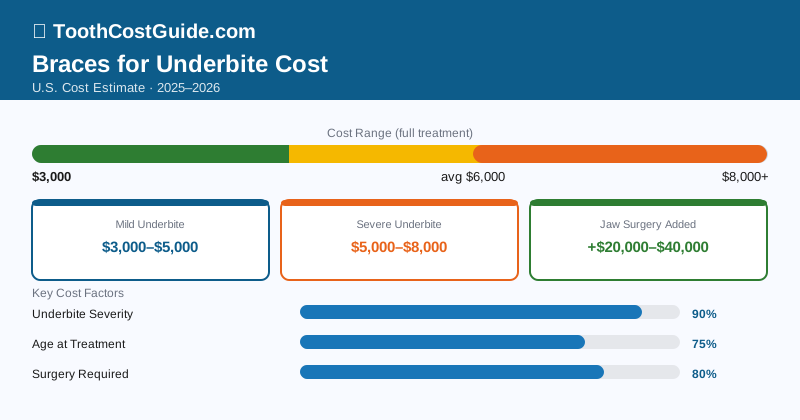
Underbite correction costs $3,000–$8,000+ for braces-based treatment, rising dramatically to $25,000–$50,000 when jaw surgery becomes necessary. The enormous range exists because an underbite can be a minor dental issue (lower front teeth positioned slightly ahead of upper front teeth) or a significant skeletal discrepancy (the lower jaw genuinely protrudes due to bone structure). Braces can address the first. Only surgery fully corrects the second.
| Underbite Treatment Option | Cost Without Insurance |
|---|---|
| Braces for mild dental underbite | $3,000–$7,500 |
| Reverse-pull headgear (facemask) | $1,500–$3,500 (Phase 1) |
| Braces + Class III elastics | $3,500–$7,500 |
| Invisalign for mild underbite | $3,000–$8,000 |
| Combined braces + jaw surgery | $25,000–$50,000 total |
| Orthognathic surgery alone | $20,000–$40,000 |
What Determines the Severity — and the Cost
Dental vs. skeletal. A dental underbite is about tooth angulation — the lower front teeth tilt forward or the upper front teeth tilt back, creating an edge-to-edge or negative overjet relationship even though the jaw bones are reasonably positioned. Braces with Class III elastics can correct this effectively. A skeletal underbite means the mandible (lower jaw) is genuinely too long or the maxilla (upper jaw) is underdeveloped. Braces can partially compensate through tooth position, but can’t change the bone itself without surgery.
Family history. Class III malocclusion (the technical term for underbite) has a stronger genetic component than most orthodontic problems. Families of East Asian descent have higher rates. If parents or siblings have underbites, children should be evaluated early — the corrective window closes faster than most parents realize.
Whether jaw growth is finished. For children whose jaws are still developing, the story can be changed. For adults whose growth is complete, the only options are dental camouflage (tooth-only compensation that works for mild-to-moderate cases) or surgery.
Treatment by Age Group
Ages 7–10: The Best Window
Reverse-pull facemask (also called protraction headgear) is the primary tool here. The device hooks to a frame worn in front of the face and uses elastic forces to pull the upper jaw forward while restraining the lower jaw. Studies show it’s most effective when the facial bones are still highly responsive — generally between ages 7 and 10.
Treatment runs 12–18 months of Phase 1 at $1,500–$3,500. Many kids who complete Phase 1 facemask treatment still need comprehensive braces later, but the jaw relationship is normalized enough that the comprehensive phase is straightforward rather than surgical.
A chin cup, which restrains lower jaw growth, is used less frequently in the US but remains common in Asian orthodontic practice. Evidence for its long-term skeletal effects is mixed.
Ages 11–16: Comprehensive Braces
After Phase 1 (if applicable), comprehensive braces address tooth positions. Class III rubber bands run in a triangular configuration to pull lower teeth backward and upper teeth forward — creating dental compensation for any remaining jaw discrepancy. For teens with some growth remaining, modest additional skeletal modification is still possible alongside tooth movement. Treatment cost: $3,000–$7,500.
Adults with Moderate Skeletal Underbite
When the jaw discrepancy isn’t extreme, orthodontic camouflage is a real option. The orthodontist retroclinesthe lower front teeth (tips them backward) and proclinesthe upper front teeth (tips them forward), creating a normal-looking relationship between the teeth even though the jaws are still slightly misaligned. Results are functional. Aesthetics are acceptable for many patients. Cost: $3,500–$7,500. Worth a genuine discussion with two orthodontists before committing to a surgical path.
Adults with Severe Skeletal Underbite
When the jaw discrepancy is too large for camouflage, surgery is the only complete solution. The process involves three stages:
- Pre-surgical orthodontics (12–18 months): Braces decompenate the teeth — removing the dental camouflage that the teeth naturally developed to mask the skeletal problem. This makes the underbite visually worse before surgery. It’s disconcerting but clinically necessary.
- Orthognathic surgery: The oral and maxillofacial surgeon repositions the jaws. For underbite, this most commonly involves setting the lower jaw back (mandibular setback), advancing the upper jaw (LeFort I osteotomy), or both. The specific moves depend on where the discrepancy lives.
- Post-surgical orthodontics (6–12 months): Final tooth position fine-tuning after the jaws are stable in their new positions.
Total cost: $25,000–$50,000 including orthodontics, surgery, anesthesia, and hospital fees.
Underbites treated early in growing children can often avoid the need for jaw surgery. The window for effective facemask/interceptive treatment is ages 7–10. After this window closes and jaw growth is complete, significant skeletal underbites require surgery for full correction. Early intervention can save $15,000–$30,000 in surgical costs.
Insurance Coverage: Two Different Policies for One Treatment
Braces and Phase 1 appliances fall under dental insurance orthodontic benefits:
- Lifetime maximum: $1,000–$3,000
- Coverage: 50% up to the lifetime maximum
- Age cutoff: Usually under 18–19
Reverse-pull facemask Phase 1 treatment is covered by most orthodontic benefit plans. It counts as orthodontic care, not a separate appliance category.
Jaw surgery falls under medical insurance:
- Medical insurance covers surgery when functional impairment is medically documented
- Coverage: typically 50–80% after deductible and out-of-pocket maximum
- Anesthesia and hospital facility fees are billed separately to medical insurance
- Pre-authorization required before any care begins
For medical insurance approval, you’ll need documentation of functional problems: chewing difficulty, speech issues, sleep apnea, jaw pain, or documented skeletal deformity. “Wanting a better profile” alone won’t satisfy an insurer. Your oral surgeon and orthodontist will need to prepare thorough clinical justification letters.
Get prior authorization in writing from both medical AND dental insurance before starting combined surgical orthodontic treatment. Once you begin pre-surgical orthodontics, you’re committed to a 2–3 year process. Discovering mid-treatment that the surgery is not covered by medical insurance creates a devastating financial surprise. Pre-authorization letters from both insurers should be in hand before the first bracket goes on.
Financing the Full Treatment
For braces-only cases, standard orthodontic financing applies: in-office 0% installment plans, CareCredit for flexible payment timing, and FSA/HSA funds for pre-tax savings.
For combined surgical cases, the financing gets more layered. The orthodontic component is typically financed through the orthodontist’s in-house plan. The surgical component — which can run $20,000–$40,000 after any insurance payments — may require medical financing through CareCredit, hospital payment plans, or personal healthcare loans.
FSA and HSA funds are eligible for both the dental and medical components of underbite treatment. If both a dental FSA and medical FSA are available through your employer, maximizing both during the treatment years meaningfully reduces out-of-pocket costs.
Academic medical centers — university hospitals with orthodontic and oral surgery residency programs — coordinate this kind of combined treatment at 30–50% below private practice fees. Cases are complex to schedule but are supervised by faculty specialists.
Practical Advice
For parents: If your child has any underbite tendency — lower jaw jutting forward, lower front teeth biting outside the uppers — see an orthodontist by age 7. Don’t wait for the pediatric dentist’s recommendation. The American Association of Orthodontists recommends age-7 screening precisely because underbite cases are most treatable at that window. A missed window is an expensive miss.
For adults considering camouflage vs. surgery: Get two orthodontist opinions and one oral surgeon consult before deciding. A good oral surgeon will be honest about what surgery can and can’t change in your specific case. An orthodontist experienced with surgical cases will have a clear view of whether camouflage gives you acceptable results. These are not trivial decisions to make based on one consultation.
For surgery cases: Confirm your oral surgeon is in-network with your medical insurance before pre-surgical orthodontics begins. Out-of-network surgery adds $5,000–$15,000 to the total cost of an already expensive treatment plan.
Bottom Line
Underbite correction ranges from $1,500–$3,500 for early childhood interceptive treatment to $25,000–$50,000 for adult cases requiring jaw surgery. The gap between those numbers makes timing critical. Insurance covers the orthodontic component under dental benefits and the surgical component under medical benefits when functional necessity is documented. For the highest-cost cases, academic medical centers offer the most affordable access to qualified combined care — and the savings on a major surgical case can be substantial.
Underbite correction has the steepest cost penalty for delayed treatment of any orthodontic condition. Children with apparent underbites should see an orthodontist by age 7. Early interceptive treatment with a reverse-pull facemask costs $1,500–$3,500 and can potentially eliminate the need for jaw surgery, saving $20,000 or more.
Frequently Asked Questions
Braces-based underbite correction typically costs $3,000–$8,000, depending on severity, treatment duration (usually 24–36 months), and whether additional appliances like facemasks are needed. If jaw surgery becomes necessary due to skeletal misalignment, total costs jump to $25,000–$50,000 when combining orthodontics with surgical correction.
Most dental insurance plans cover 40–60% of orthodontic treatment, including underbite correction, with a lifetime orthodontic benefit cap of $1,500–$2,000. However, many plans require a 12-month waiting period and only cover treatment for patients under age 18, leaving adults responsible for the full out-of-pocket cost.
Children's jaws are still developing, so interceptive treatments like facemasks ($2,500–$4,000) can guide proper jaw growth and prevent skeletal misalignment before it becomes severe. Waiting until adulthood often results in a fully developed skeletal underbite that cannot be corrected with braces alone, requiring jaw surgery ($15,000–$30,000+) in addition to orthodontic treatment.