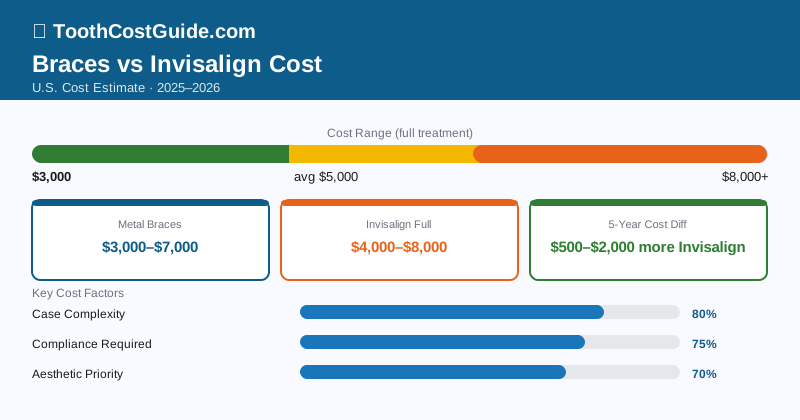
Let’s kill the myth right away: Invisalign isn’t dramatically more expensive than braces. For most cases, you’re comparing $3,000–$7,500 for traditional metal braces against $3,000–$8,000 for Invisalign Comprehensive. The pricing overlap is almost complete. The real question isn’t which costs less — it’s which one will actually work for your case and fit your life.
| Treatment Option | Cost Without Insurance |
|---|---|
| Traditional metal braces | $3,000–$7,500 |
| Ceramic braces | $4,000–$8,000 |
| Self-ligating braces (Damon) | $3,500–$8,000 |
| Invisalign Comprehensive | $3,000–$8,000 |
| Invisalign Lite (mild cases, 14 trays) | $2,500–$4,500 |
| Invisalign Express (7 trays) | $1,800–$3,500 |
| Lingual braces | $8,000–$13,000 |
What Actually Drives the Cost of Each
Braces pricing comes down to four variables: the type of bracket (metal, ceramic, self-ligating), the provider’s market and fee structure, how complex your case is, and how long treatment takes. All adjustments are included in the flat treatment fee — you don’t pay per appointment. Metal braces are the least expensive fixed option. Ceramic brackets add $500–$1,500 for aesthetics. Lingual braces (bonded behind the teeth) add $4,000–$6,000 for full invisibility.
Invisalign pricing works differently. You’re paying for a tiered product — Express (7 aligners), Lite (14 aligners), Moderate (26 aligners), or Comprehensive (unlimited). The more complex your case, the higher the tier, the higher the cost. Provider experience also plays a role: Invisalign tiers its providers by annual case volume (Bronze through Diamond), and high-volume Diamond providers sometimes offer lower fees because of the volume discounts they receive from Align Technology.
There are also hidden costs worth knowing. With Invisalign, refinements (extra aligner trays when teeth don’t move as predicted) may or may not be included — ask before you sign. Post-treatment retainers are rarely included in either braces or Invisalign fees.
The Effectiveness Question
This is where the decision actually gets made. Cost is secondary to getting the treatment that fits your clinical needs.
Situations where braces are the stronger choice:
Braces don’t require any cooperation from the patient — they’re fixed and work continuously. That makes them superior for teens with unpredictable compliance, for severe crowding cases where precise molar control matters, for large rotations (more than 20°), and for significant vertical tooth movements. Complex bite correction — severe overbite, underbite, open bite — is typically handled more reliably with fixed appliances. If your case involves multiple challenging movements happening simultaneously, braces give your orthodontist more control.
Situations where Invisalign is equivalent or better:
For mild-to-moderate crowding (under 6mm), mild spacing, moderate overbite in motivated adults, and mild crossbite — outcomes with Invisalign are clinically comparable to braces. Adults who play wind instruments can remove their aligners for practice. Athletes in contact sports can remove aligners to avoid bracket injuries. Oral hygiene is dramatically easier: flossing with Invisalign takes 3 minutes; flossing around braces brackets takes 15–20 minutes per session.
The evidence base for Invisalign has grown substantially. Align Technology reports over 15 million patients treated globally. For appropriate cases in compliant patients, outcomes are equivalent to fixed appliances.
The braces vs. Invisalign decision should be driven by case complexity first, lifestyle second, and cost third. Many mild-to-moderate cases are equally well treated by either option. Your orthodontist’s recommendation based on your specific case — not cost or aesthetics — should be the primary driver.
Head-to-Head: What You Actually Live With
| Category | Metal Braces | Ceramic Braces | Invisalign |
|---|---|---|---|
| Average cost | $3,000–$7,500 | $4,000–$8,000 | $3,000–$8,000 |
| Visibility | High | Low | Very low |
| Removable | No | No | Yes |
| Complex case capability | Excellent | Excellent | Good (mild-moderate) |
| Compliance requirement | Built-in | Built-in | 20–22 hrs/day |
| Dietary restrictions | Yes | Yes | None |
| Oral hygiene difficulty | Moderate | Moderate | Easy |
| Staining risk | No | Moderate | Low (trays replaced) |
| Emergency repairs | Broken brackets/wires | Broken brackets | Lost/chewed aligner |
| Insurance coverage | Yes | Yes | Yes (same terms) |
| Average treatment time | 18–24 months | 18–24 months | 12–20 months (moderate) |
Insurance Covers Both Equally
This surprises many patients: most dental insurance plans with orthodontic benefits treat braces and Invisalign identically. The lifetime maximum — typically $1,000–$3,000 — applies the same way regardless of which appliance you choose.
A common misconception is that Invisalign is not covered by dental insurance. Most plans that cover braces also cover Invisalign, since the clinical outcome (properly aligned teeth) is equivalent. Always verify with your specific plan — but don’t assume Invisalign is excluded simply because it’s “newer” technology.
The True Cost of Ownership
The sticker price isn’t the full financial picture. Both options carry additional costs that are easy to miss during consultations.
Braces extra costs:
- Broken bracket or wire repair: $25–$100 per incident (sometimes included, sometimes not)
- Retainers after treatment: Often included, but sometimes $250–$600 extra
- Time for oral hygiene: Flossing around brackets realistically adds 10–15 minutes per session — not a direct cost, but a commitment
Invisalign extra costs:
- Lost or damaged aligner: $50–$150 if not covered by a guarantee
- Refinements beyond the initial plan: $500–$1,500 per set if not included
- Retainers after treatment: $100–$600 (often not included in the Invisalign fee)
- Compliance failure: If worn fewer than 22 hours/day, treatment stalls — and restart costs money
Financing Looks the Same Either Way
Both options are financed identically:
In-office payment plans: Zero percent interest spread over the treatment period. The orthodontist’s front desk handles this directly, no credit check required at most practices.
CareCredit: Available for both at participating providers. Promotional 0% APR for 12–24 months.
FSA/HSA: Both are fully eligible expenses under IRS guidelines. Pay monthly Invisalign installments or braces fees with pre-tax dollars.
Dental school programs: Both braces and Invisalign are available through orthodontic residency programs at 30–50% below private practice fees.
Six Questions to Ask Your Orthodontist
- Is my case complexity appropriate for Invisalign, or are fixed braces a stronger clinical choice?
- Would treatment time differ between the two for my specific case?
- What’s the total fee — including retainers and any potential refinements — for each option?
- Does my insurance cover both at the same benefit level?
- If I’m 2 weeks behind on aligner wear, what happens?
- Are refinements included in your Invisalign fee, or quoted separately?
Bottom Line
Price-wise, braces and Invisalign are in the same ballpark. Don’t let aesthetics alone push you toward Invisalign if your case is complex, and don’t let metal-phobia lead you to undertreatment. The right call is the one your orthodontist genuinely recommends based on your teeth — not the one that sounds cooler. When you do have a genuine clinical choice, let lifestyle factors guide you: appearance, dietary habits, sports, instrument playing. And always get two consultations. What one provider recommends as “Comprehensive Invisalign only” might be “totally suitable for either” in another experienced orthodontist’s hands.
At equivalent prices, the right choice between braces and Invisalign depends on case complexity and compliance. Complex cases need braces. Mild-to-moderate cases in motivated patients work equally well with either. If your orthodontist gives you a genuine choice, lifestyle factors — aesthetics, dietary preferences, sports, instrument playing — should guide your decision.
Frequently Asked Questions
Traditional metal braces typically cost $3,000–$7,500, while Invisalign Comprehensive ranges from $3,000–$8,000, making them nearly identical in price for most patients. The final cost depends on your case complexity, treatment duration (usually 18–36 months), and your orthodontist's location and experience.
Most dental insurance plans cover 50% of orthodontic treatment costs up to a lifetime maximum of $1,500–$2,000, which applies equally to braces and Invisalign if deemed medically necessary. You'll typically pay the remaining balance out-of-pocket, though some plans exclude clear aligners or impose longer waiting periods before coverage begins.
Both options typically require 18–36 months of treatment, depending on the severity of misalignment and your compliance. Invisalign may work slightly faster for mild-to-moderate cases if you wear aligners 20–22 hours daily, while braces work continuously without relying on patient compliance.