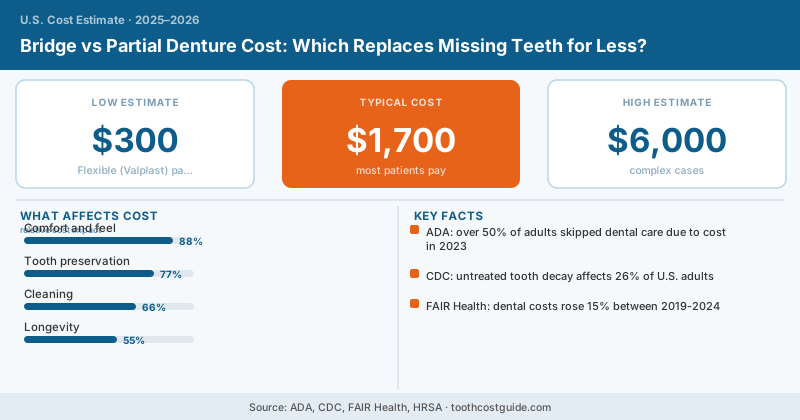
You’re missing a tooth — or a few — and you’ve got two affordable ways to fill the gap: a fixed bridge that stays put, or a removable partial denture that comes out at night. The price gap between them is wide, and so is the day-to-day experience. One cements in permanently and feels like your own teeth. The other costs far less but you take it out to clean it. Here’s how to choose.
Bridge vs Partial Denture Costs
| Option | Cost (No Insurance) | Replaces |
|---|---|---|
| Acrylic (flipper) partial | $300–$1,500 | 1–several teeth |
| Cast metal partial denture | $1,000–$3,000 | Several teeth |
| Flexible (Valplast) partial | $900–$2,500 | Several teeth |
| Traditional 3-unit bridge | $2,000–$5,000 | 1 tooth (one gap) |
| Implant (for comparison) | $3,000–$6,000 | 1 tooth |
A removable partial denture almost always costs less up front than a fixed bridge. But cheaper up front isn’t the whole story — the fit, feel, and longevity differ a lot.
How Each One Works
A fixed bridge is cemented permanently in place. For one missing tooth, the dentist crowns the two neighbors and suspends a fake tooth between them. It stays in your mouth full-time and feels close to natural teeth.
A partial denture is removable. It’s a fake tooth (or several) set into a gum-colored base that clips onto your remaining teeth with clasps. You take it out to clean it and usually at night.
That single difference — fixed versus removable — drives most of the decision.
Choose a bridge if: you have one gap, the neighboring teeth are healthy enough to anchor it (or need crowns anyway), and you want something permanent that feels like natural teeth. Choose a partial if: you’re missing several teeth in different spots, you want the lowest up-front cost, you’re not ready for permanent work, or the neighboring teeth can’t support a bridge. Many people start with a partial and move to a bridge or implant later.
The Trade-Offs Beyond Price
Comfort and feel. A bridge feels like your own teeth — nothing to remove, no clasps. A partial is bulkier, you’ll feel it, and it takes time to adjust to eating and speaking with it.
Tooth preservation. A bridge requires grinding down the two anchor teeth, permanently altering healthy teeth. A partial clasps onto teeth without reshaping them — more conservative.
Cleaning. A bridge brushes like natural teeth (with special flossing under the pontic). A partial comes out for cleaning, which some find easier and others find a hassle.
Longevity. A well-made bridge lasts 10–15+ years. A partial denture typically needs relining or replacing every 5–8 years as your gums and bone change shape.
How Many Teeth Are Missing?
This often settles it. For one gap, a bridge is a clean fit. For several missing teeth scattered around the mouth, a partial denture is the only one of the two that handles it — a bridge can only span one continuous gap with healthy anchors on each end.
Across the U.S., tooth loss is common — the CDC reports that a meaningful share of adults are missing one or more teeth, and the numbers climb with age. Both of these options exist precisely because so many people need them.
How Insurance Treats Each
Most dental PPO plans cover both bridges and partials at 50% of the allowable fee as major services. Watch the annual maximum ($1,000–$2,000 for many plans) — a bridge can blow past it while a partial may fit under it, which can tilt your real out-of-pocket toward the partial. Some plans also have missing-tooth clauses. A free predetermination spells it out; see how dental insurance works.
How to Pay Less
Dental school clinics make both bridges and partials under supervision at 40–60% below private fees. Start with a flipper (cheap acrylic partial) if you need something now and want to save for a bridge or implant later. Compare the long game with our dentures and tooth extraction guides. Uninsured? A dental savings plan or CareCredit financing helps.
Don’t pick on up-front price alone. A cheap partial that needs relining every few years can cost more over a decade than a one-time bridge — and vice versa if the bridge anchors fail. Map out the 10-year cost with your dentist, get a written treatment plan for both options, and submit a predetermination.
Bottom Line
A partial denture costs $700–$3,000 and a fixed bridge $2,000–$5,000. The partial wins on up-front price and replaces several scattered teeth; the bridge wins on comfort and permanence for a single gap. The partial preserves the neighboring teeth, while the bridge requires reshaping them. Insurance covers both at 50%, but a bridge is likelier to exceed your annual max. Count your gaps, weigh removable versus fixed, and price the 10-year cost — not just day one — before choosing between a bridge and a partial denture.
Frequently Asked Questions
A fixed dental bridge typically costs $2,000–$5,000, while a removable partial denture ranges from $700–$3,000. The bridge is more expensive upfront because it requires permanent bonding to adjacent teeth, but it lasts 10–15 years with proper care.
Most dental insurance plans cover 50% of the cost for bridges and partial dentures after you meet your deductible, though some plans cap coverage at $1,000–$1,500 per year. You'll typically pay the remaining 50% out-of-pocket, meaning a bridge could cost you $1,000–$2,500 after insurance, depending on your plan.
A fixed bridge usually takes 2–3 dental visits over 2–3 weeks, including tooth preparation and permanent placement. A partial denture takes longer—typically 4–6 weeks and multiple appointments—because it requires custom fitting, adjustments, and fabrication in a dental lab.