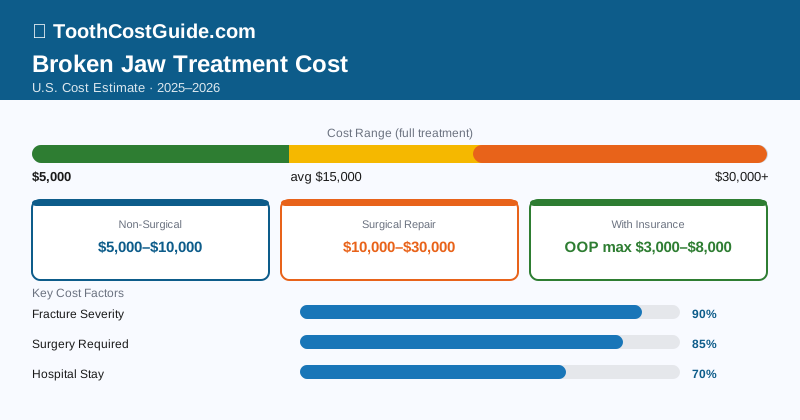
A broken jaw doesn’t give you the luxury of shopping around. You’re going to the emergency room, getting a CT scan, and talking to an oral and maxillofacial surgeon — all within hours of the injury. What happens next, and what it costs, depends on where the fracture is, how many pieces the bone broke into, and whether surgery is the right approach for your specific pattern.
Simple fractures managed with arch bars (jaw wiring) run $5,000–$12,000 including hospitalization. Complex fractures requiring open reduction and internal fixation — titanium plates drilled into the jaw to hold fragments in alignment — cost $15,000–$35,000 or more once you’ve added emergency room fees, surgical facility charges, anesthesia, and follow-up care.
| Treatment | Estimated Total Cost |
|---|---|
| Emergency room evaluation + CT scan | $2,000–$6,000 |
| Arch bars (jaw wiring), 4–6 weeks | $2,000–$5,000 |
| ORIF surgery (titanium plates) | $8,000–$20,000 |
| Hospitalization (1–3 nights) | $5,000–$15,000 |
| Anesthesia | $1,000–$3,000 |
| Post-op follow-up (4–6 months) | $500–$2,000 |
| Physical therapy (jaw rehab) | $500–$2,000 |
| Total (simple fracture) | $5,000–$12,000 |
| Total (complex fracture with ORIF) | $15,000–$35,000 |
Six Factors That Drive the Price
Where in the jaw it broke. The mandible has four common fracture zones: the condyle (the ball-and-socket joint at the top), the angle (back corner near the wisdom teeth), the body (the horizontal midportion), and the symphysis/parasymphysis (front center). Condylar fractures can sometimes be managed without surgery, particularly in younger patients with good healing capacity. Body and angle fractures with significant displacement almost always need hardware.
One fracture site or multiple. The mandible often breaks in two places simultaneously when hit with significant force — one site absorbs the direct impact, another fractures on the opposite side. Two fracture sites mean a more complex surgical repair.
Upper jaw versus lower jaw. Upper jaw (maxillary) fractures follow the Le Fort classification — I, II, or III. Le Fort III represents a complete craniofacial separation and is one of the most complex facial injuries in surgery, with costs ranging from $30,000–$100,000+. Most broken jaw discussions center on mandible fractures, which are far more common.
Surgery or no surgery. Conservative management with arch bars (metal wires holding the jaw immobile for 4–6 weeks) costs considerably less than open reduction and internal fixation. ORIF requires a full surgical suite, general anesthesia, and titanium hardware — all of which add to the bill. The tradeoff is that ORIF allows faster return to normal jaw movement and better anatomical alignment for complex fractures.
Hospital fees. Jaw fractures are hospital cases. Emergency room charges, inpatient room fees, and surgical facility overhead stack up quickly. These costs vary significantly by institution — an academic trauma center in a major city bills differently than a community hospital.
What else got broken. Jaw fractures rarely happen in isolation. Falls, car accidents, and assaults that break jaws also cause concussions, nasal fractures, orbital fractures, and dental injuries. Each associated injury adds to the total treatment cost.
The Two Main Treatment Approaches
Conservative management — arch bars and maxillomandibular fixation ($5,000–$12,000 total)
For minimally displaced fractures — particularly condylar fractures in younger patients — surgeons place metal arch bars along the upper and lower teeth and wire the jaw in a closed position. You’re on liquids for 4–6 weeks while the bone heals. This approach avoids surgical incisions, preserves bone biology, and tends to produce good outcomes for the right fracture patterns. The functional recovery isn’t instant, but the complication profile is low.
Open reduction and internal fixation — ORIF ($15,000–$35,000 total)
ORIF means the surgeon makes an incision (inside the mouth for most mandible fractures, occasionally external for complex cases), directly visualizes the fracture, repositions the bone fragments with precision, and fixes them with titanium miniplates and screws. Advantages: immediate stability, no jaw wiring, faster return to normal diet, better long-term alignment for complex fractures. The titanium hardware stays in permanently unless it causes problems.
Condylar joint replacement (specialized cases, $20,000–$50,000+)
Severely shattered condylar fractures in elderly patients with poor bone quality sometimes require total temporomandibular joint replacement with custom-fabricated prostheses. This is specialized, expensive, and performed at a small number of centers with dedicated craniofacial programs.
Understanding Insurance Coverage
This is a medical emergency, so medical insurance — not dental — handles the costs.
What your health insurance covers:
- ER visit: Your ER copay applies ($150–$500 depending on plan), then deductible and coinsurance
- Hospitalization: Covered under inpatient medical benefit after annual deductible ($1,000–$6,000 typical range) plus 20% coinsurance
- Surgery and anesthesia: Covered at the same inpatient rates
- Imaging: CT scan covered under major medical diagnostic benefits
The out-of-pocket maximum matters here. ACA-compliant health plans cap individual out-of-pocket at $9,450 for 2025. Complex jaw fracture treatment at $25,000–$35,000 will push most patients to that ceiling. Once you hit it, insurance covers 100% of in-network costs for the rest of the benefit year.
Dental insurance may contribute to tooth repairs, extractions of damaged teeth, or future implants, but the fracture treatment itself bills to medical.
Auto insurance and liability coverage. If the injury happened in a car accident, personal injury protection (PIP) or medical payments coverage applies. At-fault driver’s liability may cover the entire medical bill through the claims process. Don’t overlook this — tell the ER billing department how the injury occurred.
If you’re uninsured: Hospital charity care programs at nonprofit institutions can dramatically reduce or eliminate bills. These programs are means-tested based on income. Apply as soon as you’re admitted — don’t wait for the bill to arrive.
What to Do When It Happens
- Call 911 or get to an emergency room immediately. A broken jaw needs emergency evaluation without delay.
- Support the jaw during transport — hold it gently with a hand, a bandage under the chin, or a scarf wrapped around the jaw. Don’t try to put anything back in place.
- Don’t eat or drink anything until evaluated — surgery may be imminent.
- Tell the team about all medications, especially blood thinners (warfarin, aspirin, Plavix) and herbal supplements — these affect surgical bleeding risk.
- Insist on a CT scan. Plain X-rays are a starting point; CT gives the three-dimensional picture the surgeon needs for accurate planning.
- Ask whether ORIF or conservative management is right for your specific fracture — not every break needs surgery, and not every fracture can heal without it.
- Ask about financial assistance before you leave the hospital — patient financial services staff are usually available seven days a week.
A broken jaw is a medical emergency. Call 911 if the injury is severe, there is significant bleeding, the patient has lost consciousness or has difficulty breathing, or other serious injuries are suspected. Do not attempt to eat, drink, or speak excessively until evaluated by a medical professional. Cervical spine injury must be ruled out before treating jaw fractures in trauma patients.
Controlling the Cost
Confirm in-network status for every provider. Under the No Surprises Act, emergency care at in-network hospitals must be billed at in-network rates even if individual physicians aren’t in your network. Confirm that follow-up care — post-op visits, physical therapy — is also in-network.
Emergency Medicaid. If you’re uninsured, every state provides emergency Medicaid coverage for emergency medical care regardless of immigration status. Apply at the hospital the same day. Most states allow retroactive coverage to the application date, which can cover the entire hospitalization.
Hospital charity care. Nonprofit hospitals operate mandatory charity care programs. Eligibility is income-based — patients below 200% of the federal poverty level typically qualify for full bill reduction. At 200–400%, partial reductions are common. Don’t assume you don’t qualify without applying.
Negotiate and audit the bill. Medical bills contain errors more often than most people realize. Request an itemized bill once everything is posted. Review it for duplicate charges, services not rendered, and incorrect billing codes. Then contact the billing department — ask directly for a hardship reduction or prompt-pay discount on remaining balances.
Bottom Line
A broken jaw means $5,000–$35,000 in total treatment costs, depending almost entirely on fracture complexity and whether surgery is needed. Medical insurance covers the core costs; complex cases typically push patients to their annual out-of-pocket maximum. For uninsured or underinsured patients, hospital charity care and emergency Medicaid are meaningful options — apply immediately, not after the bill arrives. Recovery takes 6–12 weeks of bone healing, with full jaw function returning over 3–6 months.
Frequently Asked Questions
Broken jaw surgery typically costs $15,000–$30,000 or more, depending on fracture complexity, number of fracture sites, and whether plates, screws, or wires are needed. Simple fractures treated with non-surgical stabilization (arch bars or splints) cost $5,000–$10,000, while multiple or severely displaced fractures requiring open reduction and internal fixation run toward the higher end of the range.
Most health insurance plans cover broken jaw treatment as a medical emergency, including ER visits, imaging, and surgery, though you'll typically pay a copay, deductible, and coinsurance (usually 20–40% of costs). Dental insurance rarely covers jaw fractures since they're classified as medical injuries; however, some plans may contribute to post-treatment orthodontic or dental reconstruction if needed.
Initial treatment (ER visit, imaging, stabilization) happens within hours of injury, but complete healing typically takes 6–12 weeks depending on fracture severity. During recovery, you may be on a soft diet, restricted jaw movement, and pain management for 2–4 weeks; return to normal eating and activities can take 2–3 months, with follow-up imaging to confirm bone healing.