A night guard doesn’t stop grinding — it just protects your teeth from the damage. That distinction changes how you think about treatment.
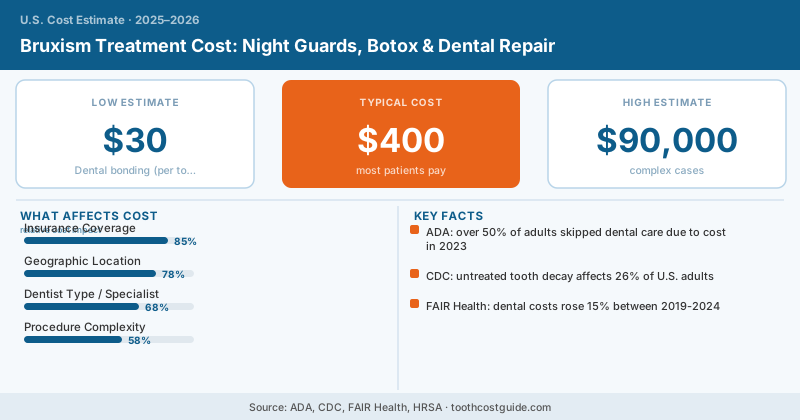
Most people assume that wearing a night guard means their bruxism is “handled.” It isn’t. The guard absorbs what your teeth would otherwise take. The grinding force is still there, working through your jaw, your joints, your muscles. For mild cases, that’s fine — a guard is enough. For moderate to severe bruxism, you may need a layered approach that goes well beyond a $400 appliance.
Here’s the full cost picture, from the cheapest first step to the most expensive repairs.
What Bruxism Actually Is
Bruxism is the involuntary clenching or grinding of teeth. It comes in two forms: sleep bruxism (happening while you’re unconscious) and awake bruxism (often a stress-linked habit during the day). The ADA estimates that 10–15% of adults grind their teeth regularly — many don’t know it until a dentist spots worn enamel or a partner mentions the noise.
The damage is cumulative and irreversible. Enamel doesn’t grow back. Once you’ve ground down a cusp or cracked a tooth, restoration is the only fix. That’s why the cost of ignoring bruxism almost always exceeds the cost of managing it early.
The Full Treatment Cost Ladder
| Treatment | Typical Cost | What It Does | Duration |
|---|---|---|---|
| OTC night guard | $30–$100 | Protects teeth (poorly) | Often abandoned within weeks |
| Custom occlusal guard (dentist) | $300–$900 | Protects teeth, repositions bite | 3–5 years with care |
| Botox (masseter/temporalis) | $400–$800/session | Reduces grinding force | Every 4–6 months, ongoing |
| Biofeedback device | $200–$500 | Alerts you during awake grinding | Ongoing |
| Dental bonding (per tooth) | $200–$600 | Repairs minor wear/chips | 5–10 years |
| Crown (per tooth) | $1,000–$1,800 | Rebuilds a severely worn or cracked tooth | 10–15 years |
| Full mouth reconstruction | $10,000–$90,000 | Rebuilds all teeth after severe damage | Permanent (ideally) |
| TMJ treatment (if involved) | $500–$3,000 | Physical therapy, splints, injections | Varies |
OTC vs. Custom Guards: Why the Price Gap Matters
A $35 boil-and-bite guard from the drugstore protects your teeth — in theory. In practice, these guards have poor retention, uneven bite coverage, and can actually shift your teeth if worn long-term. Most patients stop using them within a month.
A custom guard from your dentist is fabricated in a dental lab from an impression of your specific bite. It fits exactly. It stays in place. It distributes grinding force evenly. For most mild-to-moderate bruxers, this is the most cost-effective long-term intervention. At $300–$900 up front and lasting 3–5 years with proper cleaning and storage, it pencils out to less than $0.50 per day.
When Botox Makes Sense
Botox for bruxism is injected into the masseter — the large muscle at the angle of your jaw — and sometimes the temporalis muscle at your temple. It temporarily weakens those muscles, reducing the force of clenching and grinding without eliminating the habit entirely.
A 2021 systematic review published in JADA found that Botox injections into the masseter muscle significantly reduced pain scores and grinding intensity in patients with sleep bruxism. Effects last 4–6 months per session. At $400–$800 per session, patients who use Botox as a standalone treatment spend $800–$1,600 per year on maintenance.
Most orofacial pain specialists use Botox as a complement to a night guard, not a replacement. The guard protects teeth. The Botox reduces the muscular load.
Botox for bruxism is a medical procedure requiring precise dosing into the masseter muscle. It’s not the same technique used for cosmetic forehead injections. Go to a dentist, oral surgeon, or orofacial pain specialist with documented experience treating bruxism — not a general medical spa offering “jaw slimming” treatments. Improper dosing can cause asymmetric jaw weakness or difficulty chewing.
The TMJ Connection
Bruxism and TMJ disorders frequently travel together. The constant muscular tension and joint loading from grinding inflames the temporomandibular joint, leading to clicking, locking, or pain that radiates into the ear, neck, or temples. If bruxism has triggered a TMJ disorder, your treatment costs expand: physical therapy ($75–$200/session), a specialized TMJ splint ($500–$1,500), or corticosteroid injections ($300–$600) may all enter the picture. Treating bruxism before it escalates to TMJ damage is significantly cheaper.
Biofeedback for Awake Bruxism
For patients who clench during the day — often without realizing it — biofeedback devices offer a different approach. Wearable sensors detect muscle tension and deliver a gentle alert (vibration or sound) when clenching is detected. Devices like Biofeedback Headband systems run $200–$500 and can help awake bruxers break the habit with consistent use. They do nothing for sleep bruxism.
- Your dentist notes shortened or flattened tooth cusps at checkups
- You’re cracking or chipping teeth more frequently
- You wake up with jaw pain, headaches, or an aching bite
- Your night guard is wearing through faster than expected
- You notice increased tooth sensitivity, especially to cold
What Insurance Covers
Custom night guards are often covered under major restorative benefits at 40–60% after your deductible. Some plans categorize them as preventive and cover them at a higher rate. Call your insurer before your appointment and ask specifically: “Is an occlusal guard for bruxism covered, and under what benefit category?”
Botox is almost universally excluded from both dental and medical plans when the indication is bruxism. Restorative work — crowns, bonding — may be partially covered depending on your annual maximum and remaining benefits.
The Real Cost of Doing Nothing
Each 0.5mm of tooth height lost to grinding is gone permanently. Enamel doesn’t regenerate. A tooth that’s lost significant structure needs a crown. A tooth that’s cracked below the gumline may need extraction and replacement. The math on delayed treatment almost never works in your favor: a $500 custom guard today versus a $1,500 crown — or several of them — two or three years from now.
If your dentist has mentioned grinding at your last visit, take it seriously. Start with the custom guard. Reassess in six months. The treatment ladder exists for a reason — you want to stay on the lowest rung for as long as possible.
Frequently Asked Questions
A custom-fitted night guard from your dentist costs $300–$900. Over-the-counter guards run $30–$100 but have poor fit, which causes many patients to abandon them. The custom version is lab-fabricated from an impression of your teeth and lasts 3–5 years with proper care.
Custom night guards are often covered under major restorative benefits at 40–60% after your deductible. Some plans classify them as preventive. Botox injections for bruxism are almost never covered by dental insurance. Restorative work caused by grinding — crowns, bonding — may be partially covered depending on your plan's annual maximum.
Yes, with caveats. A 2021 systematic review in JADA found that Botox injections into the masseter muscle significantly reduced grinding intensity and jaw pain. But it doesn't protect your teeth the way a night guard does — it reduces the force of grinding, not the grinding itself. Most orofacial pain specialists use it as an add-on to a night guard, not a replacement.