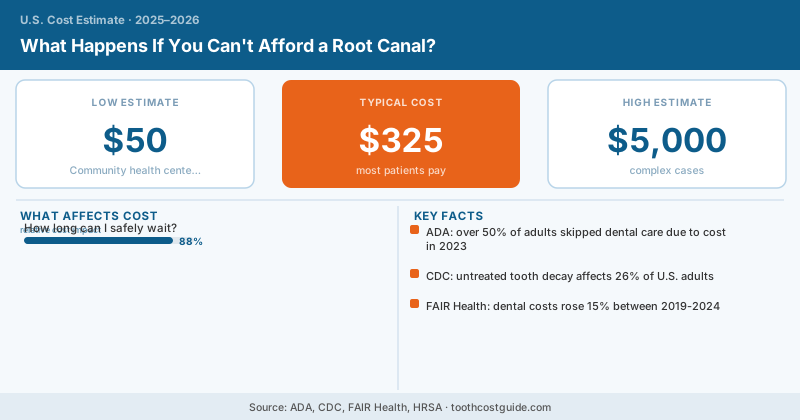
The estimate says $1,400 for a root canal, and your bank account says no. That panic is real, and it’s common — but here’s the most important thing to know first: you almost certainly have more options than “pay it all” or “lose the tooth.”
What you can’t do is wait it out. An infected tooth doesn’t heal on its own, and the longer you stall, the more it costs — financially and medically. Let’s walk through what actually happens, and the affordable paths most people never hear about.
What a Root Canal Costs — and the Cheaper Routes
| Option | Typical Cost | Notes |
|---|---|---|
| Standard root canal (private dentist) | $700–$1,800 | Front teeth cheapest, molars priciest |
| Dental school clinic | $300–$900 | Supervised students, 40–60% off |
| Community health center (sliding scale) | $50–$600 | Based on income |
| Extraction instead | $150–$600 | Cheap now, costly to replace later |
| Implant to replace pulled tooth | $3,000–$5,000 | The “cheap extraction” trap |
What Happens If You Skip It
Ignoring an infected tooth is the single most expensive choice on the table. Here’s the progression:
- The infected pulp inside the tooth keeps dying and breeding bacteria.
- An abscess can form — a painful pocket of pus at the root tip.
- Infection can spread to surrounding bone, soft tissue, and in serious cases the bloodstream. The CDC notes that untreated dental infections still send people to the ER and, rarely, become life-threatening.
- You lose the tooth anyway — then pay for extraction plus a replacement.
A toothache that suddenly stops hurting is not good news. It can mean the nerve has died — the infection is still there and still spreading, just without the warning pain. If pain vanishes after days of throbbing, see a dentist fast. See our guide on dental infection costs for what’s at stake.
The Real Affordable Options
You have more levers than most people realize:
- Dental school clinics — Accredited schools across the country offer root canals at 40–60% off because supervised students do the work. Quality is closely overseen by licensed faculty. Find one through dental school clinics.
- Community health centers (FQHCs) — These charge sliding-scale fees based on your income. For lower earners, a root canal can drop to under $200.
- In-house payment plans — Many dentists split the bill into interest-free monthly payments. Just ask; most won’t volunteer it.
- Dental discount plans — A small annual membership cuts member fees 15–40%. See dental discount plans.
- CareCredit and financing — Third-party medical credit often comes with 6–12 month interest-free promos. Read our CareCredit for dental guide before signing.
Extraction looks cheap at $150–$400, but the gap rarely stays empty. Replacing the tooth with an implant ($3,000–$5,000) or bridge ($2,000–$5,000) usually dwarfs the root canal you were trying to avoid. The American Association of Endodontists consistently emphasizes that saving the natural tooth is the better long-term value when the tooth is restorable.
A Practical Order of Operations
If money’s tight and the tooth is infected, here’s a sensible sequence:
- Get seen now, even if just for evaluation and antibiotics to control acute infection. Antibiotics buy time; they don’t cure it.
- Call a dental school for a low-cost treatment slot.
- Stack a discount plan with a payment plan to spread what’s left.
- Ask the dentist directly about their cheapest path to save the tooth.
If the tooth genuinely can’t be saved, weigh extraction against replacement honestly — our root canal vs. implant cost comparison helps.
Frequently Asked Questions
Will antibiotics fix it instead of a root canal? No. Antibiotics can knock down the acute infection and ease pain temporarily, but the dead pulp inside the tooth stays infected. The bacteria come back. Antibiotics are a bridge to treatment, not a substitute.
How long can I safely wait? Not long. There’s no safe long-term window for an infected tooth. If you’re in pain, have swelling, or had pain that suddenly stopped, treat it as urgent. Our tooth pain — when to see a dentist guide covers the red flags.
What if I have no insurance and no money at all? Start with a community health center or dental school for sliding-scale or low-cost care, and look into charitable dental programs. See free dental care programs — these exist specifically for situations like yours.
Can’t afford a root canal today? You have a path. The wrong move is doing nothing — that’s the option that gets genuinely expensive.
Frequently Asked Questions
If you can't afford a root canal ($700–$1,800), you have several options before losing the tooth: dental school clinics that charge 40–60% less, in-house payment plans, dental discount plans, CareCredit financing, or community health centers with sliding-scale fees. The one thing you shouldn't do is ignore it — an untreated infected tooth can spread infection and lead to far costlier emergency care.
The infected pulp doesn't heal on its own. Left untreated, the infection can form an abscess, spread to surrounding bone and tissue, and in rare cases become life-threatening. You'll likely lose the tooth anyway, then face extraction ($150–$600) plus the cost of replacing it with an implant ($3,000–$5,000) or bridge — far more than the root canal would have cost.
Upfront, yes — a simple extraction runs $150–$400 versus $700–$1,800 for a root canal. But extraction leaves a gap that usually needs replacing. An implant runs $3,000–$5,000 and a bridge $2,000–$5,000, so the 'cheap' extraction often becomes the most expensive path once you replace the tooth. Saving the natural tooth is typically the better long-term value.
Dental school clinics offer root canals at 40–60% off because supervised students do the work. Community health centers and FQHCs charge sliding-scale fees based on income. Some charitable programs and dental clinics offer free or reduced care. The ADA's nationwide network of accredited dental schools is a reliable starting point for low-cost treatment.
Often, yes. Many practices offer in-house payment plans that spread the cost over months. Third-party financing like CareCredit frequently offers 6–12 month interest-free promotions. Dental discount plans cut the fee 15–40% for a small annual membership. Combining a discount plan with a payment plan can make treatment affordable even with no cash on hand.