$200 now, or $2,000 later. That’s the real choice most people are making when they put off a small cavity, whether they realize it or not. A filling today is one of the cheapest procedures in dentistry. The same tooth, neglected for another year or two, can escalate into a root canal and crown costing 10 times as much.
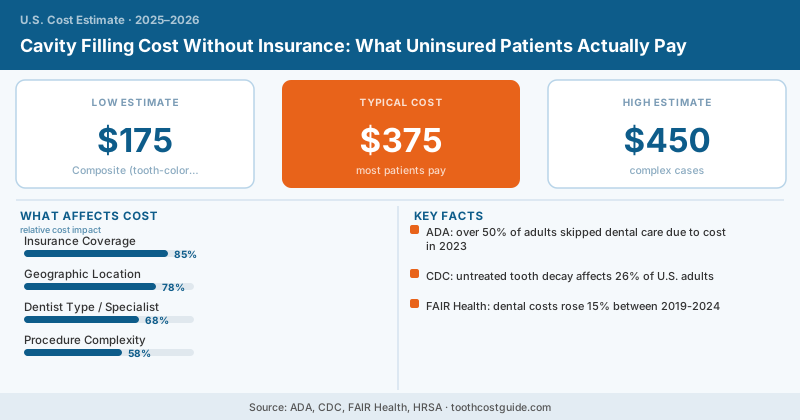
Without insurance, a cavity filling runs $150-$450 depending on material and cavity size — here’s exactly what determines where you land in that range.
| Filling Type | Small Cavity | Large Cavity |
|---|---|---|
| Amalgam (silver) | $150–$200 | $200–$300 |
| Composite (tooth-colored), front tooth | $200–$300 | $300–$400 |
| Composite (tooth-colored), back tooth | $200–$350 | $300–$450 |
| Glass ionomer (kids, specific cases) | $125–$200 | $175–$275 |
Amalgam vs. Composite: The Real Cost Difference
Amalgam — the traditional silver filling — remains the least expensive option, mostly because the material and placement technique are simpler and faster for the dentist. It’s durable, often lasting 10-15 years, but it’s visibly metallic and some patients prefer not to have it, especially on front teeth.
Composite resin costs more because the process is more demanding: the tooth must be kept completely dry during placement (any moisture contamination weakens the bond), and the material is applied in thin layers, each cured with a special light before the next is added. That extra chair time and skill translates into a $50-$150 premium per filling compared to amalgam — a cost you’re paying for aesthetics and a slightly more conservative tooth prep, not necessarily better durability.
Why Cavity Size Changes the Bill
A cavity limited to one surface of the tooth (say, just the biting surface) is classified and billed differently than a cavity that’s spread across two or three surfaces. The CDC’s data on untreated dental decay shows it only progresses over time — a small cavity caught early stays a $150-$250 fix, while the same cavity left alone for a year or two often grows to involve multiple surfaces, pushing the fee toward the top of the range or beyond into root canal territory.
Dental schools charge 40-60% below private practice rates for fillings, performed by supervised students. Federally funded community health centers offer sliding-scale fees based on income, sometimes as low as $50-$100 regardless of the practice’s standard rate. Both options take more time per visit than a private practice, but the clinical quality is closely supervised.
What’s Included (and What Might Cost Extra)
The filling fee usually includes local anesthesia and the material itself, but ask specifically whether the exam and X-ray needed to diagnose the cavity are billed separately — many practices charge $50-$150 for a new patient exam and X-rays before the filling appointment, especially if you haven’t been seen there before.
If the cavity turns out to be deeper than expected once the dentist starts working — close to or into the nerve — you may be informed mid-procedure that a root canal is now recommended instead of just a filling. Ask upfront what the plan is if that happens, so there are no billing surprises.
Financing a Filling Without Insurance
Most dental offices will accept payment in full at the time of service for a routine filling, since the cost is relatively low compared to major procedures. If money is tight, ask about:
- Dental discount plans — membership-based plans offering 15-50% off at participating dentists, useful because there’s no waiting period like traditional insurance
- CareCredit — for combining a filling visit with other needed work in one financed payment
- Sliding-scale community health centers — the most reliable low-cost option if you qualify based on income
Don’t ignore tooth sensitivity to hot, cold, or sweets, even if it’s mild. That’s often the earliest sign of a cavity, and catching it at this stage keeps you in filling territory rather than escalating toward a root canal. A dental visit for sensitivity, even without insurance, is far cheaper than waiting for the pain to become constant.
The Bottom Line
A cavity filling without insurance costs $150-$450 depending on material and size — a genuinely manageable expense compared to what the same tooth costs to treat once decay progresses. Dental schools and community health centers offer real savings if you have the flexibility to use them, and acting on early sensitivity rather than waiting is the single biggest lever you have over your own cost.
Frequently Asked Questions
A single cavity filling without insurance typically costs $150-$450 depending on the material used and the size of the cavity. Amalgam (silver) fillings are the cheapest at $150-$250, while tooth-colored composite fillings run $200-$450 per tooth.
Composite fillings require more technique-sensitive placement — the tooth must stay perfectly dry during application, and the material is built up in layers and cured with a special light — which takes more chair time than amalgam. The material itself also costs more per filling than amalgam.
Treating a small cavity now with a $150-$300 filling is dramatically cheaper than waiting until it progresses to needing a root canal ($700-$1,800) or crown ($1,000-$2,500). The CDC notes untreated decay only worsens over time — it never reverses on its own.