Here’s the decision most adults face: metal braces work great but are visually obvious, and Invisalign is discreet but can’t handle every case. Ceramic braces live in the middle of that tradeoff — tooth-colored brackets that blend with enamel, fixed to your teeth so you can’t forget to wear them, at a price that doesn’t reach Invisalign territory for complex cases.
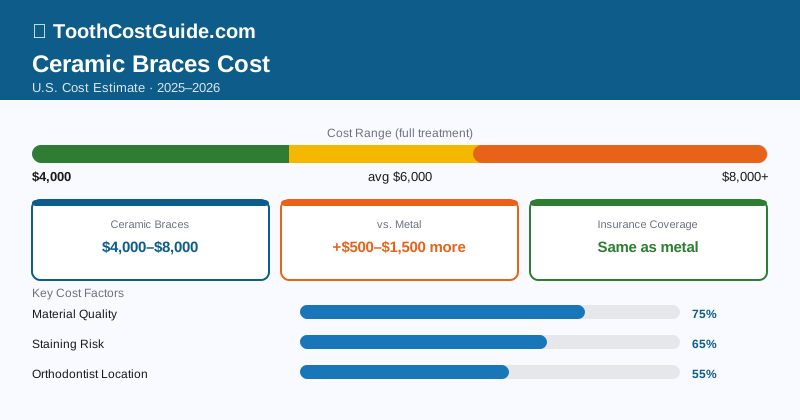
Full treatment runs $4,000–$8,000, averaging $500–$1,500 more than traditional metal braces. The clinical mechanics are identical — same archwires, same force physics, same results. The difference is the bracket material and the premium patients pay to not walk around looking like they’re in middle school.
| Braces Option | Cost Without Insurance |
|---|---|
| Ceramic (clear/tooth-colored) braces, full | $4,000–$8,000 |
| Metal braces (for comparison) | $3,000–$7,500 |
| Ceramic braces, upper arch only | $2,500–$4,500 |
| Self-ligating ceramic braces (Clarity SL) | $4,500–$8,000 |
| Lingual braces (behind teeth) | $8,000–$13,000 |
| Invisalign Full (for comparison) | $3,000–$8,000 |
What Drives the Price
Case complexity — the dominant factor. A mild 12-month crowding case runs $3,500–$5,500. A complex case involving bite correction and 30 months of treatment can reach $7,000–$8,000. Orthodontists price cases based on total clinical work, not just the bracket material. The ceramic premium is consistent across case types.
Bracket material and brand. Ceramic brackets come in two main types: polycrystalline alumina (opaque, white) and monocrystalline sapphire (nearly clear, more expensive). Standard polycrystalline brackets from brands like 3M Clarity or Dentsply Ormco Inspire ICE cost less than sapphire alternatives. The material difference adds $100–$300 per arch at the lab level, which feeds into the total fee.
Self-ligating vs. conventional ties. Self-ligating ceramic brackets like Clarity SL use an internal sliding mechanism instead of elastic ligatures. Brackets cost more and require additional training, adding $200–$500 to the total. Some evidence suggests slightly shorter treatment times with self-ligating brackets.
Upper arch only vs. full treatment. Lower front teeth are rarely visible during conversation. Ceramic on the upper arch with metal on the lower costs $3,500–$6,500 — a practical middle ground that addresses the teeth that actually show.
Orthodontist experience and market. Top-of-range fees come from experienced orthodontists in high-cost-of-living cities. Newer practices or competitive suburban markets often price ceramic braces closer to $4,000–$5,500 for standard cases.
The Four Types, Broken Down
Polycrystalline Alumina Brackets (standard ceramic) — $4,000–$7,500: The most widely used type. White or slightly off-white. Strong, predictable, and more affordable than sapphire. Brands include 3M Clarity and American Orthodontics In-Ovation C. Elastic ligatures can pick up staining from coffee, tea, and curries — a real-world consideration for most adults.
Monocrystalline Sapphire Brackets — $4,500–$8,000: Nearly clear due to the pure crystal structure. More expensive to manufacture. Harder than polycrystalline brackets — some research indicates a higher risk of enamel wear on opposing teeth over time. Best for patients who want the absolute minimum visual profile from a fixed appliance.
Self-Ligating Ceramic (Clarity SL, In-Ovation C) — $4,500–$8,000: The built-in sliding door mechanism eliminates colored elastic ties entirely, which solves the staining problem. Lower archwire friction may reduce discomfort at some adjustment stages. Add $300–$500 to the base ceramic fee.
Ceramic Upper, Metal Lower — $3,500–$6,500: Arguably the smartest configuration for budget-conscious patients who still want a discreet look. The savings versus full ceramic can run $500–$1,500 depending on the practice.
Ceramic braces are an excellent middle-ground option — significantly less visible than metal braces, much less expensive than lingual braces or Invisalign for complex cases. The main drawbacks are slight staining risk (ligature-based systems) and more fragility than metal — broken ceramic brackets are billed at $25–$75 per bracket replacement in many practices.
Ceramic vs. Metal vs. Invisalign
| Feature | Ceramic Braces | Metal Braces | Invisalign |
|---|---|---|---|
| Average cost | $4,000–$8,000 | $3,000–$7,500 | $3,000–$8,000 |
| Visibility | Low (tooth-colored) | High (silver) | Very low (clear trays) |
| Removable | No | No | Yes |
| Staining risk | Moderate | None | Low (trays replaced) |
| Best for complex cases | Yes | Yes (gold standard) | Moderate |
| Broken hardware risk | Higher | Lower | N/A |
How Insurance Handles Ceramic
Coverage for ceramic braces is identical to coverage for metal — the bracket material doesn’t change your benefit calculation. What does matter: many insurance contracts cap the “allowable cost” at the cost of standard metal braces and leave you to cover the ceramic premium out of pocket.
- Lifetime orthodontic maximum: $1,000–$3,000 per patient
- Coverage rate: Typically 50% up to the lifetime maximum
- Age limits: Most plans cover patients under 18–19; adult coverage varies
Example calculation:
- Ceramic braces cost: $6,000
- Insurance allowable (based on metal braces fee): $4,500
- Insurance pays 50%: $2,250 (to the lifetime max of $1,500 = $1,500 actual payment)
- Patient out-of-pocket: $4,500
Some insurance contracts define their benefit as the cost of “the least expensive clinically adequate treatment,” meaning they reimburse the metal braces equivalent only. Ask your orthodontist’s billing office to submit a pre-treatment estimate to your insurer before committing — knowing the real coverage amount upfront prevents unpleasant surprises.
Financing
In-house orthodontic payment plans: Most practices spread the total cost over the treatment period at 0% interest. A $6,000 ceramic braces case over 24 months is $250/month.
CareCredit: Promotional 0% interest periods of 12–24 months for qualified patients. Pay the balance before the promotional period expires — rates jump to 17–27% APR afterward.
FSA and HSA: Ceramic braces are a fully qualified expense. Maximizing FSA contributions before the treatment year saves 22–37% on what you pay from the account.
Dental school clinics: Orthodontic residency programs handle standard cases at 30–50% discounts, including ceramic bracket options for appropriate cases under faculty supervision.
Ways to Trim the Cost
Choose ceramic on the upper arch only. Lower front teeth are almost never visible during normal conversation. Hybrid upper ceramic/lower metal treatment cuts the ceramic premium by 50–60% while still addressing the teeth that matter.
Get multiple quotes. Ceramic braces fees vary $1,000–$2,000 for equivalent cases between orthodontists in the same market. Free consultations at 2–3 offices allow real comparison.
Ask about bulk family discounts. If multiple family members need orthodontic treatment, some practices offer 10–15% on subsequent cases. It’s not always advertised — ask explicitly.
Time your FSA enrollment. If ceramic braces are planned for the next 12 months, increase FSA contributions during the prior open enrollment period. You can access the full annual FSA election amount on January 1, before contributions are fully funded.
Ask about the broken bracket policy upfront. Some practices include repairs in the total fee. Others charge $25–$75 per incident. Ceramic breaks more easily than metal — understanding this policy helps you budget realistically.
The Bottom Line
Ceramic braces cost $500–$1,500 more than metal for the same clinical result, with treatment effectiveness that’s identical. At $4,000–$8,000, they overlap with Invisalign pricing for moderate cases while offering the precision advantage of fixed appliances for complex movements. Insurance applies up to the lifetime maximum, but the ceramic premium usually comes out of your pocket. For patients who want a less noticeable fixed-appliance option without the cost of lingual braces, ceramic braces are the practical middle ground.
Ceramic braces cost $500–$1,500 more than metal for the same clinical result and are available from most orthodontists. For adults and teens with mild-to-moderate cases, they combine the reliability of fixed braces with acceptable aesthetics. Staining and bracket fragility are the primary trade-offs versus metal, and insurance rarely reimburses the incremental cost difference.
Frequently Asked Questions
Ceramic braces typically cost between $4,000 and $8,000 for complete orthodontic treatment. The final price depends on the complexity of your case, treatment duration (usually 18-24 months), and your location, with urban areas generally charging more than rural regions.
Most dental insurance plans cover 50% of orthodontic treatment costs, with a lifetime maximum benefit of $1,500-$2,000, which means you'll likely pay $2,000-$4,000 out-of-pocket for ceramic braces. However, many plans have a 12-month waiting period for orthodontic coverage and may exclude cosmetic upgrades like tooth-colored brackets, so check your specific policy.
Ceramic braces work just as effectively as metal braces with nearly identical treatment timelines of 18-24 months, but ceramic brackets are more prone to staining and chipping if not properly maintained. The main trade-off is aesthetics: ceramic blends with your teeth but costs $1,000-$2,000 more than traditional metal braces.