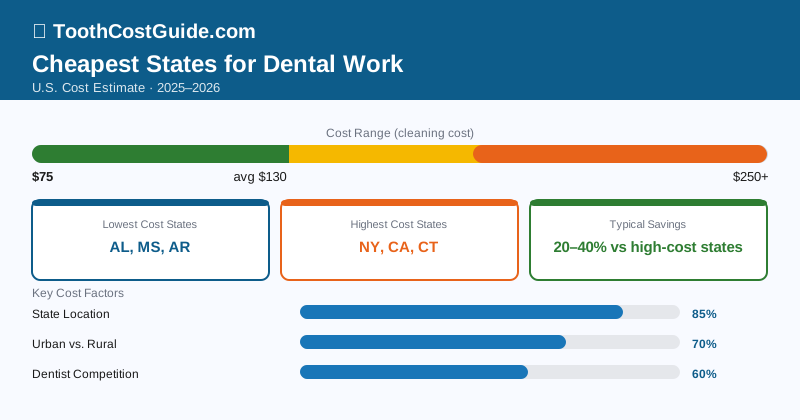
A crown in Bridgeport, Connecticut will run you $1,400 to $2,100. That exact same procedure — same porcelain materials, same CDT code, same standard of care — costs $750 to $900 in Mississippi. That’s not a small rounding error. That’s a $700 to $1,200 difference on a single tooth, and a gap you can actually do something about.
FAIR Health data consistently shows geographic price variation of up to 60% across US dental markets. For patients facing major treatment — multiple crowns, implants, full-mouth reconstruction — knowing which states are cheapest isn’t just trivia. It’s potentially thousands of dollars.
| State | Crown (avg) | Root Canal (avg) | Implant (avg) | Relative Cost Index |
|---|---|---|---|---|
| Mississippi | $750–$900 | $600–$800 | $2,800–$3,500 | Lowest |
| Alabama | $750–$950 | $650–$850 | $2,900–$3,600 | Very Low |
| Arkansas | $800–$950 | $650–$850 | $3,000–$3,700 | Very Low |
| Oklahoma | $800–$1,000 | $700–$900 | $3,000–$3,800 | Low |
| Tennessee | $850–$1,050 | $700–$900 | $3,100–$3,900 | Low |
| Kentucky | $850–$1,050 | $700–$950 | $3,100–$4,000 | Low |
| West Virginia | $800–$1,000 | $700–$900 | $3,000–$3,800 | Low |
| Texas (rural) | $850–$1,100 | $750–$950 | $3,200–$4,200 | Medium-Low |
| Ohio | $900–$1,150 | $800–$1,000 | $3,400–$4,200 | Medium |
| Florida | $1,000–$1,400 | $850–$1,150 | $3,600–$4,800 | Medium-High |
| New York City | $1,400–$2,200 | $1,100–$1,700 | $4,500–$6,000 | High |
| California (major cities) | $1,400–$2,000 | $1,100–$1,600 | $4,500–$6,000 | High |
| Connecticut | $1,400–$2,100 | $1,100–$1,700 | $4,500–$6,200 | Highest |
| Massachusetts | $1,350–$2,000 | $1,050–$1,650 | $4,400–$5,800 | High |
Why Dental Prices Vary So Much by State
Dental fees aren’t set by any central authority. Each practice sets its own schedule based on local market conditions, and those conditions differ enormously across the country.
Cost of living ripples through everything. A dental office in San Francisco’s financial district pays 3–4x the rent, staff salaries, and malpractice insurance of a practice in rural Mississippi. Those overhead costs flow directly into the fee schedule. The dentist isn’t pocketing the difference — they’re just covering their costs in an expensive market.
UCR rates create regional price anchors. Insurance companies calculate “usual, customary, and reasonable” (UCR) reimbursement rates by zip code using historical claims data. These rates effectively establish what’s considered a normal price in each market. Dentists in high-UCR markets charge more partly because that’s what the insurance ecosystem has normalized in their area.
Urban vs. rural splits are real within states. Texas illustrates this cleanly: a Dallas or Houston practice charges 20–30% more than a comparable small-city practice two hours away. The state-level numbers above are averages — within any state, you’ll find a significant spread between metro and rural areas.
Competition affects pricing too. States with high dental school enrollment — New York, California, Illinois — have more dentists per capita. That competition tends to moderate prices in some urban submarkets, even within expensive states.
The Math on Traveling for Dental Work
Domestic dental tourism isn’t a fringe concept. Patients from California, Connecticut, and New York increasingly travel to lower-cost states for major procedures, particularly when they’re already facing treatment plans in the $5,000+ range.
Here’s how the arithmetic works on a realistic scenario:
A California patient needs a full implant ($5,000–$6,000 in their home market). They fly to Nashville, have the implant placed at $3,200, stay one night, and return for the crown placement on a second trip — spending roughly $3,800 including flights and hotel versus $5,000+ at home. Net savings: $1,200 or more on one tooth.
Scale that to a larger treatment plan:
A full treatment plan (2 implants + 3 crowns + root canal):
- Connecticut/California: $14,000–$18,000
- Tennessee/Kentucky: $8,500–$11,000
- Savings: $3,000–$7,000
At that scale, the economics of traveling become very clear.
Best states for domestic dental travel:
- Tennessee — low costs, strong dental school presence (Meharry, UT Health), Nashville accessible from much of the Southeast
- Kentucky — very competitive pricing, easy reach from the Midwest
- Oklahoma — low dental costs, uncrowded cities, affordable accommodation
- Ohio (Dayton, Columbus suburbs especially) — mid-range costs, good dental school infrastructure through Ohio State
Who Should Consider Traveling for Dental Care
There’s no eligibility requirement — any American can choose where to get dental care. But not every situation makes traveling worthwhile. Here’s how to think about it:
Travel makes financial sense when:
- The total cost difference for your full treatment plan exceeds $1,000–$1,500 after adding up flight, hotel, and time costs
- Your treatment requires 2–3 visits that can be planned in advance (implants, for example)
- You have a local dentist who can handle post-treatment complications or urgent issues
Travel probably doesn’t make sense when:
- You need a single filling or cleaning — the math won’t work
- Your treatment requires many short-interval appointments
- You have a medical condition requiring close continuity of care
Advantages and Drawbacks of Cross-State Dental Care
What works in your favor:
- All US dental practices are licensed and regulated by their state dental board — the standard of care is the same whether you’re in Alabama or Connecticut
- Your records, X-rays, and post-treatment documentation transfer without language or format barriers
- You can potentially combine dental travel with visiting family or other plans in that region
- No passport required, no currency conversion, no pharmaceutical concerns
What creates friction:
- Multi-visit procedures like implants require you to make multiple trips, planning weeks or months apart
- You’re establishing a new patient relationship from scratch — the full intake process takes time
- If something goes wrong after you’re back home, you’re finding a new local provider who doesn’t know your case
- For shorter procedures, travel costs can eat a significant portion of the savings
When seeking dental care in a lower-cost state, verify the dentist’s license through that state’s dental board website before scheduling. Look for reviews from patients who traveled for care. Choosing a lower-cost state doesn’t mean choosing lower quality — but you should do your due diligence just as you would when choosing any new dentist.
A Practical Roadmap for Comparison Shopping Across States
Get a comprehensive treatment plan from your local dentist: You need a written, itemized plan with CDT procedure codes to comparison-shop effectively.
Use Fair Health Consumer: Visit fairhealthconsumer.org and check the “90th percentile” cost for your specific procedure codes across different zip codes. Compare your home zip code to lower-cost regions.
Identify target states or cities: Based on your fair-health comparison, identify 2–3 regions where costs are significantly lower. Focus on areas that are accessible (within 2–4 hours flight or drive) and have multiple quality dental practices.
Search for dentists in target area: Use Zocdoc, Google reviews, and state dental association directories to find well-reviewed dentists in your target area. Look for offices that explicitly welcome patients traveling for care.
Contact offices and request quotes: Call 2–3 offices, explain that you’re traveling for care, and ask for a fee estimate for your specific procedure codes. Offices familiar with dental tourists will be prepared for this conversation.
Calculate full cost comparison: Quote + flights or driving cost + hotel (if needed) = total cost. Compare to home dentist price. If savings exceed $1,000–$1,500, traveling may make financial sense.
Coordinate care: Establish a timeline that minimizes trips (e.g., for implants, can the workup CT scan be done at home with results sent ahead?). Ask the traveling dentist about their protocol for follow-up complications.
Even without traveling, knowing the price range in lower-cost states is valuable negotiating information. When your dentist quotes $1,600 for a crown, you can truthfully say: “I’ve looked at pricing and seen fees of $900–$1,100 for this same procedure in neighboring states. Is there any flexibility here?” Many dentists will meet you partway rather than lose you to a lower-cost area.
Bottom Line
Dental prices vary by up to 60% depending on where you live, and that gap is real enough to justify planning around it. For patients facing major treatment — multiple implants, full-mouth reconstruction, or several crowns — Tennessee, Kentucky, Arkansas, and Oklahoma consistently deliver the best combination of low fees and accessible quality care. Use FAIR Health Consumer to validate the specific cost difference for your procedures before committing to any travel. And even if you never leave your home state, knowing what comparable care costs elsewhere gives you a legitimate baseline for negotiating with your local dentist.
Frequently Asked Questions
A dental crown ranges from $750 to $900 in Mississippi, Alabama, and Arkansas, but costs $1,400 to $2,100 in Connecticut and California—a difference of up to $1,200 per tooth. The national average typically falls between $1,000 and $1,500 depending on the state and material used.
Most dental insurance plans cover 50% of crown costs after you meet your deductible, leaving you responsible for the remaining balance out-of-pocket. However, many plans have annual maximums of $1,000 to $2,000, so a single crown may exhaust or significantly reduce your yearly coverage.
For major procedures like crowns, traveling to a low-cost state can save $700 to $1,200 per tooth even after accounting for travel expenses. Plan ahead with your dentist to schedule multiple procedures in one trip to maximize savings on flights or accommodation costs.