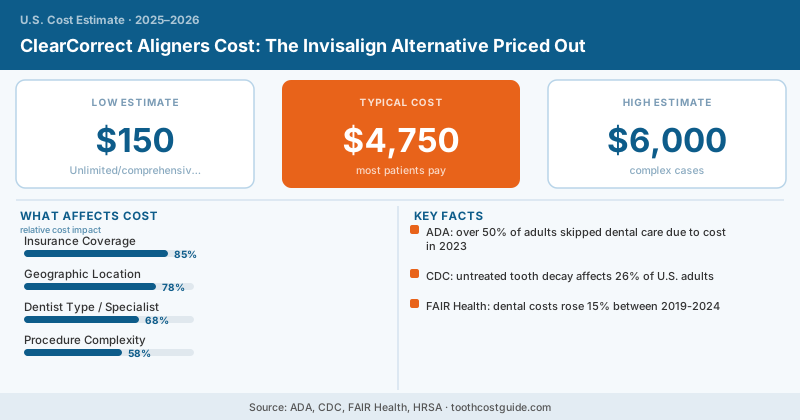
In 2010, clear aligners meant one brand: Invisalign, at whatever price that single company decided to charge. Today, ClearCorrect and several other aligner systems compete directly on price and clinical protocol, and the competition has been good for patients’ wallets. ClearCorrect typically runs $2,500-$6,000 for full treatment — often 10-20% less than a comparable Invisalign case.
| ClearCorrect Plan | Typical Cost | Best For |
|---|---|---|
| Limited (minor crowding/relapse) | $1,500–$3,000 | Mild cases, fewer than 12-16 aligners |
| Moderate | $2,500–$4,500 | Moderate crowding or spacing |
| Unlimited/comprehensive | $3,500–$6,000 | Complex cases, unlimited refinements |
| Retainers (post-treatment) | $150–$400 per arch | Included in some comprehensive plans |
Why ClearCorrect Costs Less Than Invisalign for Similar Cases
Part of the price gap comes down to brand economics rather than clinical differences. Invisalign, made by Align Technology, has spent heavily on consumer advertising and built strong name recognition — “Invisalign” has become a generic term many patients use for clear aligners broadly, similar to how “Kleenex” became shorthand for tissue. That brand premium translates into pricing power, and orthodontists using Invisalign typically pay more per case to the manufacturer, a cost passed to patients.
ClearCorrect, owned by Straumann Group, competes primarily on cost and has built a reputation among orthodontists for comparable clinical results at a lower per-case fee, which providers often pass through as savings.
Clinical Comparison: Is Cheaper Actually Worse?
Independent studies comparing clear aligner systems for mild-to-moderate malocclusion generally find comparable effectiveness across major brands when treatment planning and patient compliance are equal. The material composition, tray thickness, and attachment (small tooth-colored bumps that help grip aligners) protocols differ slightly between ClearCorrect and Invisalign, but neither has been shown to be dramatically superior for typical cases in the research literature.
For severe or complex cases — significant bite discrepancies, major rotations, or cases requiring extensive tooth movement — some orthodontists still prefer Invisalign’s more established tracking technology and larger clinical case library. Ask your orthodontist directly which system they recommend for your specific case and why, rather than assuming price alone should drive the decision.
Aligner treatment success depends heavily on the orthodontist’s treatment planning skill — how they sequence tooth movements, place attachments, and monitor progress — more than which specific aligner brand is used. A skilled orthodontist using ClearCorrect will typically outperform a less experienced provider using Invisalign. Choose your orthodontist first, then discuss which aligner system they recommend and why.
What Drives Price Within ClearCorrect Itself
Case complexity is the single biggest factor — mild crowding requiring 10-14 aligners costs far less than complex rotations and spacing requiring 30+ aligners with multiple refinement rounds.
Comprehensive vs. limited treatment plans. Limited plans cap the number of aligners and refinements included; comprehensive plans include unlimited aligners and refinement scans for the treatment duration, at a higher upfront cost but less risk of surprise additional fees mid-treatment.
Geographic location and practice type affect pricing similarly to traditional braces — general dentists offering ClearCorrect sometimes price lower than orthodontic specialists, though specialist training in complex tooth movement can matter for anything beyond mild cases.
Insurance and Financing
Since ClearCorrect falls under standard orthodontic treatment codes, insurance coverage typically mirrors what a plan would pay toward traditional braces or Invisalign — commonly 25-50% up to a lifetime maximum of $1,000-$2,500. In-house payment plans spreading the cost over the treatment duration (interest-free at most orthodontic offices) remain the most common way patients manage the upfront cost.
Beware of mail-order or “direct-to-consumer” clear aligner companies that skip in-person orthodontist supervision entirely to offer rock-bottom prices. ClearCorrect and Invisalign both require an orthodontist or dentist to take impressions, create the treatment plan, and monitor progress in person — a meaningful safety difference from unsupervised mail-order aligner companies that have drawn regulatory scrutiny in several states.
The Bottom Line
ClearCorrect delivers comparable clinical results to Invisalign for most mild-to-moderate cases, typically at a 10-20% lower price point of $2,500-$6,000. The provider’s treatment planning skill matters more than the aligner brand itself — choose your orthodontist first, and ask which system they recommend for your specific case.
Frequently Asked Questions
ClearCorrect typically costs $2,500–$6,000 for a full treatment plan, depending on case complexity and the specific provider's fees. Limited treatment plans for minor crowding or relapse cases can cost as little as $1,500–$3,000.
ClearCorrect is often priced 10-20% lower than Invisalign for comparable cases, partly because Invisalign holds a larger market share and stronger brand recognition, allowing for higher pricing. Clinical effectiveness between the two brands is generally considered comparable for mild-to-moderate cases by most orthodontic research, though material and tracking technology differ slightly.
Most dental insurance plans with an orthodontic benefit cover ClearCorrect identically to traditional braces or Invisalign, since insurers typically categorize treatment by the orthodontic benefit code rather than by aligner brand. Confirm with your specific insurer, since some older plans may still specify 'braces' narrowly in their policy language.