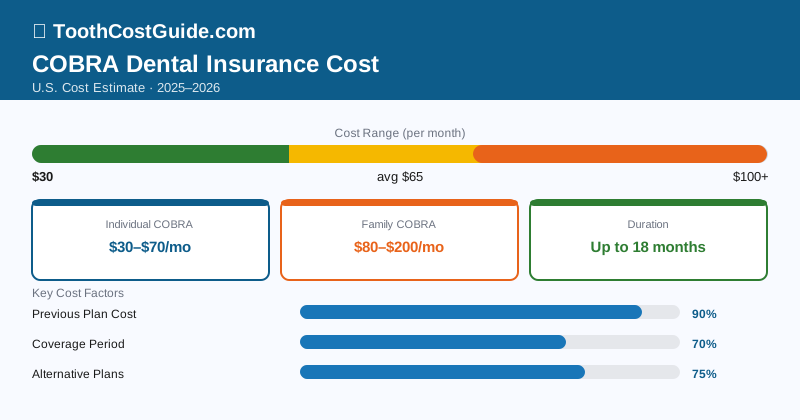
You just left your job. Your dental coverage ends at the end of the month. HR mentions COBRA. Here’s what they don’t explain: COBRA dental costs 2–5 times more than comparable individual market plans — because now you’re paying the employer’s share of the premium too, plus a 2% administrative fee.
For most people between jobs, COBRA dental is a bad deal. But “most” isn’t “all.” There are specific situations where it’s the right call. Here’s how to tell which side you’re on.
| Coverage Option | Monthly Cost | Annual Max | Waiting Periods | Best For |
|---|---|---|---|---|
| COBRA dental (individual) | $50–$150 | Same as employer plan | None (waived) | Active treatment, near end of employer wait period |
| COBRA dental (family) | $150–$400 | Same as employer plan | None | Active treatment for multiple family members |
| Individual market PPO | $30–$60 | $1,000–$2,000 | 6–12 months major | Most people between jobs |
| No-wait individual plan (Spirit) | $33–$57 | $3,000–$5,000 | None | Those needing immediate coverage |
| Dental discount plan | $8–$20 | N/A | None | Budget-focused gap coverage |
| Do nothing (self-pay) | $0 | N/A | N/A | Very healthy with no upcoming needs |
Why COBRA Dental Costs So Much
The premium shock is predictable once you understand what you were actually paying before. Your employer was covering 50–80% of your dental premium — the slice you saw on your paystub was just the employee portion. Under COBRA, that calculation flips: you pick up the whole tab plus an administrative surcharge.
Work through a realistic example:
- Your employer’s group dental plan: $75/month total premium
- What you paid each month at work: $15
- COBRA cost: $75 + 2% administrative fee = $76.50/month
- That’s a 5x jump overnight
Scale that to family coverage and the numbers get significant fast:
- Family dental premium: $200/month
- What you paid employed: $40/month
- COBRA family cost: $204/month
Typical COBRA dental ranges by tier:
- Individual: $50–$150/month
- Employee + spouse: $100–$250/month
- Family: $150–$400/month
The Retroactive Election Feature Nobody Warns You About
COBRA has a little-known mechanism that’s worth understanding even if you ultimately don’t elect it.
You have 60 days from your coverage loss date (or the date you receive the COBRA notice, whichever is later) to elect COBRA — and coverage is retroactive to the day your employer plan ended. That means if you have a dental emergency five weeks after leaving your job, you can elect COBRA in week six, pay the back premiums you would have owed, and have the emergency treated as if you’d been covered the whole time.
That retroactive window is the most powerful feature COBRA has. It functions as a safety net — if something catastrophic happens during your 60-day decision period, you can reach backward and activate coverage. Once you know you’re not facing a dental crisis, the case for continuing COBRA at full price gets weak fast.
COBRA dental costs 2–5x more than comparable individual dental plans. Most people are better served by buying a standalone individual dental plan (or a no-wait plan if needed immediately). The exception: if you’re actively in the middle of expensive dental treatment or your employer’s waiting period on major work is almost finished, COBRA preserves continuity and avoids restarting the clock.
The Waiting Period Trap When You Switch
Here’s where dropping COBRA can backfire: new dental plans come with their own waiting periods. If you spent 11 months on your employer’s plan and were a month away from satisfying the 12-month major work waiting period, dropping that coverage and buying an individual plan resets the clock to zero.
Before you assume you’re stuck, though, check whether your new insurer will accept a Certificate of Prior Coverage. Most will waive waiting periods if you demonstrate continuous coverage with no gap larger than 30–63 days. The moment your employer coverage ends, request this certificate from your insurer — not when you decide whether you need it, but immediately. It expires as a useful document once a gap in coverage appears.
What You’re Choosing Between
Standard individual PPO ($30–$60/month): Lower cost, comparable annual maximums. The tradeoff is new waiting periods — 6 months for basic services, 12 months for major. With prior coverage documentation, those waits may disappear entirely.
No-wait individual plans ($33–$57/month via Spirit Dental): Coverage from day one with no waiting period for any service, including major work. Annual maximums of $3,000–$5,000 — often better than the employer plan you’re leaving. The cost is comparable to mid-range individual plans. For most people who’ve just left a job and can’t afford to wait 12 months for a crown, this option beats COBRA on both price and flexibility.
Dental discount plans ($8–$20/month): Membership programs that reduce your fees at participating dentists by 20–60%. No insurance, no claims, no waiting periods. Useful as a bridge while you decide on a longer-term plan or while waiting for a new plan’s coverage to activate.
Three Cases Where COBRA Dental Actually Makes Sense
You’re in the middle of active treatment. Orthodontic treatment spanning two years, a multi-visit implant procedure, ongoing periodontal therapy — any course of care where changing insurers mid-stream would create coverage gaps or require re-starting from scratch. COBRA keeps you on the same plan with the same network and doesn’t reset any ongoing treatment protocols.
Your employer’s major-work wait is almost satisfied. You’ve been on your employer’s plan for 10 months and the major-work waiting period is 12 months. Two more months of COBRA closes the gap. After that, you can switch to a cheaper individual plan and use your prior coverage certificate to waive that plan’s own waiting periods.
You know you need specific expensive work soon. A crown or bridge in the next 90 days, and your employer plan’s waiting period was already satisfied. COBRA continuity means you complete the work under the same coverage rather than facing a 12-month wait at the new plan.
Transitioning Without Getting Burned
Get your Certificate of Prior Coverage immediately. Don’t wait until you’ve decided on a new plan — request it the day your employer coverage ends. Insurers sometimes take time to generate these documents, and gaps in coverage can disqualify you from waiting period waivers.
Be strategic with the 60-day window. You’ve got two months to decide. Unless something expensive happens in weeks one through four, hold off and shop. If you reach day 45 with no dental emergencies, the case for a cheaper individual plan is compelling.
Front-load dental work before you leave. If you have 60–90 days notice that you’re leaving your employer, schedule any anticipated dental work before your last day. Crown diagnostics, deep cleaning, anything your dentist has recommended — better to do it with employer-subsidized coverage than to pay COBRA rates afterward.
Failure to pay COBRA premiums on time results in immediate termination of coverage — and unlike the initial 60-day election window, there’s no retroactive reinstatement if you miss a monthly payment (after the initial grace period). Set up automatic payments if you elect COBRA dental to avoid an accidental lapse.
COBRA dental costs 2–5x more than individual market alternatives and makes financial sense only in specific situations: active treatment, nearly satisfied waiting periods, or when the retroactive election feature is needed for emergency coverage. Most people transitioning between jobs are better served by a no-waiting-period individual dental plan at $33–$57/month, especially when prior coverage documentation can waive new waiting periods.
Bottom Line
COBRA dental at $50–$150/month individual or $150–$400/month family is expensive compared to every alternative. For most people who’ve recently left a job, a standalone individual dental plan — especially a no-wait option from Spirit Dental — is cheaper and often provides equal or better annual maximums. COBRA dental makes sense only in three situations: active multi-appointment dental treatment, waiting periods nearly satisfied with major work imminent, or using the 60-day retroactive election window to cover an emergency. Everyone else should get their Certificate of Prior Coverage, buy a new individual plan, and keep the premium savings.
Frequently Asked Questions
COBRA dental insurance typically costs $50–$150 per month, depending on your former employer's plan and location. This price includes both the employee and employer premium portions plus a 2% administrative fee, making it 2–5 times more expensive than comparable individual dental plans on the open market.
COBRA dental plans usually cover preventive care (cleanings, exams) at 100%, basic procedures (fillings, extractions) at 70–80%, and major work (crowns, root canals) at 50% after you meet a deductible of $25–$100 per person. Your out-of-pocket costs for a major procedure like a crown can range from $400–$800 depending on the plan's coinsurance percentage.
For most people, individual dental plans are a better value, costing $10–$30 per month with similar coverage to COBRA. Only choose COBRA if you need continuous coverage for an expensive procedure already in progress, have a pre-existing condition your new plan won't cover immediately, or are only between jobs for 1–2 months and want to avoid plan switching.