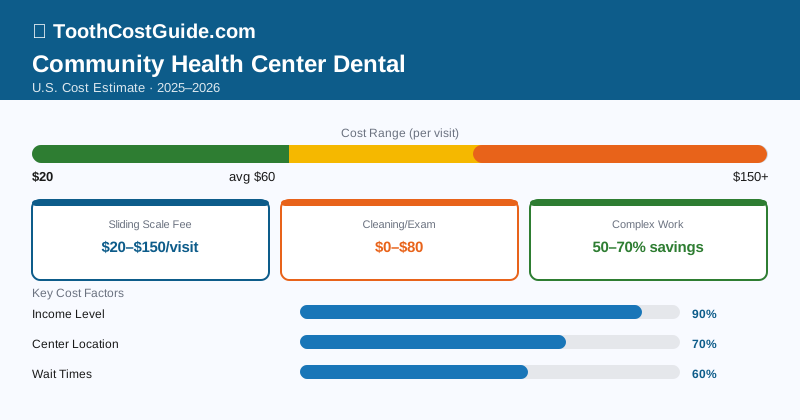
Thirty million Americans use them every year. Most people have never heard of them. Federally Qualified Health Centers — FQHCs — are the country’s largest dental safety-net system, with over 14,000 service sites operating in every state. For patients at or near the federal poverty level, a cleaning and exam that costs $200–$250 at a private dentist might run $0–$20 here. Not because the care is worse, but because federal grants cover the gap.
| Procedure | Private Office Cost | FQHC (at 100% FPL) | FQHC (at 200% FPL) | Savings |
|---|---|---|---|---|
| Dental exam + X-rays | $150–$250 | $0–$10 | $15–$50 | 80–100% |
| Adult teeth cleaning | $100–$200 | $0–$10 | $15–$45 | 80–100% |
| Composite filling | $150–$300 | $0–$20 | $25–$75 | 75–100% |
| Tooth extraction (simple) | $150–$350 | $0–$25 | $30–$80 | 75–100% |
| Root canal (molar) | $800–$1,500 | $0–$75 | $80–$200 | 85–100% |
| Full dentures | $1,500–$3,500 | $50–$200 | $200–$600 | 80–95% |
| Pediatric cleaning + exam | $100–$200 | $0–$5 | $10–$30 | 85–100% |
What Makes an FQHC Different From a Regular Clinic
FQHCs receive federal grants under Section 330 of the Public Health Service Act. That funding comes with obligations that are actually good for patients:
- They must be located in a medically underserved area or serve a medically underserved population
- They’re required to see all patients regardless of ability to pay
- They must use a sliding-fee discount program based on income and family size
- They have to offer comprehensive primary care — and most include dental
- A patient-majority board governs the organization
That last point matters: FQHCs are structurally accountable to the communities they serve.
The sliding-fee scale in plain English: FQHCs peg their fees to the federal poverty level (FPL). Your assigned fee tier depends on your income and household size:
- At or below 100% FPL: Nominal fee — typically $0–$20 per visit
- 101–200% FPL: Sliding scale, often 10–40% of the full charge
- Above 200% FPL: Full fee applies, but FQHCs still accept everyone
Not every FQHC offers dental specifically. Most larger ones do, but it’s worth confirming before you make the trip.
What the Numbers Look Like in Practice
Numbers on a table are one thing. Here’s what they mean for real households.
Family of four at 138% FPL (roughly $43,000/year — the Medicaid expansion threshold):
- Two adult cleanings per year: $0–$40 total
- Two child cleanings: $0–$20 total
- A crown: $30–$150, versus $1,200–$1,800 at a private practice
- Total annual dental spend for the family: $30–$200 vs. $600–$1,200+ elsewhere
Single adult at 175% FPL (~$27,400/year):
- Exam, X-rays, and cleaning: $15–$60 vs. $250–$450
- Root canal: $80–$200 vs. $800–$1,500
These figures aren’t speculative estimates. They’re grounded in HHS guidelines for sliding-fee minimums that FQHC grant recipients are legally required to honor.
What about insurance? FQHCs also accept Medicaid, CHIP, Medicare, and private insurance. If you’re on Medicaid, your copay at an FQHC is typically $0–$3. Having insurance doesn’t disqualify you — the FQHC simply bills your insurer and you pay any applicable copay.
Who Can Use an FQHC
The short answer: everyone. There’s no income ceiling for access. But the sliding-fee discount applies to uninsured patients (or in some cases, patients with documented financial hardship who are underinsured).
To apply for the sliding-fee discount, bring:
- Proof of income: Two recent pay stubs, a tax return, an unemployment letter, or a self-attestation form if you have no income
- Proof of household size: A statement of who lives in your home
- Photo ID: Preferred, but not required everywhere
If you have no documentation at all: Many FQHCs allow self-attestation of income. Tell the staff you have nothing to show — most centers will still enroll you in the lowest fee tier based on your word. The goal of the program is access, not gatekeeping.
Honest Pros and Cons
What works well:
- Every state has FQHC sites — 14,000+ nationwide
- No insurance required, ever
- Medicaid, CHIP, and Medicare all accepted
- Year-round care, not dependent on occasional events
- You can establish a real, ongoing relationship with a provider
What to watch out for:
- Not every community health center offers dental — always call first
- Waits of 2–6 weeks for dental appointments are common at busy sites
- Specialty services like implants or orthodontics are usually unavailable
- Quality genuinely varies between centers — newer facilities with experienced staff are better resourced
- Complex treatment may stretch across multiple visits
Not every community health center listed online offers dental services. Always call ahead and specifically ask: “Do you offer dental care? Are you currently accepting new dental patients? Do you have a sliding-fee program for uninsured patients?” Getting a clear answer before driving to the center saves wasted trips.
How to Actually Use One: A Step-by-Step Process
Step 1 — Find FQHC locations near you. Go to findahealthcenter.hrsa.gov. Enter your address, select “Dental Care” under services, and choose your preferred radius. A map shows qualifying centers.
Step 2 — Call ahead before you show up. Phone the health center and get answers to four questions: Do you have dental services? Are you accepting new dental patients? Do you have a sliding-fee program for uninsured patients? What documents do I need for the sliding-fee application?
Step 3 — Gather your income documentation. Prepare your last two pay stubs, a recent tax return, or a benefit letter. If you have no income at all, ask the center if they have a self-attestation form — or write a brief statement yourself.
Step 4 — Schedule your appointment. Some FQHCs have same-week availability. Others are booked 2–4 weeks out. Ask to be added to a cancellation list if you need care sooner.
Step 5 — Show up with your documents. Bring: photo ID, income documentation, proof of household size if requested, and any insurance cards you have. If you’re uninsured, the income documents are what matter.
Step 6 — Complete the sliding-fee enrollment. When you arrive, you’ll fill out a short application. A staff member reviews your documentation and assigns you to a fee tier. This typically takes 10–15 minutes and happens before your appointment.
Step 7 — Establish ongoing care. FQHCs work best as your dental home, not a one-time visit. Establishing yourself as a regular patient and scheduling cleanings twice a year means preventive care costs essentially nothing for low-income patients — and it prevents the expensive emergencies that come from skipping routine care.
Look beyond the nearest FQHC. Some centers are better-staffed and have more dental services than others. If the closest FQHC has a long dental waitlist, check the next few on the list. The HRSA locator shows all qualifying centers — sometimes one 10 miles further has much shorter waits and broader dental services.
The Bottom Line
If you’re uninsured, underinsured, or on a low income, FQHCs represent the most reliable, year-round source of affordable dental care in the country. The legal framework behind them — federally mandated sliding fees, universal access, and income-based discounts — makes them structurally different from a regular clinic that just happens to charge lower prices. For the lowest-income patients, care is functionally free. For everyone else, it’s significantly cheaper than the private market. The starting point is simple: findahealthcenter.hrsa.gov, filter for dental, and pick up the phone.
Frequently Asked Questions
At Federally Qualified Health Centers, a cleaning and exam typically costs $0–$20 for low-income patients, compared to $200–$250 at private dental practices. The exact fee depends on your household income and is calculated using a sliding-scale model, meaning uninsured or underinsured patients pay little to nothing.
Yes, FQHCs accept Medicaid, Medicare, and most private dental insurance plans, and you pay nothing or your normal copay. If you are uninsured or your insurance does not cover certain services, you qualify for sliding-scale fees based on your income level.
FQHCs offer preventive and basic restorative care including X-rays, fluoride treatments, fillings, and extractions; however, services vary by location and may not include complex procedures like root canals or crowns. Call your local FQHC to confirm which services are available and whether advanced treatments require a referral to a specialist.