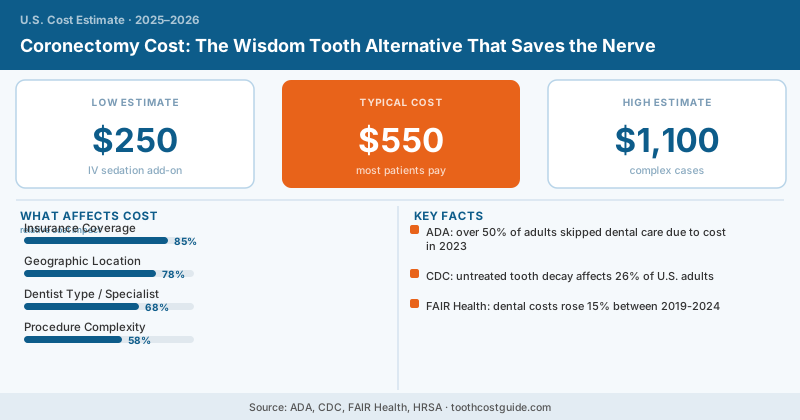
Ever heard of removing only half a tooth? That’s a coronectomy, and it costs $450–$900 per tooth without insurance. The surgeon takes off the crown of an impacted wisdom tooth but deliberately leaves the roots in place — because pulling those roots would risk permanently damaging a major nerve.
It sounds counterintuitive. Why leave roots behind? The answer is the inferior alveolar nerve, which runs through the lower jaw and sometimes wraps right around wisdom tooth roots. Yank the whole tooth and you might cause lasting numbness in the lip and chin. A coronectomy sidesteps that risk.
Coronectomy vs. Full Removal
| Procedure | What’s Removed | Cost Per Tooth |
|---|---|---|
| Coronectomy | Crown only, roots stay | $450–$900 |
| Full impacted removal | Whole tooth | $350–$1,100 |
| IV sedation add-on | — | $300–$800 |
| Follow-up imaging (CBCT) | 3D scan | $250–$600 |
The American Association of Oral and Maxillofacial Surgeons recognizes coronectomy as an accepted technique specifically for cases where the nerve risk is high. Surgeons usually confirm that risk first with a CBCT scan — a 3D X-ray that shows exactly how close the roots sit to the nerve canal.
When a Coronectomy Makes Sense
This isn’t for every wisdom tooth. It’s reserved for deeply impacted lower wisdom teeth whose roots are tangled with the nerve. If your panoramic X-ray shows that danger zone, your surgeon may recommend it over a full extraction.
The CBCT scan ($250–$600) isn’t an upsell — it’s how the surgeon decides whether you even need a coronectomy. The scan reveals the true relationship between root and nerve. Skipping imaging and doing a standard removal anyway is the exact scenario that leads to nerve injury. Treat the scan as part of the procedure’s cost.
The Trade-Offs
Leaving roots behind isn’t risk-free either. In a small share of cases, the retained roots migrate upward over time and may eventually need removal — a second, simpler surgery. Most don’t, but it’s the honest downside. Your surgeon will monitor the roots with periodic X-rays.
A coronectomy is only appropriate when nerve proximity makes full removal dangerous. If your wisdom tooth isn’t near the nerve, a standard wisdom tooth removal is usually the better, more definitive choice. Don’t request a coronectomy just to keep things “minimal” — it has to fit your anatomy.
What Recovery Looks Like
Recovery from a coronectomy is often gentler than a full extraction, since the surgeon disturbs less bone around the nerve. Expect some swelling and soreness for a few days, a soft-food diet, and the usual no-smoking, no-straw rules to protect the healing site. Your surgeon will want a follow-up X-ray weeks later, then periodic checks over the following year or two to confirm the retained roots are staying put and not migrating toward the surface. Those monitoring visits are part of the deal — budget a little for them.
Insurance and Coverage
Coronectomy is a less common code, so coverage varies. Many dental plans treat it like a surgical extraction at 50% to 80% after the deductible. Pre-authorization is smart here. Knowing how dental insurance works helps you confirm the procedure code is covered before surgery.
Keeping Costs Manageable
No insurance? University oral surgery programs perform coronectomies at reduced rates under faculty supervision. A dental savings plan shaves 15% to 25% off surgical fees, and CareCredit finances the bill over interest-free months.
The Bottom Line
A coronectomy costs a bit more than some routine extractions, but the price buys real nerve protection in the right cases. If your surgeon recommends it after a CBCT scan, that’s anatomy talking — not upselling. Compared to the lasting numbness a botched tooth extraction can cause, the extra few hundred dollars is cheap insurance.
Frequently Asked Questions
A coronectomy typically costs $450–$900 per tooth without insurance, making it significantly cheaper than full extraction in cases where nerve protection is critical. The final cost depends on tooth complexity, surgeon experience, and geographic location, with oral surgeons generally charging more than general dentists.
Most dental insurance plans cover coronectomy similarly to standard extractions, typically at 50–80% coverage after your deductible, though some plans classify it as surgical extraction and cover it at lower rates. Your out-of-pocket cost usually ranges from $90–$450 per tooth depending on your plan's coverage percentage and annual maximum.
A coronectomy is recommended when wisdom tooth roots are dangerously close to the inferior alveolar nerve, which would likely be damaged during complete removal and cause permanent numbness or pain in the lower jaw, chin, or lip. Recovery is typically faster than full extraction, with most patients returning to normal eating within 1–2 weeks.