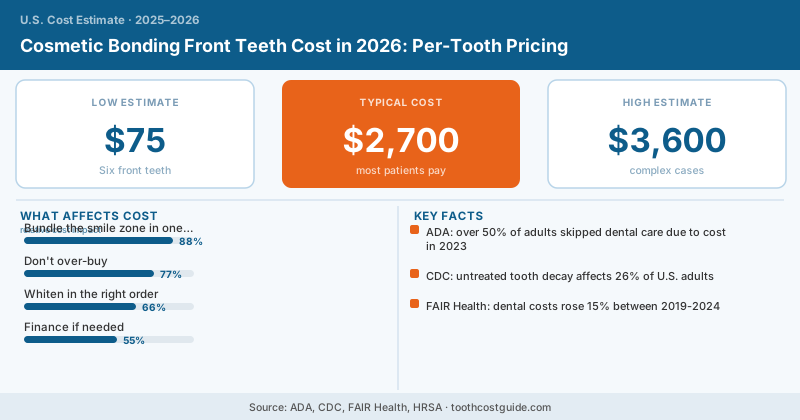
About 42% of Americans say they don’t smile freely because of how their teeth look — and for a lot of them, the issue is just a few front teeth. Cosmetic bonding fixes those teeth fast and cheap: $300 to $600 per tooth, in a single visit, with no drilling and no lab wait. For the four front teeth most people care about, you’re looking at roughly $1,200 to $2,400 total. Here’s exactly what that buys and where the price moves.
| Front-Teeth Bonding Scenario | Typical Cost |
|---|---|
| Single front tooth | $300–$600 |
| Two front teeth (central incisors) | $600–$1,200 |
| Four front teeth (smile zone) | $1,200–$2,400 |
| Six front teeth | $1,800–$3,600 |
| Gap closure (2 teeth) | $600–$1,200 |
| Touch-up/polish (per tooth) | $75–$200 |
What You’re Paying For on Front Teeth
Bonding the front teeth is more art than science, and that’s reflected in the price. Your dentist matches the composite resin to your natural shade, sculpts it onto the tooth to fix chips, gaps, or shape, hardens it with a curing light, then polishes it to a natural sheen. Front teeth are the hardest to bond well because everyone sees them — a slightly off shade or a bulky shape shows immediately. So the dentist’s skill and time on the tooth drive the cost.
A cosmetic-focused practice often charges $100–$200 more per tooth than a general dentist, and for the visible front zone, that premium usually buys a noticeably better result.
Cosmetic bonding on front teeth is reversible and removes little to no enamel — making it the ideal “try before you commit” alternative to permanent veneers. For chips, small gaps, and minor shape fixes, a $400 bonded tooth can look nearly identical to a $2,000 veneer to anyone who isn’t a dentist.
Front-Teeth Bonding vs. Veneers
This is the comparison everyone makes. The ADA generally favors more conservative treatment when it achieves the goal, and bonding is the conservative choice — no irreversible enamel removal. Bonding wins on cost, speed, and reversibility. Dental veneers win on longevity (10–20 years vs. 3–10 for bonding) and stain resistance.
For someone with a chipped front tooth and a tight budget, bonding is the obvious answer. For someone planning a permanent, uniform full-smile transformation, veneers earn their cost. Many people start with bonding and only upgrade if they want more later. Our broader dental bonding guide compares all applications.
The Staining Reality
Composite isn’t porcelain. It picks up stains from coffee, tea, red wine, and tobacco over time, and front teeth are right in the line of fire. Expect to polish or touch up bonded front teeth every few years to keep them bright. Cutting back on staining drinks, using a straw, and not smoking all extend the life of the work.
One more sequencing rule: if you’re also planning teeth whitening, whiten first. Composite can’t be bleached after it’s placed, so bonding before whitening leaves the bonded teeth visibly darker than the rest.
Does Insurance Cover It?
Purely cosmetic bonding — closing a gap between healthy teeth, reshaping a tooth you don’t like — isn’t covered. But if a front tooth is chipped from trauma or worn from a bite problem, the same procedure may be coded as restorative and covered 70–80%. Ask your dentist how they’ll classify it. If it’s restorative, an FSA can also cover it with pre-tax dollars.
Saving Money
Bundle the smile zone in one visit. Setup costs — shade matching, isolation, polishing — are shared, so dentists often discount $50–$100 per tooth on multi-tooth sessions.
Don’t over-buy. If only two teeth bother you, fix two. You don’t need a full smile makeover for a couple of chips.
Whiten in the right order. Sequencing prevents a mismatch that would force a costly redo.
Finance if needed. A six-tooth case can approach $3,600 — CareCredit offers 0% promotional periods at most offices.
Ask to see the bonding before it’s fully cured and ask for a hand mirror. A good cosmetic dentist will let you check the shape and shade in natural light and adjust before final polishing. Front-teeth bonding is the one procedure where speaking up in the chair genuinely improves your result.
Front-teeth bonding is only as good as the dentist’s eye and hand. Ask to see before-and-after photos of the dentist’s own front-teeth cases, confirm whether the work is cosmetic or restorative for insurance purposes, and get a written estimate of how long the result should last for your specific habits before you book.
Frequently Asked Questions
Cosmetic bonding typically costs $300 to $600 per tooth. For a full smile zone of four front teeth, the total cost ranges from $1,200 to $2,400, and the entire procedure is usually completed in a single dental visit.
Most dental insurance plans classify cosmetic bonding as elective and do not cover it, leaving the full cost as out-of-pocket expense. However, if bonding is done for functional reasons (like repairing a chipped tooth), some plans may cover 10-50% of the cost; contact your insurer for details on your specific policy.
Cosmetic bonding typically lasts 3 to 10 years before needing touch-ups or replacement, whereas porcelain veneers last 10 to 15 years. Bonding is faster and cheaper ($300-$600 per tooth), but veneers are more durable and stain-resistant, making them the better long-term investment for many patients.