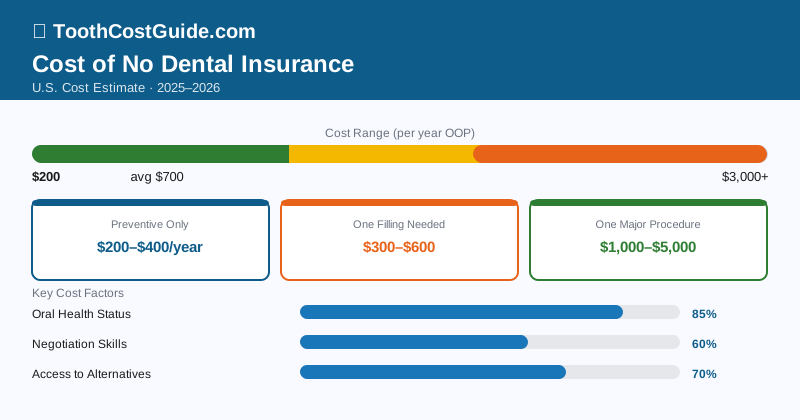
Roughly 77 million Americans — nearly one in four adults — have no dental insurance at all. That number comes from CDC data, and it’s been stubbornly persistent for years. But here’s something those same numbers don’t show: most uninsured Americans who avoid the dentist because of cost are making the problem significantly worse. The real expense isn’t what dental care costs. It’s what dental care costs after you’ve been avoiding it for two or three years.
A cleaning is $75–$200 out of pocket. A crown is $800–$1,800. A root canal, $700–$1,800. Those prices are real — but they’re also not inevitable. Being uninsured doesn’t mean paying the full “sticker price.” It means you haven’t yet discovered what’s actually negotiable.
| Procedure | Full Price (No Insurance) | Negotiated Cash Rate | Dental School | Discount Plan |
|---|---|---|---|---|
| Routine cleaning | $100–$200 | $80–$160 | $35–$80 | $60–$120 |
| Composite filling | $150–$300 | $120–$240 | $60–$120 | $90–$180 |
| Dental crown | $900–$1,800 | $720–$1,440 | $400–$750 | $600–$1,200 |
| Root canal (molar) | $1,000–$1,800 | $800–$1,440 | $500–$900 | $700–$1,260 |
| Full-mouth deep cleaning | $800–$1,400 | $640–$1,120 | $350–$650 | $560–$980 |
| Tooth extraction (simple) | $150–$250 | $120–$200 | $50–$100 | $100–$175 |
Who’s Actually Uninsured, and Why It Matters
The uninsured population isn’t monolithic. Different people fall into this gap for different reasons, and understanding where you land shapes which solutions actually apply to you.
Self-employed and gig workers have no employer dental benefit. Individual market dental insurance runs $300–$720 per year with limited benefits and annual maximums that often don’t cover major work. Many people in this category do the math and decide the premium isn’t worth it.
Part-time and hourly workers — most employers don’t offer dental benefits to part-time staff. Workers transitioning between jobs lose employer coverage during the gap.
Early retirees under 65 leave employer dental coverage behind when they stop working. Original Medicare doesn’t cover routine dental care. Medicare Advantage plans vary — some include dental, many barely do.
Adults over 65 on original Medicare — this surprises people, but Parts A and B simply don’t cover cleanings, fillings, crowns, or most extractions. It’s a significant gap that affects tens of millions of seniors.
Low-income adults who earn too much for Medicaid but too little to afford individual market premiums fall into a coverage gap that federal policy has never fully closed.
Being uninsured does not mean paying the “retail” price posted on a dental office’s fee schedule. That fee schedule is designed for insurance negotiation — it’s typically 30–50% above what the office actually collects from insured patients. As a self-pay patient, you have leverage to negotiate a rate closer to what insurers actually pay.
What Uninsured Care Actually Costs After Negotiation
The posted fee schedule at a dental office isn’t what most patients pay. Insurance companies negotiate contracted rates that run 30–50% below the stated fee schedule. As a self-pay patient, you can often negotiate toward those same rates.
How that plays out on a crown:
- Fee schedule (sticker price): $1,800
- What Delta Dental PPO typically reimburses: $900–$1,100 (roughly 50–60% of fee schedule)
- A reasonable cash-pay target: $1,000–$1,350 (55–75% of fee schedule)
Not every office will do this. Some won’t budge. But many will, especially when you explain your situation upfront and commit to immediate payment.
Negotiation Approaches That Hold Up in Practice
Lead with the direct ask. Before your appointment, call and say: “I’m paying out of pocket and don’t have dental insurance. Do you offer a self-pay or cash discount?” A significant share of independent offices have a formal policy of 10–20% off for self-pay patients. Others will negotiate informally.
Ask what they collect from insurers. Try: “What does Delta Dental PPO typically pay you for this procedure?” Some dentists will share this, and some will offer you the same rate. You’re asking them to extend their insurance-equivalent rate to a cash customer.
Same-day payment is leverage. A dental office billing insurance waits 30–90 days for reimbursement and sometimes receives nothing if a claim is denied. Same-day cash payment eliminates that uncertainty. Offer to pay in full the day of the appointment — it’s worth real money to a small practice.
Combine procedures for a volume discount. If you need multiple fillings, or a cleaning and X-rays together, ask: “Can you give me a better rate if I schedule all of this for one appointment?” Service bundling is a normal business practice.
Use published fee data as your reference. Fair Health Consumer (fairhealthconsumer.org) publishes the 50th and 80th percentile fees for every dental procedure code by zip code. If a dentist quotes you at the 80th percentile, you can mention the 50th percentile and ask whether they’d honor it. It’s not confrontational — it’s informed.
Alternatives That Beat Paying Full Rate
Dental discount plans ($80–$200/year): Pre-negotiated fee schedules at participating dentists. No waiting periods, no annual maximums. These activate within 48–72 hours. For uninsured adults who aren’t eligible for community health centers and don’t live near a dental school, a discount plan is often the first practical step.
Dental school clinics (40–70% savings): For planned, non-emergency procedures — especially expensive ones like crowns, implants, and root canals — dental schools provide the most substantial cost reduction available outside of income-based programs. Find the nearest accredited school through adea.org.
Community health centers (sliding-scale fees): FQHCs (federally qualified health centers) adjust fees based on income. At or below the poverty line, dental care may cost $20–$60 per visit. Use findahealthcenter.hrsa.gov to locate one near you.
In-office membership plans: About 25,000 dental practices now offer their own $99–$400/year membership plans that include cleanings, exams, X-rays, and a discount on other treatment. Strong option for patients who want to establish an ongoing relationship with a specific practice.
If you’re uninsured and facing a large dental bill, ask your dentist’s treatment coordinator: “Can I get a written estimate for each procedure separately so I can prioritize by clinical urgency?” This lets you address the most critical issues first — preventing complications — while spreading less urgent work across future appointments and budgets.
The Compounding Problem of Avoidance
The most expensive thing about being uninsured isn’t the care itself. It’s what happens when people skip care because of cost.
The pattern is predictable:
- Skip cleaning for 1 year (saves $150) → cavity forms ($200 filling if caught early)
- Skip cleaning for 3 years → cavity extends, now needs a crown ($1,000–$1,800)
- Skip cleaning for 5 years → crown tooth also needs root canal ($2,700–$3,600 total)
- Skip cleaning for 7+ years → tooth is extracted ($150–$550), bone loss begins
- Replace missing tooth → implant ($3,000–$6,000) or bridge ($2,500–$6,000)
The total cost of avoiding two $150 cleanings per year: potentially $3,000–$6,000 over a decade. Studies on uninsured populations consistently find this cycle. Dental disease doesn’t stay static — it progresses.
Emergency Dental Care Without Insurance
Dental emergencies hit harder for uninsured patients because avoided care tends to convert manageable problems into acute ones. When you need urgent care and have no coverage:
Call dental offices directly. Explain that you’re uninsured and need urgent care. Ask what self-pay emergency rates look like. Many dentists will see you and negotiate payment terms on the spot.
Community health center emergency line. Most FQHCs have same-day or next-day emergency dental slots.
Dental school emergency clinic. Available during school hours. Not suitable for after-hours emergencies, but often accessible and affordable.
Urgent care for stabilization. If you can’t access a dentist and you clearly have an infection, a walk-in urgent care ($75–$150) can prescribe antibiotics to buy time. This doesn’t fix the problem — it just stabilizes it. You still need definitive dental treatment.
ER for serious infections only. Swelling that extends to the jaw or neck, difficulty swallowing, or fever over 103°F is a true emergency that warrants the ER immediately. For everything short of that, the ER is an expensive, inappropriate setting for dental care.
Financing Options for the Uninsured
Without insurance covering part of the bill, uninsured patients are often looking at larger single charges. Financing becomes important.
CareCredit is available at most dental offices. Approval is based on credit score, not insurance status. Useful for $500–$3,000 dental expenses at 0% promotional rates if you pay off the balance in time. Read the deferred interest terms carefully before signing.
FSA/HSA accounts — even without dental insurance, if your employer offers an FSA or HSA-eligible health plan, these pre-tax accounts cover dental care and provide an effective 22–37% discount. Don’t overlook this even if you’re skipping dental insurance.
Medicaid — if your income qualifies, Medicaid dental coverage is better than any other option on this list. Check eligibility at healthcare.gov or your state Medicaid office.
Payment plans — ask. Most dental offices will accommodate 2–4 monthly installments for established patients. It never hurts to request it.
Bottom Line
Being uninsured doesn’t mean you’re stuck paying full price. Negotiation, dental discount plans, dental school clinics, and community health centers give uninsured Americans access to dental care at dramatically reduced cost. But none of that matters if you’re avoiding the dentist entirely — that’s where the real expense builds up. A practical starting point: enroll in a dental discount plan ($99/year, activates within days), schedule at a dental school clinic for any major planned work, and set aside $75–$100/month in a savings account or HSA dedicated to dental expenses.
Always get a written treatment plan before agreeing to any dental work. As an uninsured patient, it is especially important to receive itemized estimates in writing before treatment — there’s no insurance company review process to catch billing errors, and understanding each procedure code and fee protects you from unexpected charges.
Frequently Asked Questions
An uninsured patient typically pays $75–$200 for a routine cleaning and exam at a general dentist, though prices vary significantly by geography and practice. In major metropolitan areas, expect the higher end of that range, while rural areas may be closer to $75–$100. Many dental offices offer discounted rates or payment plans if you ask directly.
Most dental insurance plans exclude or severely limit coverage for cosmetic procedures like teeth whitening and veneers, and they often cover only 50% of major work like crowns, bridges, or implants after you meet a deductible. Orthodontics and dental implants are frequently excluded entirely or capped at $1,200–$1,500 per year, leaving patients to cover thousands of dollars out-of-pocket.
Dental discount membership plans (like Careington or DentalPlans.com) cost $80–$200 annually and provide 10–60% discounts at participating dentists, making them cheaper than insurance premiums for uninsured patients. Federally Qualified Health Centers (FQHCs) and dental schools also offer reduced-cost or sliding-scale care, and negotiating directly with your dentist can result in 20–40% discounts for upfront cash payment.